
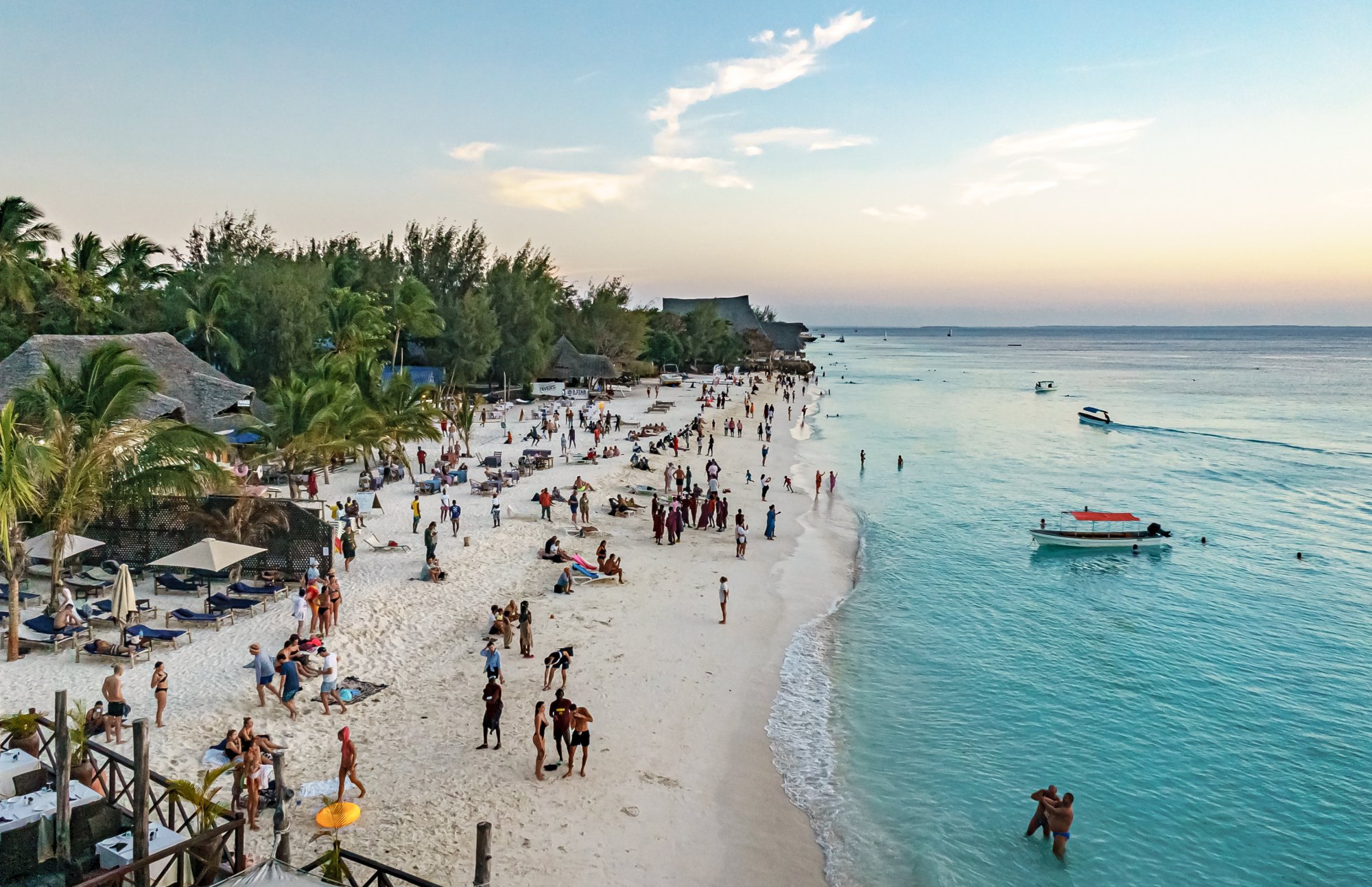
The northern tip
Nungwi sits at the very northern point of Unguja, where the island’s east and west coasts converge. It began as a fishing and boatbuilding village and is now the most developed stretch of coast on the island, with the largest concentration of accommodation, bars, dive centres and boats anywhere in Zanzibar.
People come here for one structural reason above all the others, and it is worth stating first because it decides whether a holiday works.
The tide, and why Nungwi is different
Zanzibar’s tides are semidiurnal — two highs and two lows a day, about six hours apart, arriving roughly fifty minutes later each day — with a range running from close to a metre at neaps to over three metres at springs. On the east coast that range empties a wide reef flat and leaves the sea several hundred metres out at low water.
At the northern tip it does not. The water here is deeper close inshore and the reef flat is narrow, so the effective tidal problem is much smaller. You can get in and swim at any state of the tide. That is the whole reason Nungwi and neighbouring Kendwa are sold as the swimming end of the island, and it is why they are the busiest.
It does not mean the tide is absent. Boats still leave on the water rather than on the hour, the beach narrows and widens, and a falling spring tide still runs hard through the gaps. It means that the choice between a morning swim and an afternoon swim is yours rather than the moon’s, which on this island is a genuine luxury. The mechanics across the whole coast are in the beach holidays guide.
Boatbuilding
Nungwi holds the majority of Zanzibar’s shipyards — something in the order of ten or eleven active at a time — and the boats are built on the beach in the open, by eye, without plans. Planks are shaped, steamed, bent and fastened by hand, and a hull takes shape over months in full view of anyone walking past.
Five wooden vessel types work the Zanzibar Channel: the mashua, roughly eight to twelve metres and usually motorised; the jahazi, the large cargo dhow; the dau; the ngalawa, a dugout of roughly three to five metres usually carried on outriggers; and the boti. Watching one being built is free, unscheduled and among the more interesting half-hours on the island. It is also somebody’s workplace, so ask before photographing people and stay out of the way of the work.
The sailing itself — including why the lateen rig and the monsoon cycle shaped the whole Indian Ocean trading world — is covered in the dhow sailing guide.
On and in the water
Most first-time divers in Zanzibar dive out of this end of the island, because most dive centres are here. The north gives access to the reef around Mnemba, off the north-east corner, which is the island’s signature site and also its busiest: it sits inside a conservation area with fishing restrictions, and the difference that makes is visible in the density of fish. A caution repeated across this site, because it catches people out: Mnemba is a private island, non-guests may not land, and there is an exclusion zone around it. What is sold as a Mnemba trip is a trip to the water. Diving and snorkelling both cover it in more detail.
The drop-offs beyond the reef north and east of the island, including the water past Mnemba and the banks off the northern tip, put pelagic fish within a reasonable run of Nungwi, which is where most Zanzibar-based charters work from. The deep-sea fishing guide covers what is out there and why published billfish month windows on this coast should be treated sceptically.
Sea kayaking runs from here, and this is the standard departure point for sunset sails — the north tip has the largest concentration of boats and the best open-water sunsets on the island. Nungwi faces the wrong way for the prevailing winds, so it is not a kitesurfing beach; that is the east coast.
The turtle pond
The Mnarani Marine Turtles Conservation Pond at Nungwi is a natural tidal lagoon in the coral rock, separated from the sea by a few metres of old reef, with a wooden pier for visitor access and smaller pools for juveniles and injured animals. It was established in 1993, originally to rehabilitate turtles caught in fishing nets, and there is an annual release event each February. A comparable lagoon enclosure operates nearby.
This is one of the more debated visitor attractions on the island and it is right that it is. A working Zanzibar dive operation states its own position bluntly: do not swim with captive sea turtles. The animals here are in an enclosure, and paying to get in the water with them is a different thing from encountering one on a reef. The sea turtle watching guide sets out both sides, including the rehabilitation case, and where wild turtles are actually seen — which on this island is over seagrass rather than over coral.
What Nungwi is like
Busy. More developed, more built, more nightlife and more boat traffic than anywhere else on Unguja. That is either the appeal or the reason to go elsewhere, and both are legitimate.
The village is still a working fishing village behind the hotel strip, and the two sit closer together here than they do on most of the island. Beachwear on the hotel beach is unremarkable; a few hundred metres inland it is not. Shoulders and knees covered in the village, the same as anywhere else on the coast.
On the sand you will meet people selling excursions, carvings, fruit and boat trips. A firm, friendly no is understood and respected. For anything involving money or a boat, arrange it through your accommodation or a licensed operator rather than on the beach — a point about recourse rather than anybody’s honesty. Nungwi has the highest concentration of beach sellers on the island simply because it has the highest concentration of visitors.
Arriving on the islands is a separate formality from arriving on the mainland: Zanzibar runs its own immigration administration and requires compulsory inbound travel insurance bought through the government portal. It is also worth asking your accommodation in writing what per-night government charges will be added to the bill. Both are covered in the guide to Zanzibar’s own entry rules and paperwork.
When to come
Unguja is on the bimodal rainfall pattern: the Tanzania Meteorological Authority puts the long rains, masika, at March to May and the short rains, vuli, at October to December — October, not November. A good number of coastal operations close for part of masika.
The kaskazi, the lighter north-easterly monsoon, runs roughly December to March and gives the calmest water. The kusi, the stronger south-easterly, runs roughly June to September. Because Nungwi is at the tip rather than on either flank, it is more exposed to whichever wind is blowing than the sheltered west coast is, and boat days are more often rearranged here than people expect. The guide to Tanzania’s seasons and monsoons covers how the monsoon calendar works against the rains.
Common questions about Nungwi
Can I swim at Nungwi at low tide?
Yes. The water is deeper close inshore at the northern tip and the reef flat is narrow, so swimming is possible at any state of the tide. This is the main practical difference between the north and the east coast, and the main reason Nungwi is as busy as it is.
Is Nungwi too busy?
It is the most developed beach on Unguja, with the most accommodation, the most boats and the most nightlife. If that is what you want, nothing else on the island matches it. If it is not, Kendwa just south is quieter with the same swimming, and the east coast is quieter again with a very different tide.
Can I watch dhows being built?
Yes. Nungwi holds most of the island’s active shipyards and the boats are built on the open beach, by eye and without plans. It costs nothing and nothing is scheduled. It is a working yard, so ask before photographing anyone and keep clear of the work.
Is the turtle pond worth visiting?
It is contested rather than straightforward. It is a natural tidal lagoon established in 1993 to rehabilitate turtles caught in nets, with an annual release each February, and there is a real rehabilitation case behind it. There is also a clearly argued position among working Zanzibar dive operations that swimming with captive turtles is never acceptable. Read the sea turtle guide before deciding.
Can I kitesurf at Nungwi?
Not meaningfully. The north and west coasts face the wrong way for the prevailing winds. The kitesurfing is on the east coast, from Matemwe down to Jambiani, where the exposure, the lagoon and the schools are.
How far is Nungwi from Stone Town?
It is at the opposite end of the island from the town and the airport, and the transfer is the longest standard one on Unguja — though nothing here is more than a couple of hours from anything else. Transfers are almost always arranged through accommodation.