Baobab country on the edge of the Maasai Steppe
Tarangire National Park lies south of Arusha on the northern edge of the Maasai Steppe. Tanzania National Parks gives its area as 2,850 square kilometres and its gazettement as 1970, and both its brochure and its website agree on those figures. What the brochure adds is the point that matters: the park is only a small part of a much larger ecosystem of some 30,000 square kilometres comprising most of what is called the Maasai Steppe, or southern Maasailand.
That relationship between a small park and a large unfenced hinterland is the single fact that explains Tarangire. Animals are not confined to it. They use it, heavily, for part of the year, and they leave it for the rest. TANAPA describes the park as the dry season refuge for an enormous swathe of southern Maasailand, and says that between July and November the wildlife here is extraordinary by any standards Africa-wide.
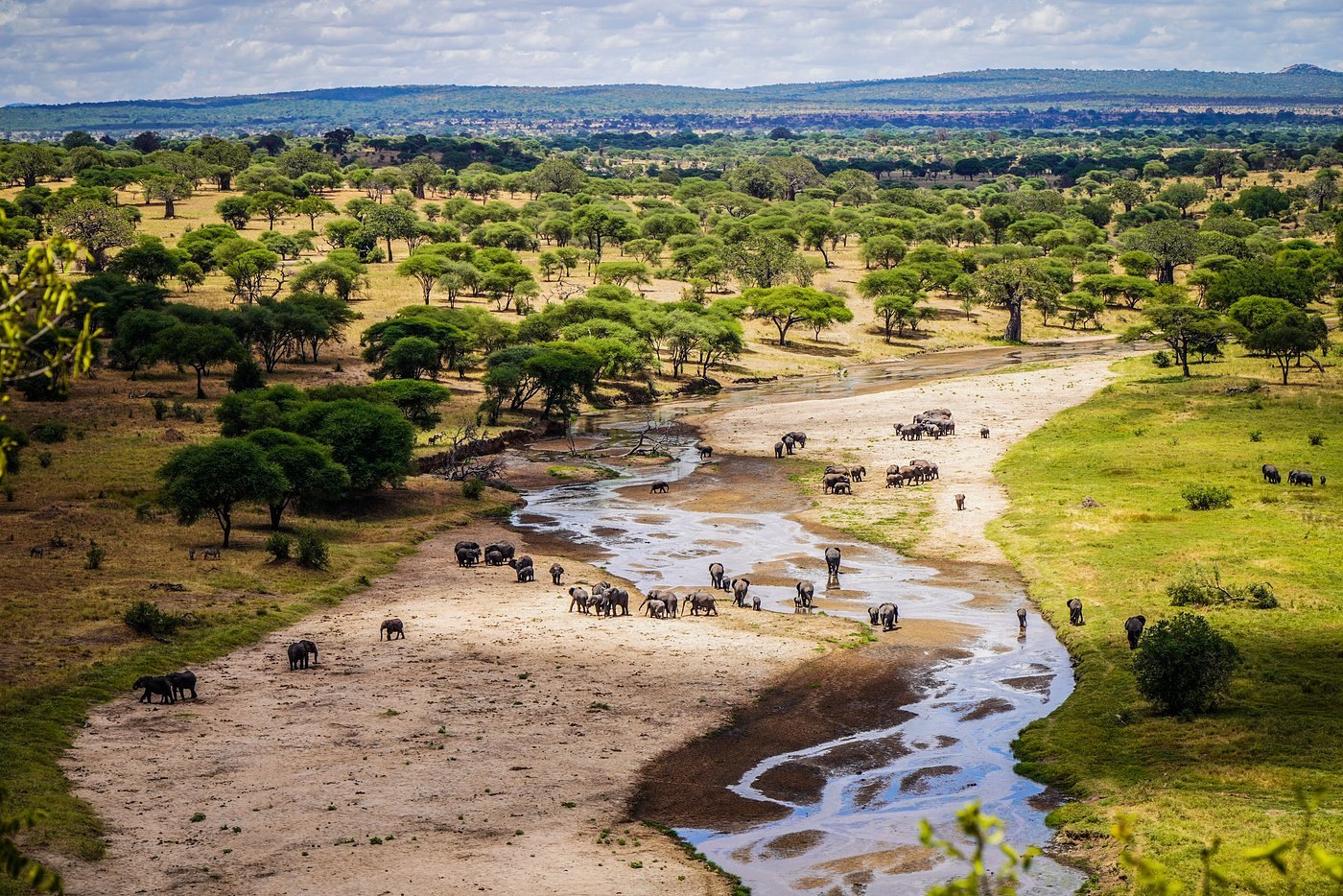
The look of the place is distinct from anything else on the northern circuit. Wide open plains in the north give way southward to ridges and valleys studded with acacia and with baobabs, then to vast seasonal swamps. The Tarangire River runs north through the middle of it, fed by seasonal sand rivers rising to the east and south-east, linked to the Silale, Gurusi and Larmakau swamps, and finally emptying into Lake Burunge. In the dry months it shrinks to a chain of pools in a sand bed, and those pools are where the park concentrates.
The name is a compound of two languages, which is a fair signal of the country the park sits in. TANAPA gives it as Tara, a Mbugwe word meaning river and also snaking, and Ngire, a Hadzabe word for warthog — of which the park has a great many.
The elephants, and the density claim behind them
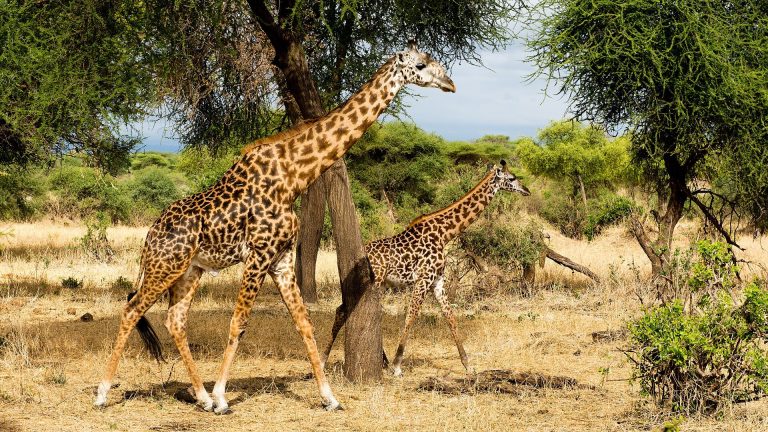
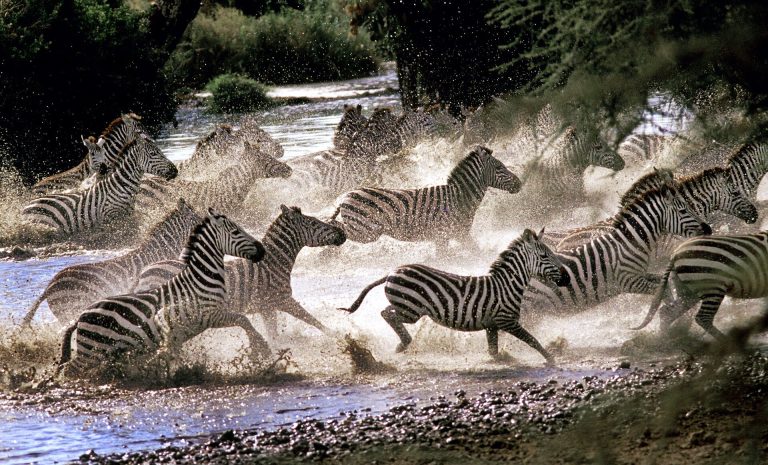
Tarangire is sold on elephants and the reputation is earned, but the mechanism is worth understanding rather than taking on trust. When the surrounding steppe dries out, the only reliable surface water for a very large area is in the Tarangire River bed and around Silale Swamp. Elephant, buffalo, zebra, wildebeest, giraffe, eland and ostrich converge on it. TANAPA states that at the height of the dry season in October the density of large animals here has been estimated as second only to Ngorongoro Crater worldwide, and that lion and leopard are frequently seen along the same water.
The corollary is the part most itineraries leave out. In the green season much of that game disperses back into the wider steppe, and a park that is astonishing in September can be quiet in April. This is not a defect. The green season brings newborn animals, migrant birds and an emptier park, and Tarangire remains a year-round destination in TANAPA’s own description. But a traveller who books Tarangire in March expecting the photographs taken in October has been sold a season rather than a place.
Elephants aside, the park’s other signature is its baobabs. TANAPA says they can live up to three thousand years and grow trunks more than a hundred feet in circumference, and naturalists have described the huge baobab as a complete ecosystem in itself: its nooks and crannies hold bee hives or are occupied by small mammals such as genet and civet, its enormous flowers are pollinated by fruit bats, and many of the trees are hollow. TANAPA records that hollow baobabs here provided shelter for wandering bands of hunter-gatherers in the past. Abandoned termite mounds do similar work at ground level, sheltering dwarf mongoose, pangolin, snakes and aardvark, and colonies of mongoose are among the more reliable sightings on a drive.
Birds
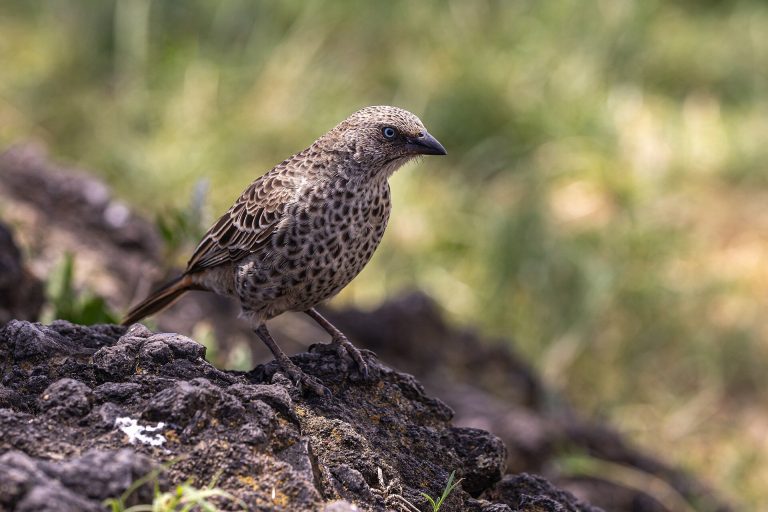
TANAPA calls Tarangire a birder’s paradise with more resident breeding species than anywhere else in Tanzania. The species total needs a caveat: the park brochure gives “over 550 different species” on one page and “more than 500 species” three pages later, so the honest figure is more than five hundred. Named among them are the yellow-collared lovebird, the rufous-tailed weaver and the ashy starling, with the richest birding in the open acacia woodland, along the wetlands and on the Tarangire River floodplain. Raptors are the visible half of it: the brochure runs from the martial and bateleur eagles down to the pygmy falcon, which it describes as tiny but vicious. The swamps hold a separate cast again, and they are the reason a serious birding day here looks nothing like one in the Serengeti. The bird watching guide covers how to plan around that.
What you can do at Tarangire
TANAPA lists four tourist activities for the park, and they make it unusually versatile for the northern circuit: day game viewing, night game drives, balloon safaris, and walking safaris with an armed guide.
The game drive is the backbone, and the river circuits in the north are where most of a first visit is spent. What sets Tarangire apart is the second item on that list. Night game drives are permitted here, which they are not in the Serengeti and not on the Ngorongoro Crater floor. Tarangire appears by name in TANAPA’s night game drive schedule, and the night game drive guide sets out the rules that govern one, from the 19:00 to 23:00 window to the filtered spotlights and the armed ranger who must accompany the vehicle. For anyone hoping to see genet, civet, porcupine, bushbaby or a hunting leopard, this is one of the few places on the classic circuit where it is actually on offer.
Tarangire also appears in TANAPA’s list of parks where balloon safaris operate, making it the northern circuit’s second established ballooning park after the Serengeti. And walking safaris are listed with the qualification that they are accompanied by an armed guide — TANAPA’s own wording for this park, and worth noting because the authority does not publish a blanket armed-ranger rule for walking across all parks.
The park suits photographic safaris particularly well, because a baobab and an elephant in the same frame is a picture the Serengeti cannot give you, and bush dining and camping safaris both work here: the park keeps two public campsites in the north and special campsites scattered through the rest of it, along with a rest house, cottages and a student hostel.
Getting there, and the three gates
TANAPA gives the distance from Arusha to the Main Gate in the north as 121 kilometres on tarmac, and the general brochure puts the drive at about an hour and a half. That proximity is why so many itineraries open here rather than at Manyara: it is the first park you reach on the way out of town. Kilimanjaro International Airport is a further 46 kilometres east of Arusha.
The park’s own rainfall pattern is bimodal — short rains from October to December, long rains from March to May, and dry conditions from June to October and again in January and February. The brochure gives a high of around 38 °C in January and February, falling to about 15 °C in July, which is worth knowing before packing for what people imagine is a uniformly hot country.
Two other gates matter for trip design. Boundary Hill, on the eastern side, serves camps and lodges in the community areas outside the park. Sangaiwe, on the western side, has easy access from the main road to Dodoma, and TANAPA points out a route many itineraries miss: entering at Sangaiwe gives access to the southern entry of Lake Manyara, from which a traverse of the full length of that park leads to Mto wa Mbu and on up through Karatu to Ngorongoro and the Serengeti. It is a longer way round and a considerably better one.
By air, there is an airstrip at Kuro in the centre of the park with daily scheduled flights connecting to the main safari destinations. Most visitors arrive by road from Arusha, which is the pattern the guide to travelling the northern circuit describes.
Where Tarangire fits
Tarangire is normally given one or two nights near the start of a northern circuit, and one night is genuinely thin: it buys an afternoon drive and a morning drive, and the park’s interior — the southern swamps in particular — is a long way from the northern gate. Two nights allows a full day beyond the river circuits. Three is unusual and rewards anyone who wants the night drives and the walking, since both need daylight hours that a transfer day consumes.
Tarangire is almost always a one- or two-night stop rather than a destination in itself, which is worth weighing against how many days a Tanzanian itinerary needs. Its natural pairings are Lake Manyara, which is close and completely different in habitat, and the community and Maasai country east of the park, covered in the Maasai cultural visits guide. South and west, the road towards Dodoma passes Lake Babati and the country below Mount Hanang, a direction very few northern circuit itineraries take.
Entry is a published government charge rather than an operator’s price. TANAPA’s 2023/24 tariff booklet sets Tarangire’s conservation fee at US$50 per non-EAC adult for twenty-four hours in peak season and US$45 from 15 March to 15 May, with a reduced rate for children of five to fifteen. Tarangire is one of only five parks with a seasonal split at all. The booklet is TANAPA’s most recent and its VAT basis is contradicted on the authority’s own website — the guide to how Tanzania’s park fees are published sets out both.
Common questions about Tarangire
When is the best time to visit Tarangire?
For the elephant concentrations, the dry months from around July to November, with October the peak of the congregation around the river and Silale Swamp. For birds, newborn animals and an empty park, the green season. TANAPA describes Tarangire as a year-round park whose distinct seasons offer different experiences, and that is a fair description rather than a hedge.
How many nights does Tarangire need?
Two is the useful answer. One night gives an afternoon and a morning drive and keeps you near the northern gate. Two allows a full day reaching further south. Anyone planning to use the night drives or the walking safaris should assume two at minimum, because those activities take time that a travel day does not leave.
Can you do a night drive in Tarangire?
Yes. Tarangire is one of the national parks named in TANAPA’s night game drive schedule and night drives appear among its listed activities. They run in the evening rather than through the night, under published rules covering vehicles, spotlights and ranger accompaniment.
Can you walk in Tarangire?
Yes. TANAPA lists walking safaris among Tarangire’s activities and specifies that they are conducted with an armed guide. Walks are arranged in advance rather than taken on impulse.
Is Tarangire better than the Serengeti?
They answer different questions. The Serengeti offers scale, the migration and the highest concentration of large predators. Tarangire offers dry-season density in a much smaller area, a landscape of baobabs and swamps that looks like nowhere else on the circuit, and night drives and ballooning within ninety minutes of Arusha. Most itineraries include both, and the pairing is stronger than either alone.
Are there balloon flights over Tarangire?
Yes. TANAPA names balloon safaris among Tarangire’s tourist activities and the park appears in its balloon operation schedule, which makes it the northern circuit’s second established ballooning park. Flights lift at dawn and are weather dependent, as they are everywhere.
Where do you stay at Tarangire?
Inside the park there are permanent camps and lodges, park-owned cottages and a rest house, two public campsites in the north and special campsites elsewhere. There is also a substantial cluster of camps and lodges in the community areas outside the eastern boundary, served by the Boundary Hill gate.