
Tanzania Photography Safaris
A safari built around photography rather than a species checklist, with longer stays in one area, earlier starts and vehicles set up for camera work.
February on the Ndutu plains, July to October at the Mara River and the dry months in Tarangire and Ruaha produce the strongest wildlife pictures on a Tanzania photography safari, and a private vehicle with a pop-up roof and a window seat does more for the results than a new lens. Drones need permits from several authorities before they can fly in a national park, so aerial frames usually come from a balloon basket.
Safaris That Include Photographic Safaris

9 Days Tanzania Safari Holiday
by Insight Safari Holidays Verified operator
12 Days Wildlife Photography Tour Tanzania
by Insight Safari Holidays Verified operator


7 Days Great Migration Safari Tanzania | Mara River Crossing Tour
by Kori Safaris Verified operator
8 Days Big Five & Wildebeest Migration Photo Safari Tanzania
by Insight Safari Holidays Verified operator
7 Days Serengeti Migration Safari & Wildlife Tours
by Insight Safari Holidays Verified operator
9 Days Tanzania Migration Safari, Great Migration Experience
by Kori Safaris Verified operator
See all 13 safaris that include photographic safaris
Photographic Safaris Guide in Tanzania
Tanzania Photography Subjects by Place and Month
Where in Tanzania each kind of picture is most likely, in which months, and what it means for your lens and vehicle.
| Subject | Where | Best months | Region | What it means for you |
|---|---|---|---|---|
| 01Calving herds and predator huntsWildebeest, lion, cheetah, hyena | Ndutu and the southern Serengeti plains | December to March, peak February | Northern circuit | Open short grass and clean horizons; a 100 to 400 mm zoom and a fast shutter for chases |
| 02Mara River crossingsWildebeest, zebra, crocodile | Mara River, northern Serengeti | July to October | Northern circuit | Crossings cannot be scheduled; plan three or four nights and keep a wider lens ready for the whole bank |
| 03Leopard in treesSausage trees and riverine woodland | Seronera valley, central Serengeti | All year | Northern circuit | Long waits under one tree; a private vehicle lets you stay |
| 04Lions on granite kopjesResting prides on rock outcrops | Gol, Moru and Simba kopjes, Serengeti | All year | Northern circuit | Low sun on rock in the first hour; a standard zoom for lions in their setting |
| 05Black rhino on the crater floorDiceros bicornis | Ngorongoro Crater | All year | Northern circuit | Usually distant; your longest lens or a teleconverter, and no off-track driving |
| 06Elephant herds under baobabsLoxodonta africana | Tarangire National Park | June to October | Northern circuit | Herds gather on the river in the dry season; a wide or standard zoom gives the trees their scale |
| 07Groundwater forest, baboons and tree lionsLake Manyara shore and forest | Lake Manyara National Park | Late June to October, January and February | Northern circuit | Tree-climbing lions are a bonus, not a plan; forest shade needs higher ISO |
| 08Flamingos feeding close to shoreLesser and greater flamingo | Ngorongoro Crater lake, Empakaai Crater, Lake Manyara, Momella lakes | All year, numbers vary | Northern circuit | Flocks move with water levels; ask your guide which lake holds birds that week |
| 09Natron soda flats and flamingo breedingLake Natron and Ol Doinyo Lengai | Lake Natron | Breeding mostly January and October, not every year | Northern circuit | Colonies not approachable Shoot the patterned flats and shoreline birds, not the nests |
| 10Breeding plumage and migrant birdsRollers, bee-eaters, raptors, waders | Tarangire, Serengeti, Manyara, Katavi, Gombe | November to April | All regions | Wet-season light and green backdrops; your longest lens and a beanbag |
| 11Large lion prides, wild dog and kuduGreat Ruaha River | Ruaha National Park | June to October | Southern parks | Open-sided vehicles common; a beanbag works best from the front or a side seat |
| 12Eye-level elephant, hippo and crocodile from a boatRufiji River and lakes | Nyerere National Park | June to November, December to February workable | Southern parks | The only common way to get the lens to water level; fast shutter on a moving boat |
| 13Crowded hippo pools and buffalo herdsKatavi floodplains | Katavi National Park | August to October | Western parks | Fly-in only for most visitors, so the 15 kg bush flight limit decides your kit |
| 14Wild chimpanzees in forestPan troglodytes | Mahale Mountains and Gombe | All year, trails easier June to October | Western parks | No flash One hour with the group, 10 m distance; a fast lens beats a long one |
| 15Nocturnal wildlife on a spotlit driveLeopard, genet, bushbaby, porcupine | Tarangire, Manyara, Ruaha, Nyerere, Katavi; not inside the Serengeti | All year where permitted | All regions | Filtered spotlights are dim; high ISO, fastest lens, accept grain |
| 16Sunrise from a balloon basketPlains, herds and the balloon's shadow | Central Serengeti, Tarangire, Ruaha | All year in central Serengeti; other launch sites seasonal | Northern circuit, southern parks | The legal way to shoot from the air in a park; wide to standard zoom, wrist strap |
| 17Crater rim and highland viewsNgorongoro highlands and Empakaai | Ngorongoro Conservation Area | All year | Northern circuit | Cold dawns at altitude; keep spare batteries warm in a pocket |
| 18Maasai and village portraitsBy consent only | Ngorongoro Conservation Area and Arusha region villages | All year | Northern circuit | Ask first A fee is often expected; agree it with your guide before cameras come out |
Last checked November 2026. Months are typical windows, not promises, and sightings are never guaranteed. Migration timing shifts with rain each year. Sources: Tanzania National Parks (TANAPA) park rules and tariff, Ngorongoro Conservation Area Authority, Tanzania Wildlife Management Authority, BirdLife International, Tanzania Meteorological Authority seasons.
Where to Shoot on a Tanzania Photography Safari
A Tanzania photography safari works best when you plan it around subjects rather than parks, and the country sorts its best subjects by region and season more neatly than most. The north holds the migration and the crater, plus the baobab country of Tarangire. The south trades crowds for open-sided vehicles and river light. The west is chimpanzee forest and floodplain, reached by light aircraft.
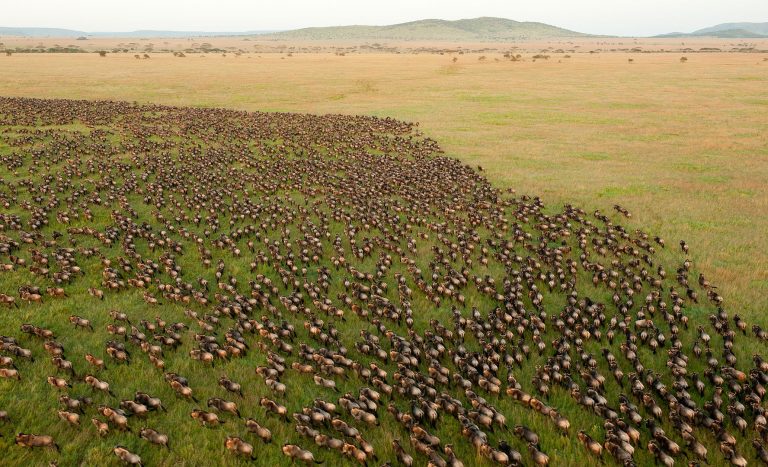
The southern Serengeti and Ndutu are where most serious photographers start. The Ndutu short-grass plains straddle the Serengeti boundary and the Ngorongoro Conservation Area, and the Ngorongoro Conservation Area Authority puts the calving season from the end of December, when the herds arrive from the north, through to April. TANAPA's own best-time note names January and February.
After the short rains the ground lies open and green, so nothing sits between the lens and a cheetah working a herd of new calves. Lions and hyenas follow them. Afternoon storms build at the same time of year, putting dark skies behind pale grass in a way dry-season trips never see.
One rule surprises people here. Neither authority publishes an off-road exemption for Ndutu: TANAPA's rules forbid leaving the tracks in the national park, and the NCAA forbids it across the conservation area unless the Conservation Commissioner authorises it. Ask any camp that promises otherwise exactly what permission it holds.
The central Serengeti is the all-year option. The Seronera valley has the sausage trees and riverine woodland where leopard sightings cluster, and the granite kopjes to the east and south (Gol, Moru, Simba) give lions on rock in low sun. A leopard in a tree can mean two hours parked under one branch for five minutes of action, which is the clearest case for a private vehicle anywhere on the circuit.
The northern Serengeti owns the river crossings. The herds reach the Mara River area between early June and late July and stay into November or December; a fifteen-year study in the Proceedings of the National Academy of Sciences counted crossings on roughly 52 days a year, give or take 16. That is a lot of days and still no guarantee for yours. Photographers who come back with the picture usually book three or four nights, wait at a crossing point for hours, and keep a standard zoom on a second body, because the frame that tells the story is often the whole bank rather than one animal in the water.
Ngorongoro Crater gives density and black rhino in a single morning, though the rhino are usually far out on the floor and need your longest lens. Mist on the floor at first light and the rim at sunrise make the crater worth a dawn descent rather than a mid-morning one. Flamingos feed on the crater lake and at Empakaai, where the birds sit closer to the shore than at Natron.
Tarangire is the elephant park. From June to October the herds pull onto the Tarangire River, and the baobabs give a sense of scale no other northern park offers; a wide or standard zoom earns its place here more than anywhere else on the circuit. Lake Manyara is best in late June to October and in January and February by TANAPA's own description, with groundwater forest, big baboon troops plus the occasional lion in a tree. Lake Natron rewards anyone who wants patterned soda flats and Ol Doinyo Lengai at dawn, but the flamingo breeding colonies sit far out on caustic mud that no boat, hide or walker can reach.
South of the northern circuit the light and the vehicles change. Ruaha in the dry months of June to October gathers lion prides, elephant, greater and lesser kudu and a realistic chance of wild dog along a shrinking river, framed by baobabs and granite ridges. Nyerere adds boat trips on the Rufiji. Out west, Katavi from August to October packs hippo into drying pools and buffalo onto open floodplain, and Mahale and Gombe hold the chimpanzees.
Two parks that photographers sometimes skip deserve a line. Arusha National Park has black and white colobus and the Momella lakes, and it suits a first afternoon when you want to test autofocus settings before the main trip. Lake Eyasi, west of the crater highlands, is where visits to Hadzabe and Datoga communities take place, which is a portrait trip rather than a wildlife one.
Month by Month Photography Safari Calendar for Tanzania
The north and the south run on different rainfall calendars. The Tanzania Meteorological Authority classes the northern parks as bimodal, with long rains from March to May and short rains starting in October or November, while the southern and western parks sit in the unimodal zone, wet from November to April or May in one block.
| Month | North | South and west | Light |
|---|---|---|---|
| January | Ndutu calving | Wet, Nyerere open | Storm skies |
| February | Calving peak | Wet, Nyerere open | Storm skies |
| March | Late calving | Wet | Dramatic, rain |
| April | Long rains | Wet, camps close | Grey, heavy |
| May | Rains easing | Drying out | Clearing |
| June | Herds move north | Dry season starts | Clear, hazy |
| July | Mara crossings | Dry, game on rivers | Hard, dusty |
| August | Crossings | Katavi, Ruaha peak | Hard, dusty |
| September | Crossings | Katavi, Ruaha peak | Hard, dusty |
| October | Crossings, rain due | Hot, very dry | Hazy |
| November | Short rains | Rains begin | Clouds return |
| December | Herds head south | Wet | Green, broken cloud |
The pattern cuts both ways for a photographer. July to October is easier travelling with reliable game on the rivers, yet the light is harder, the air dustier and the vehicles more numerous at every sighting. January and February give the best light and the calving, and the price is muddy tracks and an afternoon storm that can end a drive early. The site's best time to visit Tanzania page covers the rainfall zones in detail.
Safari Vehicles and Window Seats for Photography
Most northern circuit safaris run in a converted Land Cruiser with a pop-up roof. Standing under the roof gives a 360 degree view and shade, and it puts the lens roughly two metres above the ground. That height is the vehicle's main weakness for photography: a lion shot from above against grass looks like a record shot, while the same lion shot from window height against the sky looks like a portrait. Shooting through the open side window from a seat, with the lens resting on a beanbag on the sill, brings the camera down by most of a metre and is often the better frame.
Open-sided vehicles are common in the southern parks and in private concessions, and they put the camera lower still. Photographers who have used both note one catch: a beanbag is far less useful in an open vehicle unless you sit beside the driver or on an end seat with a rail to rest it on. A few Serengeti camps also run specialist photographic vehicles with drop-down sides and three swivel seats, so that a photographer can lie at floor level for low-angle work. They are rare and booked well ahead, so ask early if that matters to you.
A private vehicle changes more than the seat. On a shared game drive the sighting lasts as long as the least patient passenger, and the vehicle leaves just as a leopard starts to climb down. On a private trip you decide when to go, and you can leave camp at gate opening and stay out with a packed lunch. Ask the operator for four things in writing: that the vehicle is private, how many seats it has, whether every passenger gets a window, and whether the guide will switch the engine off at a sighting. Engine vibration through the body is the most common reason long-lens frames come back soft.
One rule shapes every vehicle choice in the parks. TANAPA's park rules keep vehicles on authorised tracks, ask drivers not to go closer than 25 metres to animals, and require visitors to stay inside the vehicle. If a cheetah is 150 metres off the road, that is the distance you shoot it from, which is why reach matters so much in Tanzania.
Lenses, Beanbags and Camera Kit for a Photographic Safari
Pack two camera bodies if you can. Every lens change on a dusty track lets grit onto the sensor and costs you the moment, so the usual pattern is a telephoto zoom on one body and a standard or wide zoom on the other, left mounted all day.
A fast telephoto zoom in the 100 to 400 mm or 150 to 600 mm range does most of the work on a photographic safari in Tanzania, because the off-track rule takes away the option of driving closer. Birders and rhino hunters in the crater add a teleconverter, which buys reach at the cost of a stop of light and some focusing speed. A 24 to 70 mm or 24 to 105 mm zoom covers elephants under baobabs, herds against the plains and camp life. A fast wide lens is for the night sky and for forest work with chimpanzees, where the animals are close and the light is poor.
Support matters more than most first-time safari photographers expect. A tripod does not fit in a game drive vehicle and passes every engine shudder straight into the lens, so a beanbag resting on the window sill or roof edge is the standard tool. Travel with the bag empty and fill it with rice or dried beans in Arusha; forum trip reports often recommend a double bag that drapes over a door and a cord to retrieve it when it falls out of the window. A window clamp with a gimbal head suits very heavy primes. A tripod is still worth packing for night skies and crater-rim sunrises, used at camp rather than in the vehicle.
Weight is the real limit on kit. Coastal Aviation, the main scheduled airline to the Serengeti airstrips and the remote southern and western parks, publishes a maximum of 15 kg per person including carry-on luggage, with soft bags strongly recommended though not required. Its XL seat class raises the allowance to 30 kg, subject to availability, and Coastal charges for extra weight at freight rates or sells an extra seat. On a fly-in trip a 600 mm prime with two bodies and a laptop can use most of that 15 kg before a single shirt goes in, so weigh the camera bag at home and confirm the limit with your operator.
Dust is the other constant, worst from July to October. Keep cameras in a cloth cover or zipped bag between sightings, carry a rocket blower rather than compressed air, and never wipe dry grit across a front element. Several trip reports suggest changing lenses inside a pillowcase, which works well. The Vice President's Office bans plastic carrier bags of any thickness from entering mainland Tanzania, while toiletry zip bags that stay with the traveller remain allowed, so pack dust covers made of cloth or proper camera rain covers instead of shopping bags.
Many camps run on solar or generators, sometimes with charging only in the main area or at set hours. Bring at least three batteries per body, a multi-port USB charger, the right plug adapter and a car charger if your vehicle has sockets. Back up every evening to two drives kept in different bags, and only format a card once you have checked both copies. A burst-heavy day at a river crossing can fill several cards before lunch.
Safari Light, Gate Hours and the Midday Gap
Close to the equator the sun rises and sets at much the same time all year, and it climbs fast. In the Serengeti, sunrise falls between about 6.20 am and 6.50 am and sunset between about 6.30 pm and 7 pm across the year. The usable warm light lasts roughly an hour at each end, after which the light turns flat and hard until mid-afternoon.
Gate hours cut into that light. TANAPA's park rules allow driving between 6 am and 6 pm, which means the sunset itself often happens after vehicles should be off the tracks or back at camp. In practice the best evening frames come from camps inside the park, where the last game drive finishes close to the lodge, or from a sundowner stop at a permitted site. Morning is the reverse: leaving camp at 6 am puts you on the plains for sunrise, while a lodge outside the park gate loses the first hour to the drive in. If light matters to you, sleep inside the park.
The middle of the day still has uses. Lions sleep and elephants drink at midday on the Tarangire River, birds keep moving, and cloud on a green-season day softens the light for hours. Many photographic trips skip the return to camp altogether, take a packed lunch, and wait at a promising sighting so they are already in position when the light warms again around 4 pm. Backlight is worth trying too: shooting towards a low sun gives rim-lit dust and breath on a cold Ngorongoro morning, and silhouettes of giraffe on the skyline.
Drone Rules on a Tanzania Photography Safari
Drone photography in Tanzania needs paperwork before the drone leaves home, and for national parks the paperwork is heavy enough that most photographers leave the drone behind. The Tanzania Civil Aviation Authority states that all drone operations in the country require its approval and permit, whether the flight is commercial, research or recreational. Every drone needs registering with the authority and third-party liability insurance, and foreign operators need their permits before they arrive. Applications go through the authority's online system, opened by an email enquiry, and it asks non-residents to apply three to four weeks before travel.
The authority lists national parks among the places where drones may not fly without special permission, alongside airports, military sites and State House. Its guidance says flights inside a park need additional permits from the park authorities. TANAPA declared the national parks a no-drone zone for photography and filming in 2014, citing security and anti-poaching concerns, and park drone permission now runs through a longer chain: operators who arrange it report needing the Tanzania Film Board, the civil aviation permit and the Ministry of Defence and National Service before TANAPA will consider an application, with a defence officer assigned to accompany the drone operator. The Ngorongoro Conservation Area is run by its own authority and needs a separate permit.
Customs can confiscate a drone that arrives without an import permit, and rangers can seize one flown inside a protected area. TCAA lists fines and prosecution among the penalties. Its general limits also apply wherever you do fly legally: 120 metres above ground, visual line of sight, and no night flying without a special permit. If aerial pictures are the goal, a sunrise balloon flight over the Serengeti, Tarangire or Ruaha is the legal route, and a scenic flight in a light aircraft is another. The site's balloon safari listings show which trips include one.
Shooting from Balloons, Boats, Night Drives and Forest Treks
From a balloon you shoot scenery more than wildlife. The pilot steers only by changing height, the basket turns slowly, and the light at take-off is low. A wide to standard zoom covers most of it, a wrist strap is worth having, and the frame many people keep is the balloon's own shadow crossing a herd.
Boat safaris give the angle a vehicle never can: the lens at the eye level of a drinking elephant or a crocodile on a sandbank. TANAPA tariffs boating in Nyerere, Mahale, Rubondo Island, Gombe and Saadani, among others, and the Rufiji in Nyerere is the main one for photographers; there are no boat trips on the Serengeti's rivers or on Lake Manyara. A beanbag on the gunwale and a shutter speed faster than seems necessary handle the movement of the boat. Keep a dry bag for everything not in your hands.
Night game drives run in Tarangire and Lake Manyara on the northern circuit, in Ruaha, Nyerere, Katavi and Mikumi further south, and in the private concessions, but not inside the Serengeti. TANAPA's rules limit each vehicle to two spotlights rated between 200,000 and 800,000 candlepower, fitted with filters to cut the intensity. That is dimmer than most people picture and deliberately so. Shoot at high ISO with your fastest lens, use the edge of the beam, and accept grain; never use flash on nocturnal animals.
Chimpanzee trekking at Mahale and Gombe is close-range forest work under rules that shape every picture. Visitors keep at least 10 metres from the chimpanzees, wear a mask within 50 metres, and get a maximum of one hour once the group is found, with no more than six visitors at a time. The rules ban flash. A fast lens around 24 to 105 mm or 70 to 200 mm suits the distances better than a long telephoto, and you will work at higher ISO than you would like. Porters can usually carry a camera bag on the steeper trails.
Photography Safari Ethics with Wildlife and People
The rules in the parks exist for the animals, and good guides keep to them even when a client asks otherwise. Never ask a driver to leave the track or creep closer than 25 metres to a cat on a hunt; TANAPA warns that a driver can lose access to an area, or his job, for it. Do not call, whistle, bang the vehicle or throw anything to make an animal look up. Keep voices low at a shared sighting and give a hunting cheetah room, because a ring of vehicles can cost it the kill.
Photographing people is a separate matter. Ask before you raise the camera, in Maasai villages or at markets, and accept a no. Many Maasai expect a fee for photographs, so agree it through your guide before the visit. Showing someone the picture on the screen is an easy courtesy. Do not photograph military sites, police, government buildings or airports, and treat any official request to delete a picture as final.
Wildlife birding has its own rule: playing recorded calls to pull a bird into the open is best avoided in a national park, especially in breeding season. Forest guides who know the calls will find the bird without it.
Private Safari, Group Tour or Photo Workshop
A private safari with a photographer-aware guide suits most people: your own vehicle, your own hours and a seat for every lens. A hosted photo workshop adds a professional who reviews your pictures each evening and positions the vehicle for light, which helps if you want to improve rather than just record. It adds no special access, since a workshop in a national park follows the same track rules as everyone else. Check the group size; beyond about six photographers across two vehicles, the attention each person gets thins out. A shared group tour is the cheapest way in, and it works for casual photography if you accept that the vehicle will move on before you are ready.
Tanzania Photography Safari FAQ
What is the best month for a Tanzania photography safari?
February, for calving and predator action on the open Ndutu plains under storm light. July to October suits river crossings in the northern Serengeti and dry-season concentrations in Tarangire and the southern parks, with harder light and more vehicles.
Can I fly a drone in the Serengeti or Ngorongoro?
Not on a tourist basis. Every drone flight in Tanzania needs a Tanzania Civil Aviation Authority permit, and national parks need further permission from the park authority, which in practice also involves the Film Board and the Ministry of Defence. Ngorongoro needs its own permit from the conservation area authority.
Do I need a permit to take photos in Tanzania's parks?
Not for personal photography; your park entry covers it. Professional filming is different: the Ngorongoro Conservation Area Authority charges each filming crew member US$354 per day, covering entry, camping, guiding and filming, and TANAPA runs its own filming fees for the national parks. Anyone shooting for a client should arrange permits through the operator before travel.
What does a photographic day in Ngorongoro Crater add to the cost?
The Ngorongoro Conservation Area Authority charges non-East African adults US$70.80 per entry, valid for 24 hours, plus a crater service fee of US$295 per vehicle per descent. On a private vehicle only the people in it share the crater fee, which is worth knowing when comparing private and shared trips.
Which lens should I bring if I can only carry one?
A 100 to 400 mm zoom, or a 150 to 600 mm if you shoot birds. The track rules in Tanzania's parks mean the subject is often farther away than in places where vehicles can drive closer, so reach is worth more than a wide aperture.
Is a beanbag better than a tripod on a photographic safari?
Yes, inside the vehicle. A tripod has no room to stand and passes the engine vibration into the lens. Bring an empty beanbag and fill it with rice or beans on arrival, and save the tripod for night skies at camp.
Can I use flash on safari?
Avoid it on wildlife. The park viewing rules ban flash with chimpanzees, and it disturbs nocturnal animals on night drives. Use high ISO and a fast lens instead.
Tanzania Safari.travel is a marketplace for safaris run by independent tour operators. To build a trip around the subjects and months above, compare the photographic safari listings, check which ones offer a private vehicle with a window seat for every guest, and send your enquiry straight to the operator, with no booking fee added. Tell them your target subjects and lens weight at the start, so they can plan the camps and flights around them.