
Birdwatching in Tanzania
Birding across a national list of well over 1,000 species, from the soda lakes and the Eastern Arc endemics to the waterbirds of the Rufiji and Lake Victoria.
The Avibase checklist for Tanzania, which follows the Clements taxonomy, records 1,160 bird species, and about 30 of them live in no other country. Birdwatching in Tanzania splits along that line: northern safari parks such as Tarangire and the Serengeti give long, easy lists from a vehicle, best from November to April when migrants arrive, while most endemics, the Udzungwa partridge among them, hide in Eastern Arc mountain forest reached only on foot.
Safaris That Include Birdwatching

27 Days Birding in Tanzania
by Insight Safari Holidays Verified operator

4 Days Mahale Mountains Chimpanzee Safari Tanzania
by Insight Safari Holidays Verified operator
15 Days Kenya & Tanzania Big Five Safari
by Insight Safari Holidays Verified operator

5 Day Safari in Tanzania Adventure
by Insight Safari Holidays Verified operator

9 Days Tanzania Birding Adventure
by Wild Whispers Africa Verified operator

11 Days Tanzania Wildlife Safari & Wildebeest Migration
by Insight Safari Holidays Verified operator
See all 34 safaris that include birdwatching
A Guide to Birdwatching in Tanzania
Tanzania Bird Watching Species Guide
Thirty one of Tanzania's most sought after birds, with their range, where to look and how you would see each one, so you can work out which parks and forests belong on your trip.
| Species | Range and status | Where to look | How you see it | What it means for you |
|---|---|---|---|---|
| 01Udzungwa partridgeXenoperdix udzungwensis | EndemicIUCN: Endangered | High montane forest in the Udzungwa Mountains, about 1,350–2,060 m | Forest trek | A camping expedition with a specialist guide; very few visitors try |
| 02Iringa akalatSheppardia lowei | EndemicIUCN: Vulnerable | Montane forest, Udzungwa Mountains | Forest walk | Listen for it on the forest floor with a guide who knows the call |
| 03Rufous-winged sunbirdCinnyris rufipennis | EndemicIUCN: Vulnerable | Forest, Udzungwa Mountains | Forest walk | Found in only one mountain range, so plan at least two forest days |
| 04Usambara weaverPloceus nicolli | EndemicIUCN: Endangered | Usambara Mountains, East and West | Forest walk | Scarce; birding groups often miss it even with a local guide |
| 05Usambara akalatSheppardia montana | EndemicIUCN: Endangered | Magamba forest, West Usambara | Forest walk | Higher forest above Lushoto; go early with a guide |
| 06Usambara thrushTurdus roehli | EndemicIUCN: Near threatened | Magamba forest and the South Pare Mountains | Forest walk | One of the easier Usambara targets on a first walk |
| 07Usambara hyliotaHyliota usambara | EndemicIUCN: Endangered | Lowland forest near Amani, East Usambara | Forest walk | Canopy bird; needs patience and a guide who knows the trees it uses |
| 08Banded sunbirdAnthreptes rubritorques | EndemicIUCN: Vulnerable | Amani Nature Forest Reserve and Udzungwa | Forest walk | Often seen around flowering trees in the Amani gardens |
| 09Amani sunbirdHedydipna pallidigaster | Near endemicIUCN: Endangered | Amani, East Usambara | Forest walk | Shared only with one coastal forest in Kenya |
| 10Long-billed tailorbirdArtisornis moreaui | Near endemicIUCN: Threatened | Amani, East Usambara | Forest walk | Known from Amani and one mountain in Mozambique; a top target for listers |
| 11South Pare white-eyeZosterops winifredae | EndemicIUCN: Vulnerable | South Pare Mountains | Forest walk | A half day detour from the Moshi to Tanga road |
| 12Uluguru bushshrikeMalaconotus alius | EndemicIUCN: Endangered | Uluguru Mountains above Morogoro | Forest trek | Steep climb into the forest; for dedicated birders |
| 13Loveridge's sunbirdCinnyris loveridgei | EndemicIUCN: Endangered | Uluguru Mountains | Forest trek | Pairs with the bushshrike on the same Uluguru trip |
| 14Tanzanian red-billed hornbillTockus ruahae | EndemicIUCN: Not threatened | Ruaha National Park and dry bush in central Tanzania | Game drive | Common in Ruaha; first found there and named after the park |
| 15Yellow-collared lovebirdAgapornis personatus | EndemicIUCN: Not threatened | Tarangire and Ruaha | Game drive | Seen on ordinary game drives in baobab country |
| 16Grey-breasted spurfowlPternistis rufopictus | EndemicIUCN: Not threatened | Serengeti, including the Seronera area | Game drive | Walks along the track edges in the early morning |
| 17Pemba green pigeonTreron pembaensis | EndemicIUCN: Vulnerable | Pemba Island forest and farmland | Forest walk | Needs a flight or ferry to Pemba |
| 18Pemba scops owlOtus pembaensis | EndemicIUCN: Vulnerable | Pemba Island, including Ngezi forest | Night walk | Book a guided evening walk; it is calling after dark |
| 19Pemba sunbirdCinnyris pembae | EndemicIUCN: Not threatened | Pemba Island | Walk | Easiest of the four Pemba endemics |
| 20Pemba white-eyeZosterops vaughani | EndemicIUCN: Not threatened | Pemba Island | Walk | Moves in small flocks through gardens and forest edge |
| 21Kilombero weaverPloceus burnieri | EndemicIUCN: Vulnerable | Kilombero floodplain, south of Udzungwa | Specialist trip | Reed beds with little visitor access; arrange with a specialist operator |
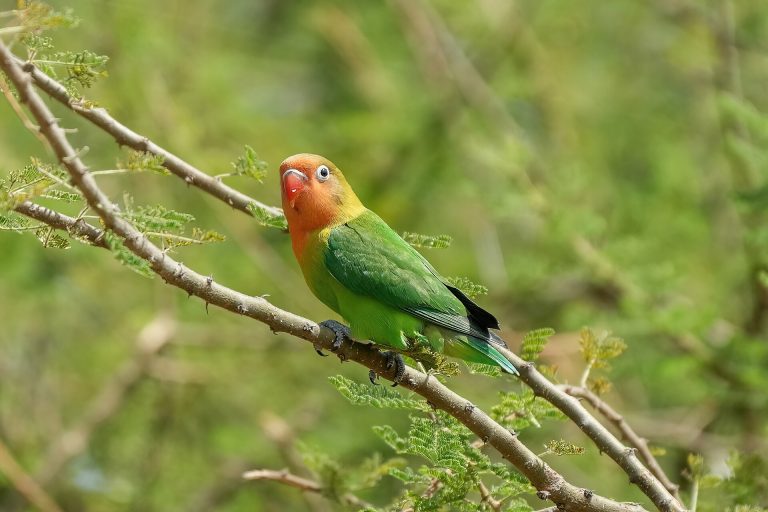
| 22Fischer's lovebirdAgapornis fischeri | Near endemicIUCN: Near threatened | Serengeti, Ngorongoro and Karatu | Game drive | Flocks around lodges and acacia; easy on a normal safari |
| 23Ashy starlingLamprotornis unicolor | Near endemicIUCN: Not threatened | Tarangire and Ruaha | Game drive | Common along the Tarangire River tracks |
| 24Rufous-tailed weaverHisturgops ruficauda | Near endemicIUCN: Not threatened | Serengeti and Tarangire | Game drive | Noisy around lodge grounds and picnic sites |
| 25Lesser flamingoPhoeniconaias minor | Regional specialIUCN: Near threatened | Lake Natron, Lake Manyara, Momella Lakes | Drive or walk | Numbers rise and fall with lake levels; check recent reports |
| 26Hartlaub's turacoTauraco hartlaubi | Regional specialIUCN: Not threatened | Arusha National Park forest and the Usambaras | Drive or walk | Look for red flight feathers crossing the forest road |
| 27Kori bustardArdeotis kori | Regional specialIUCN: Near threatened | Serengeti plains and the Ngorongoro Crater floor | Game drive | Heaviest flying bird in Africa; easy to spot in short grass |
| 28SecretarybirdSagittarius serpentarius | Regional specialIUCN: Vulnerable | Serengeti grasslands | Game drive | Hunts on foot; ask your driver to scan open plains |
| 29African skimmerRynchops flavirostris | Regional specialIUCN: Near threatened | Rufiji River in Nyerere National Park | Boat trip | Sandbanks seen best from a river boat in the dry months |
| 30Denham's bustardNeotis denhami | Regional specialIUCN: Near threatened | Kitulo National Park plateau | Drive or walk | Southern Highlands grassland; pairs with the Kitulo flower season |
| 31Fischer's turacoTauraco fischeri | Regional specialIUCN: Near threatened | Jozani forest on Zanzibar and Amani | Forest walk | Coastal forest bird; possible on a Zanzibar beach stay |
Range key: Endemic to Tanzania means found in no other country; Near endemic means shared with one or two neighbours; Regional special means a widespread or threatened bird that birders travel to Tanzania for. Names and endemic status follow the Avibase checklist for Tanzania, which uses the Clements taxonomy. IUCN categories as listed there; "Threatened" marks a species whose category differs between sources. Sightings are never guaranteed. Last checked November 2026. Sources: Avibase and Clements checklist, IUCN Red List, BirdLife International, Tanzania Tourist Board park pages.
Bird Watching Safaris on the Northern Circuit: Tarangire, Manyara and Arusha
Most people who go birdwatching in Tanzania do it on an ordinary northern circuit safari, and the three parks closest to Arusha carry the bulk of that list. Each one covers a different habitat, so two or three days across them can add up to a very respectable total before you reach the Serengeti.
Tarangire National Park is baobab and acacia country, with the Tarangire River holding water through the dry months. The Tanzania Tourist Board puts its bird list at nearly 500 species.
A Tarangire birding safari is the most reliable place on the circuit for two birds that matter to listers: the yellow-collared lovebird, which is a Tanzanian endemic, and the ashy starling, found almost nowhere else. Both turn up on normal game drives along the river tracks, so you do not need a special route to see them. Raptors are the other draw. Bateleur and martial eagle are regular, vultures gather wherever something has died, and the Silale Swamp fills with storks and pelicans once the rains return.
Lake Manyara works differently. The park is a narrow strip between the Rift Valley escarpment and a shallow soda lake, so a single morning drive passes from groundwater forest through acacia woodland to open shoreline. Birding guides commonly quote a hundred species in a day here. Silvery-cheeked hornbills feed in the forest near the gate, while the lakeshore holds pelicans, yellow-billed storks and, when the water level suits them, flamingos.
Arusha National Park is the one most people skip, and it repays a day. The Tanzania Tourist Board lists more than 400 species across montane forest on the slopes of Mount Meru, the Ngurdoto Crater and the alkaline Momella Lakes. Hartlaub's turaco crosses the forest road with a flash of red in its wings. The lakes hold both lesser and greater flamingos, plus grebes and, in the northern winter, migrant waders. Because the park sits just outside Arusha, it suits the first or last day of a trip, and birders often use it to learn the common forest calls before heading anywhere harder.
One practical point about this circuit: the specialist birds are mostly near endemics shared with southern Kenya, so a Kenya birder will recognise much of the list. The true endemics start further south and east.
Serengeti and Ngorongoro Birding Safaris
A Serengeti birding safari is about the big birds of open grassland. Kori bustard, the heaviest flying bird in Africa, walks the short grass plains, and the secretarybird hunts snakes on foot in the same country. Ostriches and ground hornbills are both likely on a few days of game drives. The park also holds the grey-breasted spurfowl, a Tanzanian endemic, which feeds along the track edges around Seronera in the early morning, and Fischer's lovebird, whose small green flocks gather around lodges and acacia thickets.
Vultures follow the herds. Where several species circle over one spot, a kill is often underneath, which is why a birder and a big cat watcher can share a vehicle in the Serengeti without much friction. Rufous-tailed weavers, another near endemic, are noisy and easy around picnic sites.
The Ngorongoro Conservation Area adds altitude. Highland forest on the crater rim holds sunbirds and forest species that do not occur on the plains, and Jackson's widowbird turns up in the rim grasslands near the airstrip. On the crater floor, crowned cranes graze beside the zebra, and the soda lake often carries flamingos. Two cautions from recent trip reports: morning fog can sit on the rim until late morning, and the rim road is busy and dusty enough that guides keep vehicle roofs closed there. Plan rim birding for the afternoon if your route allows it.
Flamingo Watching at Lake Natron and Lake Manyara
Lake Natron, a soda lake on the Rift Valley floor close to the Kenyan border, is the only regular breeding site for the lesser flamingo in East Africa. Around three quarters of the world's lesser flamingos hatch here, and the lake is a Ramsar wetland of international importance. The water is so alkaline that few predators reach the nesting mounds out on the flats.
That same chemistry is the catch. The breeding colonies sit far out on caustic mud, so a flamingo watching trip at Natron usually means a walk across the shoreline flats near Engare Sero with a local guide, watching feeding birds rather than the nests themselves. The Tanzania Tourist Board gives the hatching period as September to April, with numbers that vary from year to year. Heat is the other factor. Midday temperatures on the lake floor often pass 40°C, so go early and carry water.
Lake Manyara is the easier flamingo stop because it sits right on the northern circuit. Flocks can line the shore by the thousand, or be almost absent. Numbers there depend on water level and food far more than on the calendar, so a flamingo picture in a brochure says little about the week you visit. Ask your operator for recent sightings, and treat Natron, Manyara, the Ngorongoro Crater lake and the Momella Lakes as a set: in most weeks at least one of them holds a good flock. The site's flamingo watching safaris page lists trips that include these lakes.
Eastern Arc Birding Tours: Usambara, Pare and Uluguru
This is where Tanzania's endemics live. The Eastern Arc is a chain of old, isolated mountain blocks running from the Pare Mountains near Kilimanjaro south to the Udzungwa range, each capped with wet forest that has been cut off from its neighbours for a very long time. Birds evolved separately on each block, which is why a single mountain can hold a species found nowhere else on earth.
An Usambara birding tour usually splits between two forests. In the West Usambaras, Magamba forest above Lushoto holds the Usambara thrush and the Usambara akalat, both endemic, along with Hartlaub's turaco and the Usambara double-collared sunbird. In the East Usambaras, the Amani Nature Forest Reserve covers lower, warmer forest with a different set: the endemic banded sunbird and Usambara hyliota, the near endemic Amani sunbird, and the long-billed tailorbird, known from Amani and one mountain in northern Mozambique. Birding often starts in the old botanical garden around the reserve headquarters, where flowering trees pull in sunbirds within sight of the guesthouse.
Expect to work for it. Forest birds here call far more often than they show, many sit high in the canopy, and the weaver that gives the range its best known name is scarce enough that experienced groups with local guides sometimes leave without it. A realistic Usambara plan gives each forest two full mornings. Lushoto and Amani are a long drive apart, on roads that slow badly in the rains.
The South Pare Mountains make a short detour on the road between Moshi and the Usambaras for one bird, the endemic South Pare white-eye, which birders on recent trips found within an hour of reaching the forest. Further south, the Uluguru Mountains above Morogoro are the only home of the Uluguru bushshrike and Loveridge's sunbird. The Uluguru forest sits high on steep slopes, so seeing either bird means a hard climb rather than a stroll. This range suits dedicated listers far more than general safari travellers.
Accommodation shapes the plan as much as the birds do. Lushoto has guesthouses and small lodges within reach of Magamba, Amani has a simple reserve guesthouse and a few rooms nearby, and the Pare and Uluguru forests are usually done as day trips from Same and Morogoro. Forest days start at first light, when the canopy is most active, and wind down by late morning once the heat builds; afternoons are better spent on forest edge and gardens than deep inside the trees.
For a general safari traveller, Amani is the one Eastern Arc forest worth adding: it has guesthouse accommodation, easy garden birding and a realistic chance at several endemics in two days.
Udzungwa Mountains Forest Birding Treks
The Udzungwa Mountains National Park covers the largest of the Eastern Arc blocks and protects it as a national park. There are no roads inside, so every Udzungwa birding trek is on foot. The headline bird is the Udzungwa partridge, a forest partridge so distinct that scientists placed it in a genus of its own when they described it in the mid 1990s. It is listed as endangered, lives in high montane forest at roughly 1,350 to 2,060 metres, and is seen by very few visitors, since reaching its range takes a camping trek of several days with a specialist guide.
The lower trails are more forgiving. Forest near the park headquarters holds the endemic Iringa akalat and rufous-winged sunbird, and the Udzungwa red colobus, a primate found only here, often feeds in the same trees. The neighbouring Kilombero floodplain holds the endemic Kilombero weaver and two cisticolas described only recently, but it has little visitor infrastructure and needs a specialist operator.
Southern and Western Birding Safaris: Ruaha, Nyerere, Kitulo and Rubondo
Ruaha National Park sits where East African and southern African bird ranges overlap, and the Tanzania Tourist Board puts its list above 570 species. A Ruaha birding safari is the surest way to see the Tanzanian red-billed hornbill, which was first noticed in Ruaha and has only been treated as a separate species this century. It is common in the park, so a visiting birder rarely needs to search for it. Ruaha also holds yellow-collared lovebirds and ashy starlings, and its miombo woodland adds southern species absent from the northern parks.
In Nyerere National Park, formerly part of the Selous, the Tanzania Tourist Board records about 440 species and names January to April as the bird watching season. The Rufiji River is the reason to go: a boat trip passes sandbanks where African skimmers rest in the drier months, with kingfishers, bee-eaters and herons along the banks. Boat trips here are covered on the site's boat safari listings.
Kitulo National Park on the Southern Highlands plateau is mostly visited for wild flowers, and the grassland that holds them is also a site for Denham's bustard and the threatened blue swallow. Rubondo Island in Lake Victoria offers forest and lakeshore birding by boat and on foot, with African fish eagles nesting at high density. Katavi in the far west draws large gatherings of waterbirds along its rivers and floodplains as they shrink in the dry season. All three are remote and best combined with other southern or western parks rather than visited for birds alone.
Pemba and Coastal Bird Watching Trips
Pemba Island, north of Zanzibar, holds four endemics in a small area: the Pemba green pigeon, Pemba scops owl, Pemba sunbird and Pemba white-eye. The sunbird and white-eye are easy around gardens and forest edge. The scops owl calls after dark, so arrange an evening walk, with Ngezi forest in the north being the usual site. A two night stay is usually enough for all four.
On Zanzibar itself, Jozani forest holds Fischer's turaco and island races of several forest birds, and the coastal mudflats from Dar es Salaam to the islands draw crab plovers and migrant waders between November and April. A beach stay at the end of a safari can add twenty or thirty new species with very little effort.
Migrant Season Bird Watching: November to April
The months from November to April give the biggest lists, which is why most dedicated birding tours of Tanzania run then. Palearctic migrants such as European bee-eaters and white storks arrive, together with a long list of waders, from Europe and Asia, intra African migrants move in with the rains, and resident weavers and widowbirds moult into breeding colours and display. Birds call more, so forest species become easier to find by ear.
The dry season pulls the other way. From June to October vegetation thins, waterbirds crowd onto the shrinking pools and rivers, and roads are firmer, which makes it the easier time to combine birding with a mammal safari. One September trip report from a resident guide logged 463 species in two weeks across the north and the Usambaras, so dry season birding is far from poor. You lose most of the migrants and the breeding plumage, and gain easier access.
| Months | Migrants | Breeding | Access |
|---|---|---|---|
| Nov to Dec | Arriving | Starting | Short rains |
| Jan to Feb | Peak | Peak | Mostly dry |
| Mar to Apr | Leaving | High | Long rains |
| May | Few | Ending | Wettest roads |
| Jun to Oct | Absent | Low | Dry, easy |
For a first birding trip that also wants big game, January and February are the compromise: the migrants are present, the short dry spell keeps roads open, and the Serengeti herds are on the southern plains. The site's best time to visit Tanzania guide covers the wider seasonal picture.
Birding Safari Guides, Vehicles and Kit
The guide decides more of your list than the park does. Every licensed safari guide knows the common birds, but a guide who birds seriously finds species by call, knows where the endemic sits on each loop, and will wait twenty minutes for a shy bird without sighing. When you enquire, say clearly that birds are the priority and ask whether the guide carries a field guide and a call library. In the Eastern Arc forests, a local site guide who knows the trails is usually hired on top of your driver guide.
A private vehicle matters for the same reason. On a shared safari, the people next to you may not want to stop for a small brown cisticola, and that tension ruins birding days. With your own vehicle you set the pace.
On ethics, keep call playback to a minimum. Repeated playback stresses territorial and nesting birds, several of Tanzania's endemics have tiny populations, and good guides use it sparingly, if at all. Logging your sightings on eBird adds to the record that Nature Tanzania, the national BirdLife partner, uses to monitor the country's Important Bird Areas.
If you only have one week, choose one track. A northern circuit trip gives volume and big game with little walking; an Usambara and Amani trip gives endemics with real effort. Trying both in seven days mostly buys time on the road.
Birdwatching in Tanzania FAQ
How many bird species are there in Tanzania?
The Avibase checklist for Tanzania, which follows the Clements taxonomy, lists 1,160 species, including regular migrants and rare vagrants. Older or rounded figures of 1,100 to 1,150 appear in many guides, and the total changes as species are split or new records are added.
How many bird species can I see on a normal safari?
It depends on the guide and the season far more than the parks. One resident guide's recent trip report logged more than 120 species on a single day around Arusha, and published reports from two and three week birding tours that add forests and wetlands mention 460 to 470 species.
Can I see Tanzanian endemics on a standard northern circuit safari?
A few. The yellow-collared lovebird in Tarangire, the grey-breasted spurfowl in the Serengeti and the Tanzanian red-billed hornbill in dry bush are all realistic on ordinary game drives. Most other endemics live in Eastern Arc forests or on Pemba and need a separate trip.
Is Tanzania good for beginner birdwatchers?
It is one of the easier places in Africa to start. The big, colourful savanna birds such as rollers, hornbills and eagles sit in the open and are easy to learn from a vehicle. Beginners usually enjoy the northern parks most and find the forest birding of the Eastern Arc slow and frustrating.
Do I need a special guide for birdwatching in Tanzania?
For the northern parks, a safari guide with strong birding knowledge is enough, so ask for one when you book. For the Usambara, Uluguru and Udzungwa forests, a specialist bird guide or local site guide who knows the calls makes the difference between seeing endemics and hearing them.
Does a birding safari cost more than a regular safari?
Usually a little, because birders tend to want a private vehicle rather than a shared one, a guide with specialist skills, and extra days for forests that sit off the main route. Park and lodge costs are the same as for any safari. The site's guide to what a Tanzania safari costs explains the main price drivers.
When is the best time to see flamingos in Tanzania?
Lesser flamingos can be seen in any month somewhere in the north, but numbers at each lake depend on water levels. At Lake Natron, hatching runs roughly from September to April. Lake Manyara, the Ngorongoro Crater lake and the Momella Lakes in Arusha National Park are the other regular sites.
A birding trip is easiest to plan once you can see which parks and forests a real itinerary covers. Tanzania Safari.travel is a marketplace for safaris from independent tour operators: you can compare the safaris that include bird watching, from short Tarangire trips to longer routes through Ruaha and the forests, then send your enquiry straight to the operator running the trip you like, with no booking fee added. Tell them your target species and ask for a guide who birds.