
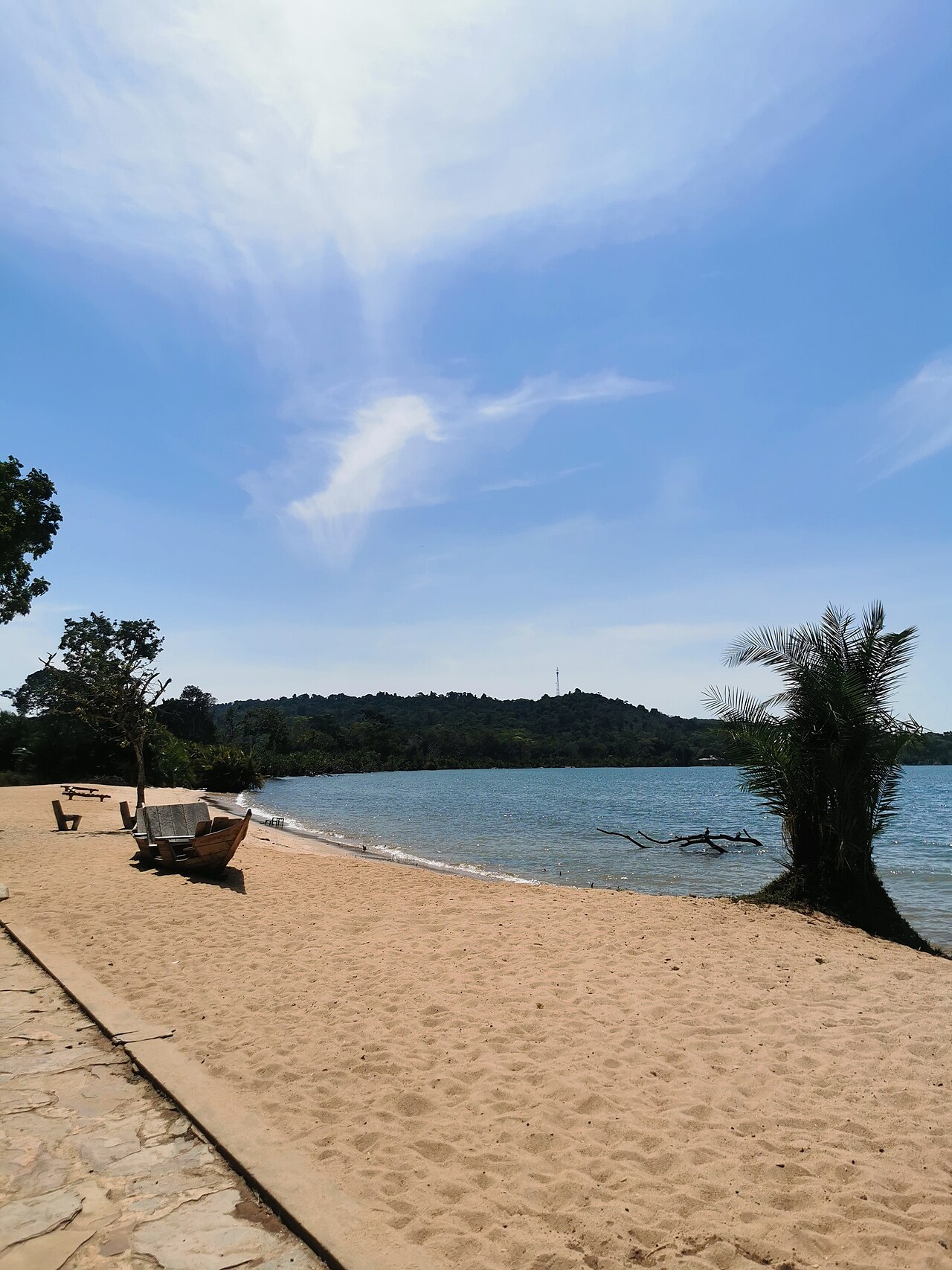
A rainforest island in Lake Victoria
Rubondo Island National Park occupies the south-western corner of Lake Victoria, in Geita Region. TANAPA gives it 456.8 square kilometres, records that it was first set up as a game reserve in 1965 and became a national park in 1977, and calls it “the green pearl in blue waters”.
What makes Rubondo unusual is the vegetation. TANAPA describes the island’s thick remains of Congolese lowland rainforest as one of the last surviving rainforests in western Tanzania — a fragment of a forest belt that properly belongs to central Africa, stranded in a lake. Around it are papyrus swamps, sandy beaches and quiet bays, and the whole thing is surrounded by water on every side.
It is also, by some distance, the most substantial of the Lake Victoria destinations for a traveller. Saanane is a half-day; Rubondo is several.
Why the forest matters
Rubondo’s forest is not a version of the woodland on the mainland. TANAPA describes it as the thick remains of Congolese lowland rainforest, forming a diverse ecological mosaic and representing one of the last remaining rainforests in western Tanzania. Being on an island has preserved it: the forest survived while equivalent forest on the shore did not.
That has a practical consequence for a visitor. The birds and plants here are in part a central African community rather than an East African one, which is the same reason the Minziro Forest Reserve up in Kagera matters to specialists. Rubondo, unlike Minziro, is a gazetted national park with rangers, campsites, an airstrip and published rules, which makes it by far the more practical of the two to actually visit.
The island was gazetted across the main island and a number of smaller ones, so much of what a boat trip covers is shoreline, channel and islet rather than open water.
The wildlife
Sitatunga. The park’s signature animal is the sitatunga, the swamp-dwelling antelope with splayed hooves that lives in the papyrus. TANAPA calls it the uncommon species that defines the park. It is secretive and seeing one is not guaranteed, but Rubondo is one of the better places in East Africa to try.
Other mammals. TANAPA lists hippo, elephant, giraffe, bushbuck, mongoose, suni antelope, otter and monkeys, with crocodiles on the shorelines.
Birds. This is a serious birding destination. TANAPA records Afrotropical and Eurasian migratory species, an introduced African grey parrot population, and a density of African fish eagles it describes as the highest anywhere. Herons, kingfishers and forest specialists fill out a list of around 400 species. See the bird watching guide.
Chimpanzees. Rubondo’s chimpanzees are not a native population, and this deserves stating plainly. Seventeen wild-born chimpanzees, most of which had spent years in European zoos and circuses, were brought to the island in four groups between 1966 and 1969 under a project led by Bernhard Grzimek and the Frankfurt Zoological Society, and sixteen were released. The animals on the island today descend from them.
For decades they were effectively unwatchable. TANAPA now lists a chimpanzee habituation experience in which visitors approach on foot under a guide’s supervision, and frames it as achievable without the arduous mountain trekking that Mahale and Gombe demand. That framing is accurate but it should be read carefully: habituation is a process, not a state. A habituation experience is a different product from trekking a fully habituated community. Sightings are less certain and the animals are less relaxed. The chimpanzee trekking guide sets out the difference in detail.
The honest advice is to go to Rubondo for the island, the forest, the birds and the sitatunga, and to treat chimpanzee sightings as a bonus rather than the reason for the trip.
What there is to do
TANAPA’s published activity list for Rubondo is boat safaris, guided forest walks, birding excursions, the chimpanzee experience by arrangement, bush meals and picnic sites, and public and special campsites.
Boat safaris along the shoreline and through the papyrus channels are a headline activity in their own right here rather than an add-on. TANAPA highlights the quiet coves, sandy spits and thickets of the coastline and the sunsets from the west-facing bays.
Forest walks and walking safaris must be led by authorised rangers, and are the way the island is seen on foot.
Fishing. TANAPA describes catch-and-release sport fishing for Nile perch, under permit and controlled. See the freshwater fishing guide.
Beaches. TANAPA names Asilia, Mchangani and Michikoko among the island’s freshwater beaches, and describes the Irumo Gulf — which it calls the deepest part of Lake Victoria — as the place for sunrise and sunset views. The bilharzia discussion in the Lake Victoria guide is essential reading before deciding to swim.
Camping and bush meals are both on TANAPA’s list, with special campsites requiring advance booking.
Getting there
TANAPA describes access as typically by boat transfer arranged with the park or licensed operators from mainland landing points such as Nkome or Kasenda, depending on conditions. By air, the route is to Mwanza or Bukoba and then by road to the embarkation point; charter flights may use Rubondo’s own airstrip by prior arrangement.
The dry season from June to October gives more predictable lake conditions, and TANAPA advises confirming boat schedules in advance. Lake crossings, internal flights and the rest of the logistics of moving around Tanzania matter more here than at any drive-in park. Because everything is island-based, resupply — cash, boat fuel, food — needs planning before leaving the mainland.
Rules and safety
TANAPA asks for boating speed and no-wake zones to be respected near papyrus and nesting sites, landing only at designated points, walking only with authorised rangers, and fishing only under permit and generally catch-and-release. Drones require prior written permission.
On safety: lifejackets on every boat, awareness of hippos and crocodiles near the shoreline, no approaching or feeding wildlife, and a respectful distance from the chimpanzees. Lake conditions change quickly.
Entry is a published government charge rather than an operator’s price. TANAPA’s 2023/24 tariff booklet sets Rubondo Island’s conservation fee at US$30 per non-EAC adult for twenty-four hours, flat all year, with a reduced rate for children of five to fifteen and nothing below five. Boat transfers are charged separately and are the larger cost here. The booklet is the most recent TANAPA has published and its VAT basis is contradicted on the authority’s own website — the guide to where park fees sit against everything else covers both.
Seasons
Rubondo is in Geita Region, which the Tanzania Meteorological Authority places in its bimodal Lake Victoria zone alongside Kagera, Mwanza, Shinyanga, Simiyu and Mara. Two rainy seasons: Vuli from October to December and Masika from March to May, which puts Rubondo on the two-season side of Tanzania’s divided rainfall calendar. TANAPA gives the park a temperature range of 18 to 26 degrees Celsius and an elevation of around 350 metres.
Common questions about Rubondo
How big is Rubondo Island National Park?
TANAPA gives 456.8 square kilometres. It was a game reserve from 1965 and became a national park in 1977.
Are the chimpanzees wild?
They are wild now, but they are descended from seventeen wild-born chimpanzees brought to the island from European zoos and circuses in four groups between 1966 and 1969, sixteen of which were released. TANAPA offers a habituation experience rather than trekking to a long-habituated community, and sightings are correspondingly less certain.
What is a sitatunga?
A swamp-dwelling antelope with splayed hooves adapted to walking in papyrus. TANAPA treats it as the park’s defining species. It is secretive, and Rubondo is one of the better places in East Africa to look for one.
How do you get to Rubondo?
Usually by boat from mainland landing points such as Nkome or Kasenda, arranged through the park or licensed operators. By air, fly to Mwanza or Bukoba and continue by road to the embarkation point; charter flights can use the island airstrip by prior arrangement.
Is Rubondo good for birds?
Very. Around 400 species, including Afrotropical and Eurasian migrants and an introduced African grey parrot population, with a density of African fish eagles that TANAPA describes as the highest anywhere.
How long should a visit be?
Longer than a day trip. The boat transfer is substantial, the activities are spread across forest, shoreline and water, and the wildlife that makes the island distinctive is the kind you look for rather than drive past.
When is the best time to go?
June to October gives the most predictable lake conditions for boat transfers. The two rainy seasons in this zone are October to December and March to May.