
Freshwater Fishing on Tanzania's Great Lakes
Fishing the great lakes: Nile perch and tilapia on Victoria, the four endemic Lates species that are Tanganyika’s big predators, and trout in the Southern Highlands streams around Mufindi.
Lake Tanganyika, Lake Victoria and Lake Nyasa offer fishing with nothing in common with the coast: different species, different permits, harder logistics and a health hazard the sea does not have. Tanganyika's big predators are four endemic Lates species rather than the Nile perch operators often claim. This guide covers all three lakes, the rules, and the risks worth taking seriously.
Safaris That Include Freshwater Fishing
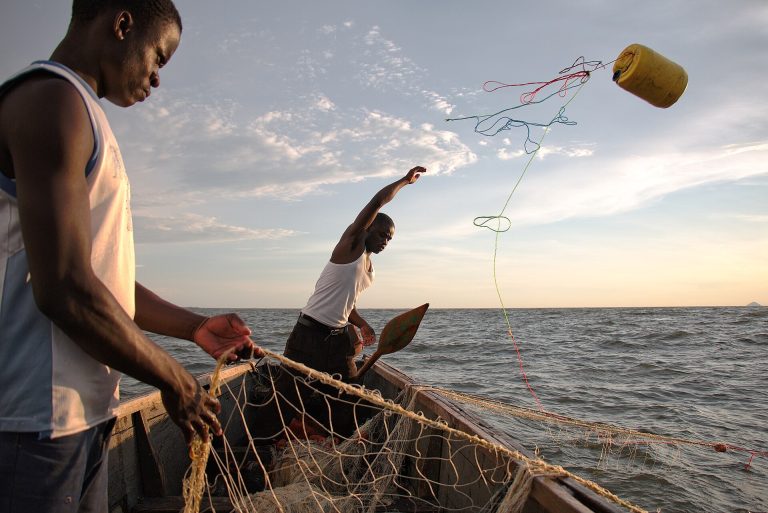

A Guide to Freshwater Fishing in Tanzania
Why freshwater fishing here is a different product
Tanzania's lake fishing has almost nothing in common with the charter fishing on the coast. The water is different, the fish are different, the permits are different, the logistics are harder, and there is a health hazard that does not exist at sea.
It is also, in places, some of the most unusual fishing available anywhere. Lake Tanganyika is the second deepest lake in the world and holds a fish fauna that evolved in isolation, most of it found nowhere else. Lake Nyasa holds more fish species than any other lake on earth. Lake Victoria holds an introduced predator that reshaped an entire ecosystem within a human lifetime. None of that describes a normal fishing destination.
The lakes sit in the west and south of the country, which means they attach naturally to the western and southern safari circuits rather than to the coast. The saltwater activity is covered separately in the deep sea fishing guide.
Lake Tanganyika, and the fish it does not have
This is where most published information about Tanzanian freshwater fishing goes wrong, so it is worth being precise.
Lake Tanganyika holds large predatory fish that are commonly called perch, and they are frequently described as Nile perch. They are not. The lake's big latid predators are four species of the genus Lates, all endemic to Tanganyika, of which Lates stappersii is the commonest. Nile perch, Lates niloticus, is a different fish altogether and is the species introduced into Lake Victoria. Calling Tanganyika's fish Nile perch is not a harmless simplification; it confuses an endemic assemblage with an invasive one.
The other claim to treat carefully is goliath tigerfish, Hydrocynus goliath, which appears on a great many pages about Tanganyika. The species is a Congo basin fish and is reported from the lake in the standard species databases, but a genetic study published in 2011 suggested it may in fact be restricted to the Congo basin, with other Hydrocynus species present in Tanganyika instead. Tigerfish are certainly there. Whether they are goliath tigerfish is genuinely disputed, and anyone promising you one should be aware of that.
Beyond the predators, the lake holds very large catfish and an extraordinary diversity of cichlids, the latter overwhelmingly of interest to divers, snorkellers and the aquarium trade rather than to anglers.
Access is from Kigoma in the north, from the lodges along the Mahale shore, and from the far south around Kipili and Kasanga. It is remote, most of it is reached by light aircraft and boat, and fishing is generally arranged through whatever lodge you are staying at rather than as a standalone charter.
Lake Victoria
Victoria is the Nile perch lake, and its story is worth knowing before you fish it. Nile perch was introduced in the twentieth century, established, and became an enormous commercial fishery, and the collapse of the lake's endemic cichlid diversity that followed is one of the most studied ecological events in freshwater science. It is now also the basis of the local economy across three countries.
For an angler, that means a large, aggressive predator in accessible water, alongside tilapia and other species. Fishing is arranged out of Mwanza, from the island lodges, and from the national park islands, with Rubondo Island the best known for combining fishing with wildlife.
Victoria is also the most heavily fished commercially of the three lakes and the most affected by pollution, hyacinth and shoreline population pressure, which varies enormously between one bay and the next.
Lake Nyasa
Nyasa, called Lake Malawi from the other shore, holds more fish species than any lake in the world, including at least seven hundred cichlids, and that is the reason to go. It is not primarily a sport fishing destination in the way the other two are.
The Tanzanian shore around Matema and the Livingstone mountains is beautiful and little visited, and fishing there is generally small-scale, local and informal rather than organised. Given the lake's conservation significance, a catch-and-release approach and a light hand are the only defensible way to fish it, and taking cichlids is not something a visitor should be doing.
Rivers, and fishing inside national parks
The Rufiji, the Great Ruaha and other river systems hold catfish, tilapia and tigerfish, and some southern-circuit camps offer fishing on them.
Fishing inside a national park is a regulated activity, not an assumption. The national parks authority publishes sport fishing guidelines, permits are required, and the rules on where, when, what tackle and what may be kept vary by park. Some parks permit it, some do not, and some permit it only in defined stretches. This is worth confirming in advance rather than discovering at a gate, and a camp that offers park fishing should be able to produce the paperwork.
The other constraint on river fishing is the obvious one. Crocodiles and hippos are present in all of these systems, and a riverbank is where people meet both.
Permits and the rules
Sport fishing in Tanzania is licensed under the Fisheries Act and its regulations, and the licensing covers both the angler and, separately, the vessel. Non-citizens have additional requirements. A well-organised lodge handles all of it; an informal arrangement with somebody's boat generally does not.
Fees exist, are set by the authorities, change, and are not quoted here. Ask what is payable, to whom, and whether it is included in what you are arranging. The national park and Ngorongoro tariffs are the exception on this site, kept in one place where they can be dated and sourced: what the state charges, and what an operator adds.
Two further points. Zanzibar and mainland Tanzania are separate jurisdictions for fisheries purposes, which is irrelevant on the lakes but catches people who assume one national system. And Tanganyika, Victoria and Nyasa are all shared with other countries, so an international boundary runs through water that looks continuous. Know which side you are on.
Methods and tackle
Trolling and casting with lures is the standard approach for the lake predators, jigging over drop-offs works on Tanganyika, and live and dead bait is used for the big catfish. Fly fishing is possible and done, more often on the rivers and for tigerfish than on the open lakes.
Bring your own tackle. Specialist gear is not reliably available outside a handful of lodges, and replacement of anything broken or lost is effectively impossible in these locations. Wire traces are essential for tigerfish. Strong hooks, because the fish here are not delicate.
On conservation practice, the sensible position on all three lakes is to release what is not going to be eaten, to use barbless or crushed barbs where you intend to release, to keep fights short and handling minimal, and to leave cichlids entirely alone. Taking a share of the catch for the camp kitchen is normal and reasonable; taking more than that is not.
Bilharzia, crocodiles and weather
These three things do more to shape a lake fishing trip than the fishing does, and the first is routinely understated.
Schistosomiasis. Also called bilharzia, and acquired when larvae released by freshwater snails penetrate skin on contact with water. Wading, launching a boat, handling wet nets or lines, or standing in the shallows is enough; no swimming is required. The United States Centers for Disease Control names only two categories of water as safe in countries where the parasite is transmitted: the sea, and chlorinated swimming pools. Its description of transmission explicitly includes streams and rivers, not only still water, and the widely repeated belief that fast-flowing water is safe has no backing from CDC or from the World Health Organization.
All three lakes have produced documented infections in visitors. A report in the Journal of Travel Medicine in 2013 described eight of sixteen fieldworkers infected at Kigoma on Lake Tanganyika, two of them entirely without symptoms. Another in 2011 described sixty-six of seventy-seven visitors infected after a retreat near Mwanza on Lake Victoria. On Lake Nyasa, a CDC investigation published in The Lancet in 1996 found transmission in a lake widely believed at the time to be free of it, and a 2019 paper in Emerging Infectious Diseases reconfirmed that and called for international travel advice to be revised.
CDC advises drying yourself well with a towel after contact but says explicitly not to rely on that to prevent infection. Early infection frequently produces no symptoms, which is why anglers who have been in or around lake water commonly arrange a test some weeks after returning. The World Health Organization identifies praziquantel as the recommended treatment and notes that infections in travellers are rising with eco-tourism and are sometimes severe. Neither body ranks Tanzania's lakes against each other for risk and neither does this guide. Take it up with a travel health professional before you go.
Crocodiles and hippos. Present in all three lakes and in the rivers, concentrated in vegetated shallows, river mouths and bays. Landing a fish at the water's edge, wading to launch, and cleaning fish at the shoreline are the three situations that bring anglers into contact with both. Local knowledge about a specific stretch of water is decisive here in a way it is not for schistosomiasis, and it should be asked for and followed.
Weather. Tanganyika and Victoria are large enough to generate a genuinely dangerous sea, and squalls build fast, often in the afternoon. Small boats a long way out on either lake are exposed, and a boat should carry lifejackets and a means of calling for help. Nyasa is famous for sudden strong winds off the mountains.
Logistics
These are remote places. Kigoma and Mwanza have flights and some road access; Mahale and the southern Tanganyika shore are light aircraft and boat; the Nyasa shore is a long drive from Mbeya. Nothing here is a day trip from a safari. What reaching them involves is set out in who flies the western airstrips, and what the roads and the lake ferries actually do.
Almost all visitor fishing on the lakes runs through lodges and camps rather than through standalone charters, which is a consequence of the distances involved. That has the advantage that permits, boats and local knowledge come bundled, and the disadvantage that your options are whatever the lodge has.
Take repellent and take the malaria precautions seriously; the lake shores are not a low-risk environment. Take sun protection for long exposed days on open water, and take more spare tackle than feels reasonable.
Common questions about freshwater fishing in Tanzania
Is there Nile perch in Lake Tanganyika?
No. Tanganyika's large latid predators are four endemic Lates species, of which Lates stappersii is the commonest. Nile perch, Lates niloticus, is the introduced species in Lake Victoria. A great many operator pages conflate the two.
Can I catch goliath tigerfish there?
Tigerfish are certainly present. Whether they are goliath tigerfish is disputed: the species is reported from the lake in the standard databases, but a 2011 genetic study suggested it may be restricted to the Congo basin with other Hydrocynus species in Tanganyika. Treat a confident promise of a goliath with some caution.
Do I need a permit?
Yes. Sport fishing is licensed under Tanzania's fisheries legislation, covering both angler and vessel, with extra requirements for non-citizens. Fishing inside a national park needs park permission on top, and the rules differ by park. A well-run lodge handles all of it.
Is bilharzia really a risk if I am only fishing?
Yes. Infection needs only skin contact with water, so wading, launching a boat and handling wet gear are all exposures. CDC names only the sea and chlorinated pools as safe categories, includes streams and rivers in its transmission description, and does not support the common claim that fast-flowing water is safe. Documented traveller outbreaks exist on all three Tanzanian great lakes. Discuss testing with a travel health professional.
Which lake is safest from bilharzia?
Neither CDC nor WHO ranks them, and neither will this guide. Lake Nyasa is the cautionary example precisely because it was long assumed to be free of the parasite and was found not to be.
Should I bring my own tackle?
Yes. Specialist gear is not reliably available outside a few lodges and replacing anything lost or broken in these locations is effectively impossible. Wire traces for tigerfish and strong hooks throughout.
Can I keep what I catch?
Within the permit conditions, yes, and a share for the camp kitchen is normal. The defensible practice is to release what will not be eaten, keep fights short, minimise handling, and leave the cichlids alone entirely, particularly on Lake Nyasa, where they are the reason the lake matters.
Can I combine lake fishing with a safari?
Yes, but not as a day trip. The lakes sit on the western and southern circuits, most access is by light aircraft and boat, and fishing is generally arranged through the lodge rather than separately. Rubondo Island on Lake Victoria and the Mahale shore of Lake Tanganyika are the two places where fishing and wildlife genuinely sit together.