
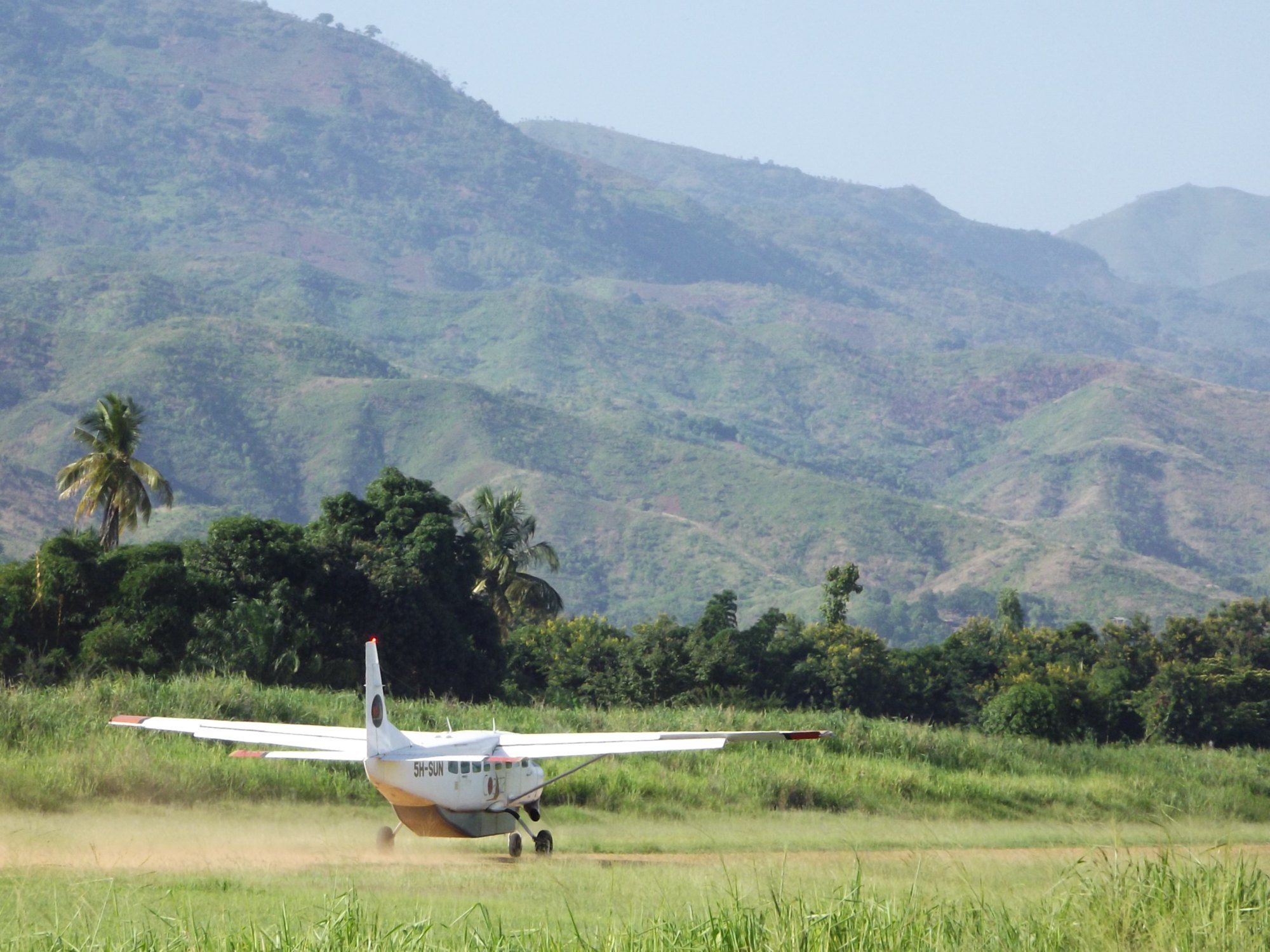
Tanzania is not one transport network. It is four, and they barely touch each other. There is an international gateway system with three doors, and which one you come through changes your whole itinerary. There is a light-aircraft system that runs on a weight budget rather than a timetable, and its most consequential rule fits in five characters: 15 kg. There is a road system whose tarmac ends at a specific and knowable place. And there are ferries and railways that are genuinely worth doing but belong to a different kind of trip from the one most people are planning. This page works through all four, and it is blunt about the drive times, because the commonest way a Tanzanian itinerary fails is that somebody treated a long day as an afternoon.
The three gateways, and which one your trip actually wants
The Tanzania Airports Authority lists three international airports among the facilities it operates — Julius Nyerere at Dar es Salaam, Kilimanjaro, and Msalato at Dodoma — alongside domestic airports including Arusha, Dodoma and Songwe. Zanzibar’s Abeid Amani Karume International Airport sits under the islands’ own administration. Msalato is not a safari gateway and can be set aside. For a visitor, the decision is between three.
| Airport | Code | What it is the gateway to |
|---|---|---|
| Kilimanjaro International | JRO | The entire northern circuit — Serengeti, Ngorongoro, Tarangire, Lake Manyara — and both mountains, Kilimanjaro and Meru. |
| Julius Nyerere International | DAR | The southern circuit — Nyerere, Ruaha, Mikumi, Udzungwa — plus the ferry and the short hop to Zanzibar, and the connections west to Katavi and Mahale. |
| Abeid Amani Karume International | ZNZ | Zanzibar and Pemba. A beach-first trip, or the end of a safari rather than its beginning. |
Why JRO is the northern-circuit door
Because the northern circuit is a road circuit with one entrance, and JRO sits at that entrance. Everything in it is reached by driving west from Arusha, and Arusha is on the airport’s doorstep rather than on the far side of the country. The airport’s own site places it 40 km east/south-east of Arusha and 30 km west/south-west of Moshi, so it lies between the two towns rather than beyond either; TANAPA gives Kilimanjaro International to Moshi as “about 45 minutes”, and TANROADS’ road distance chart makes Arusha to Moshi 80 km. TANAPA’s park access figures then run out from Arusha: Tarangire’s main gate “about 1½ hours” on a good road, Lake Manyara “about 2 hours” on tarmac.
Flying into Dar es Salaam for a northern-circuit safari means adding a domestic sector — TANROADS makes the road distance Dar es Salaam to Arusha 646 km — for no gain, unless the trip does the coast first or a Dar routing is very much cheaper and the extra sector is accepted knowingly.
The airport nobody mentions until the day before
Arusha has two airports, and they are not the same place. Kilimanjaro International is the long-haul one. Arusha Airport, a separate domestic field on the other side of town, is where most northern-circuit light-aircraft flights actually leave from. The Airports Authority lists them separately, as an international airport and a domestic one, and the safari operators fly from both: Coastal Aviation’s published destination list, for instance, carries Arusha and Kilimanjaro as two distinct points.
This matters on the morning you fly into the park. An itinerary that says “fly to the Serengeti” without naming the departure airport is ambiguous, and the two are far enough apart that mistaking one for the other loses the flight. Get the airport on the ticket, not the city.
Zanzibar as an arrival
Flying straight into ZNZ is the right call for a beach-only trip and for any itinerary that starts on the islands. Know two things before choosing it: Zanzibar operates its own immigration administration, so arriving there means clearing entry into the archipelago specifically — and the same applies on a domestic flight from the mainland, as below — and the islands impose entry conditions of their own, including a compulsory inbound insurance bought through a single official portal. Those are paperwork rather than transport, and they are set out in Tanzania travel requirements.
Domestic flights: who flies them, and the fifteen kilograms
Tanzania’s internal aviation is unusually well developed for the size of its economy, because the alternative in much of the country is two days of driving. A handful of operators run scheduled light-aircraft services to park airstrips, selling by the seat, and the same aircraft are chartered whole.
Who actually flies the airstrips
The roster to work from is the Tanzanian regulator’s own. The Tanzania Civil Aviation Authority publishes an AOC Register — Flight Operations, then Certifications, then “List Of AOC Holders” — naming every holder of a Tanzanian air operator certificate with its TCAA/AOC/nnn number, its type of operation and its main base. Read on 23 September 2026 it ran to thirty-four holders. The ones a safari traveller is likely to meet are on it: Coastal Travels, listed as Coastal Air (TCAA/AOC/004), Auric Air Services (TCAA/AOC/022), Regional Air Services (TCAA/AOC/010), Flightlink (TCAA/AOC/025), Fly Safari Airlink (TCAA/AOC/047), Air Excel (TCAA/AOC/028), Safari Plus (TCAA/AOC/046), Zantas Air (TCAA/AOC/018) and Tropical Air (TCAA/AOC/006), together with the scheduled carriers Air Tanzania (TCAA/AOC/001) and Precision Air Services (TCAA/AOC/003), and half a dozen balloon operators whose base is given as Seronera.
Annex A of the European Commission’s EU Air Safety List, in the legal notice dated 9 June 2026, covers “All air carriers certified by the authorities with responsibility for regulatory oversight of Tanzania” and then names thirty-four of them individually, carrying the same certificate numbers. It is worth reading, but it is a snapshot taken on that date rather than a register, and the two lists are not the same list. Four operators on the TCAA register — Premier Air, Pro-Flight, Miracle Air and Flying Odyssey, which hold its highest certificate numbers — are not named in the annex; four named in the annex, among them Everett Aviation (TCAA/AOC/042), are not on the register. For three more the annex prints “TCAA/AOC/” with no number where the register supplies one. Since the European listing is country-wide by construction, the individual names in it are illustrative. The register is the document that changes when a certificate does.
Coastal Aviation’s own destination list, read on 22 September 2026, gives a fair picture of the network’s shape: Arusha, Dar es Salaam, Kilimanjaro, Tarangire, Lake Manyara, Ngorongoro, Serengeti, Ruaha, Selous, Tanga, Zanzibar, Pemba, Mafia, Rubondo Island and Songo Songo, plus cross-border points at Nairobi, the Maasai Mara and Kigali.
Note what that list implies. “Serengeti” is not one airstrip. The park is served by several — Seronera in the centre, Kogatende and Lamai in the north near the Mara River, Kirawira in the western corridor, Lobo in the north-east, Kusini in the south — and which one you land at decides which part of a 14,763 km² park you are in and how far your camp’s vehicle has to drive to collect you. Ask for the airstrip name, not the park name.
The 15 kg soft bag, and why it exists
This is the single rule that most changes how a traveller packs for Tanzania, and it is not a suggestion. These are the operators’ own published policies, read on 22 September 2026.
| Operator | Published allowance | Soft bag | Maximum dimensions |
|---|---|---|---|
| Coastal Aviation (Coastal Travels Ltd) | “a maximum luggage allowance of 15kgs (33lbs) per person including carry-on luggage” | “strongly recommended but are not obligatory” | Soft duffle 40 × 40 × 80 cm; hard-shell case 76 × 48 × 29 cm |
| Regional Air Services | “the luggage allowance is 15 kilos in soft bags. These allowances shall include all hand baggage” | Stated as the allowance itself | Checked 60 × 45 × 33 cm; hand luggage 30 × 53 × 23 cm |
| Auric Air Services | 20 kg per passenger, inclusive of hand luggage, cameras and personal items | Recommended, for packing into the aircraft pods | 90 × 65 × 35 cm per piece |
Three things follow that a packing list will not tell you.
The figure includes everything. All three operators state that the allowance covers hand baggage. Where a carry-on is defined at all, it is defined inside the total rather than alongside it: Regional Air’s baggage sheet allows a handbag, a small rucksack, a coat or a walking stick stowed under the seat or in an overhead bin, at 30 × 53 × 23 cm, and adds that these “must not exceed 5 Kgs/ 11lbs and are part of the baggage allowance of 15kgs/ 33lbs”. There is no second allowance to put a camera bag in.
Fifteen is the convention, not the law. Coastal and Regional both publish 15 kg; Auric publishes 20 kg. If your itinerary mixes carriers — and a north-and-south trip often does — you pack to the lowest one on the route, which is usually fifteen. Anyone quoting you a single national figure is generalising from one airline.
The reason is the aircraft, not the airline. These are single-engine turboprops with a fixed maximum take-off weight, flying to unpaved strips at altitude in hot air, where every kilogram is traded against fuel. Coastal’s conditions put the decision where it actually sits: excess baggage is carried at the company’s discretion “after taking into consideration the aircraft being used and the admissible maximum load”, with the captain having the final word on the day. The soft-bag preference is a shape problem rather than a weight one — hold pods are a fixed volume and a rigid case wastes it, which is why all three publish dimension limits alongside the weight.
All three publish a route out of the problem, and they are not the same route. Auric sells excess in 10 kg slabs, up to 40 kg, at a published rate that differs between its coastal and its safari routes, and above that a freight seat carrying 75 kg. Regional Air sells the freight seat too — booked in advance, also 75 kg — and will otherwise take additional luggage on a space-available basis at a published per-kilo rate. Coastal sells weight rather than space: an XL premium seat class that raises the passenger’s own allowance to 30 kg, subject to availability. Buying a seat for your luggage is a real option on a photographic trip, and a conversation to have before departure day rather than at the airstrip. The practical answer for most travellers, though, is a soft duffle, laundry done at camp — nearly every safari property offers it — and the hard case left with your Arusha or Dar hotel, along with the mountain kit or the city clothes you do not need in the bush.
What a bush flight is actually like
Scheduled bush flights are not point-to-point. A rotation leaves Arusha and works around several airstrips in turn, dropping and collecting, so your “one hour to the Serengeti” may include intermediate landings and be quoted as a departure time rather than an arrival time.
Sector times are published, and they repay reading. Auric Air’s schedule sheet, valid from 15 June 2025 to 31 December 2026, gives a departure and an arrival for every sector it sells: Arusha to Tarangire’s Kuro strip at 07:30 and 08:00, Arusha to Lake Manyara at 08:30 and 08:55, Arusha to Seronera in the central Serengeti at 08:00 and 09:30, and Arusha to Lamai, in the far north, at 07:30 and 10:10. Coastal publishes a timetable on the same pattern. What neither publishes is a guarantee: Auric’s sheet says in its own header that “All times are estimates and will depend on the final route on the actual date”. Read the printed time as the shape of the morning rather than as a promise. That is how the network can exist at all — but it means a bush flight is a morning or an afternoon, not a slot. There are no jet bridges, no baggage carousels and often no terminal; seat allocation is a loading decision made by the pilot rather than a preference you express; and departure times move with weather and with the aircraft’s other stops.
Where a flight genuinely earns its place is set out in how many days you need in Tanzania: it converts a driving day into a game-viewing day. TANAPA’s own figure for Mahale — a three-hour flight from Arusha with a refuelling stop, then a boat transfer of an hour and a half to two hours — is a reminder that in western Tanzania the flight is not an upgrade, it is the only practical access.
The EU Air Safety List, stated plainly
A traveller researching Tanzanian aviation will eventually find this, usually in an alarming form, so it is worth setting out accurately.
The European Commission’s Air Safety List, updated on 9 June 2026, bans all air carriers certified in Tanzania from operating within the European Union. Air Tanzania was listed individually in late 2024 and the ban was extended to all Tanzanian-certified operators in June 2025. The Commission’s stated basis is the capacity of the national regulator to exercise safety oversight, not a finding against any particular operator: the list exists, in the Commission’s framing, for airlines “not meeting international aviation safety standards”, and a country-wide listing follows from shortcomings identified in the oversight system itself.
What that does and does not mean for a traveller. It does not change any Tanzanian itinerary, because none of these carriers flies to Europe. It is not a statement that a given bush flight is unsafe, and it is not a Tanzanian regulator’s own finding. It is, however, a published external assessment of the regulator, and it is the sort of thing worth knowing rather than discovering. The Commission itself notes that the only authentic version of the list is the one annexed to the current Commission Implementing Regulation in the Official Journal — so if this matters to your decision, read the current annex rather than any website’s summary, including this one.
Roads: the hub, the surface, and honest drive times
Almost every Tanzanian safari has a road component, and on the northern circuit the road component is most of the trip.
Arusha is the hub, and the circuit runs west from it
Arusha is where the northern circuit’s vehicles are based, where the guides live and where most itineraries begin and end. A northern trip is a loop out from Arusha and back, and the order of the parks is set by geography: Tarangire or Lake Manyara first, Karatu and the Ngorongoro rim next, the Serengeti beyond. Deviating from that order costs half a day per deviation.
The surface, and where it changes
TANROADS, the national roads agency, states that it manages 37,435 km of roads under the Roads Act No. 13 of 2007, made up of 12,527 km of trunk roads and 23,939 km of regional roads. It does not publish, on that page, the share of each class that is bitumen — so rather than guess at a percentage, here is the operationally useful version. The northern circuit’s spine is tarmac: TANAPA describes the Arusha–Lake Manyara road as tarmac and says it continues towards Ngorongoro and the Serengeti. Past the highlands the character changes. Inside the Ngorongoro Conservation Area and the Serengeti you are on graded park tracks with speed limits, and the drive from the crater rim across to the central Serengeti is a game drive rather than a transfer. It should be planned as most of a day.
The UK Foreign, Commonwealth and Development Office — a foreign government’s advice, used here only as corroboration — describes park roads as “mainly dirt tracks” that “can become hazardous or impassable after heavy rain”, says that “many roads need repair, including in major towns and cities”, and advises travellers to “avoid driving outside major towns and cities at night”. All three match what Tanzanian sources imply and what operators build their schedules around.
Season is what decides how much of that bites. Tarmac is unaffected; park tracks are where the rains land, and black-cotton soil in the western Serengeti and around Ndutu turns to grease when wet. Some parks stop being drivable at all — TANAPA calls Katavi “only accessible in the dry months”. Which months those are depends on where you are going, because Tanzania runs two rainfall calendars rather than one: see the best time to visit Tanzania, which is the decision that should come before this one.
Arusha to the Serengeti is a long day
This is the figure to sit with. TANROADS’ distance chart routes Arusha to Musoma through the Serengeti and makes it 499 km. That is the width of the northern circuit in one number, and it is why a Serengeti leg cannot be a day trip. The drive from Arusha to a central Serengeti camp is a full day with game viewing folded into its second half — not an afternoon, and not something to schedule on the day you land off a long-haul flight.
The road legs beyond the northern circuit are a different order again. TANAPA gives Dar es Salaam to Mikumi as about four hours over 283 km of good surfaced road, Dar to Ruaha as 625 km, and Dar to Katavi as about 1,400 km “requiring 20+ hours”. The full published distance table, and what each leg does to an itinerary, is in how many days do you need in Tanzania.
The safari vehicle, and what “private” actually buys
On the northern circuit the standard vehicle is an extended Toyota Land Cruiser with a roof that lifts — the pop-top — so that passengers can stand and view over the cab while the vehicle is stopped. It is not a convertible; the roof is a hatch on struts, and it stays down while moving.
Closed versus open-sided
Closed-sided pop-top vehicles are the northern-circuit norm. Open-sided vehicles, with no glass and often no doors, are more common in the southern and western parks and at the higher end of the market. They give a better photographic line and much better sound, and they are markedly colder on a six o’clock departure and dustier all day.
There is also a fee consequence that quotes rarely spell out. TANAPA’s Tariffs booklet for 1 July 2023 to 30 June 2024 charges vehicle entry by tare-weight band, in steps that jump sharply, and states that “Open vehicles will be charged 50% extra of the normal vehicle fee”. The full fee table, with the Ngorongoro vehicle permit and the per-vehicle crater service fee alongside it, is in how much does a Tanzania safari cost.
What a private vehicle buys, and what it does not
A “private vehicle” means the vehicle and its driver-guide are yours: you set the departure time, you decide how long to sit with a leopard, you go back to the river because the morning was not enough, and you stop when a child needs to. On a shared departure those decisions are made by consensus or by the guide. What it does not buy is a cheaper trip — the vehicle costs the same whether one person or six are in it, which is the arithmetic that dominates a Tanzanian quote. A private vehicle for two is the most expensive way to travel per head; the same vehicle for a family of five is barely a premium at all.
Three questions worth putting to an operator about the vehicle specifically, because the answers vary and rarely appear in a brochure:
- How many people will actually be in it? A seven-seat Land Cruiser sold with six passengers means nobody has a window. Ask for the guaranteed maximum, not the capacity.
- Is there a guaranteed window seat for every passenger? This is the single most useful thing to fix in writing on a photographic trip.
- Charging, a fridge, and a radio? Inverter sockets for camera batteries, a cool box, and a working vehicle-to-vehicle radio are all common and none is universal. The radio is the one that finds the wildlife.
The guide is the other half of the vehicle, and the part that actually differentiates two otherwise identical game drives. A driver-guide who spots, knows the individual animals in a territory and talks to other vehicles is worth more than the vehicle’s specification.
Zanzibar: ferry or flight
From Dar es Salaam you have a genuine choice; from anywhere else you fly.
| Fast ferry | Flight | |
|---|---|---|
| Where it leaves from | Dar es Salaam ferry terminal, in the city centre | Julius Nyerere International, out of town |
| Arrives | Stone Town harbour, in the middle of the old city | Abeid Amani Karume International, then a road transfer |
| Luggage | Effectively unrestricted; you carry it on | Airline allowance, and a light-aircraft allowance if it is a bush carrier |
| Weather | Sea state matters; rough crossings happen | Rarely disrupted |
| Immigration | Separate Zanzibar entry check on arrival | Separate Zanzibar entry check on arrival |
The ferry operators, and what they publish
Azam Marine and Kilimanjaro Fast Ferries is the larger operator, running what it describes as “daily commutes to and from Dar-es-salaam, Zanzibar, Pemba, and Tanga” with its Kilimanjaro-class vessels — Kilimanjaro IV, V, VI and VII — plus two roll-on/roll-off ships, Azam Sea Link 1 and 2. Zan Fast Ferries also operates the Dar–Zanzibar route.
Azam publishes its fares by class, and they carry a resident and a non-resident column, which is worth knowing before anyone quotes you a “local price”.
| Class | Resident | Non-resident |
|---|---|---|
| Economy | TShs 40,000 | US$ 35 |
| Business | TShs 50,000 | US$ 40 |
| VIP | TShs 80,000 | US$ 60 |
| Royal | TShs 120,000 | US$ 100 |
One honest gap: Azam’s rates page gives fares and classes but no crossing duration, and no departure times. Durations quoted around the internet for this route vary widely and none of them traces to the operator. Treat any crossing time you are given as approximate, confirm sailings directly with the operator within a day or two of travel, and do not build a same-day international connection on top of a ferry.
Zanzibar is a separate immigration check, even on a domestic flight
This surprises people every week. Zanzibar is part of the United Republic of Tanzania and has its own immigration administration. Arriving from the mainland — by the Dar es Salaam ferry, or on a domestic flight from Arusha or the Serengeti — you pass through a Zanzibar immigration desk and present your passport again. Your Tanzanian visa covers it; there is no second visa. But the passport goes in the daypack, not in the hold bag, and the queue is real time that a tight connection does not have.
Zanzibar’s compulsory inbound insurance applies on the same basis, and the visa guidelines have something specific to say about which destination you nominate when you apply. Both are covered in Tanzania travel requirements, which is where the paperwork lives.
Once you are on the island, the same fast ferries continue north to Pemba, and light aircraft link Unguja, Pemba and Mafia.
The railways, honestly framed
Tanzania has three railways and they are three different propositions. None of them is a sensible way to reach a national park, with one exception. All of them are a good way to see the country if the journey is the point — which is the spirit in which rail and ferry journeys are worth doing at all.
TAZARA, Dar es Salaam to Zambia
The Tanzania–Zambia Railway Authority runs the line from Dar es Salaam to New Kapiri Mposhi in Zambia, and puts its own length at 1,860 km. TAZARA’s own site is clear about the service: “We run three types of passenger trains, i.e. Express, Ordinary and Special Trains.” The Express is the Mukuba, the Ordinary “stops at every serviceable railway station in the respective regions of Tanzania and Zambia”, and both run twice a week, on Tuesdays and Fridays, in opposite directions. TAZARA publishes departures “at 16:00 CAT and 15:50 EAT” for the Express from New Kapiri-Mposhi and Dar es Salaam respectively, and “13:50 EAT and 14:00 CAT” for the Ordinary. The headline figure is TAZARA’s own: “It takes approximately 46 hours to travel between Dar es Salaam and New Kapiri Mposhi.”
Two days on a train through the Selous ecosystem and the southern highlands, with a dining car, is a genuine journey and one of the great African rail rides. It is also a service whose real-world punctuality does not match its published times, and a train that arrives many hours late is normal rather than exceptional. Build a spare day on either side of it or do not do it at all.
The exception mentioned above is the one leg where TAZARA is actually a useful transfer: TANAPA gives Dar es Salaam to Mang’ula, for Udzungwa Mountains, as six to seven hours by rail with departures on Tuesdays and Fridays at about 2pm. TAZARA separately operates an Udzungwa shuttle, introduced in 2014, on the same corridor.
The Central Line, and the standard gauge beside it
The old metre-gauge Central Line runs west from Dar es Salaam towards Tabora, with branches to Kigoma on Lake Tanganyika and to Mwanza on Lake Victoria. Tanzania Railways Corporation sells tickets on it and operates Deluxe, Ordinary and commuter services. As a way of reaching western Tanzania it is slow and its timekeeping is unreliable; as a slow traverse of the country it is exactly what people who like trains come for.
Alongside it, Tanzania has built an electrified standard-gauge railway, and this one is a different animal entirely. Tanzanian press — the Daily News and others — reported a new TRC Dar es Salaam–Dodoma standard-gauge timetable effective 3 January 2026, running express, ordinary and electric multiple-unit services, with further services added on the corridor later in the year as demand grew. On the times reported, the express covers the route in under four hours. TRC’s own site sells tickets but did not serve a readable timetable when checked on 22 September 2026, so confirm with TRC rather than from any secondary source, including this page.
The standard gauge is a different class of railway from anything else on Tanzanian rails. It also does not yet go anywhere a safari traveller needs to be. That may change; today it does not.
Getting around towns
Between airports and parks you will spend some time in Arusha, Moshi, Dar es Salaam or Stone Town, and the options there are their own small system.
- Dala-dala — the shared minibuses that are Tanzania’s everyday public transport. Cheap, ubiquitous, route-based, and packed. Most visitors use them as an experience rather than as transport.
- Bajaji — three-wheeled auto-rickshaws, the standard short hop in most towns. Agree the fare before getting in.
- Boda boda — motorcycle taxis. Fast, and helmets for passengers are not reliably provided.
- Taxis — unmetered. The fare is negotiated before departure, and hotels will call a known driver, which is the sensible default at night or from an airport.
- Ride-hailing — and here the received wisdom is now out of date. Uber ceased operating in Tanzania on 30 January 2026, after a long dispute with the Land Transport Regulatory Authority over fare caps and a commission ceiling imposed in 2022, according to trade press reporting from TechCabal, ITWeb Africa and TanzaniaInvest. Bolt continues to operate and is the market leader; other local and regional apps also serve the main cities. Guidance telling you to use Uber in Dar es Salaam was written before that date.
- Dar es Salaam’s bus rapid transit — the mwendokasi, on dedicated lanes on the Kimara–city corridor. Fast by Dar standards if your route matches it.
- Stone Town on foot — the old town’s lanes are too narrow for cars, so walking is not a preference there but the only option. Historical walking tours are how most visitors first navigate it.
Dala dalas, bajajis and boda bodas are one category in the FCDO’s advice rather than three, and the wording is worth having whole rather than parcelled out between them. “Local buses (‘dala dalas’), motorbike taxis (‘boda bodas’), and tuk-tuks (known locally as ‘bijajis’)”, it says, “can have poor safety standards. They are often poorly maintained and badly driven. They rarely have proper insurance cover. There are frequent accidents, some of which result in fatalities.” One warning, three modes.
Driving yourself
Self-driving Tanzania is legal, done, and genuinely uncommon for a first visit. It is worth saying why rather than just discouraging it.
The licence. Tanzania drives on the left. The FCDO’s advice — again, a foreign government’s guidance, and written for UK licence holders specifically — is that “you can drive in Tanzania with a UK driving licence for up to 6 months”, that for longer stays “an international driving permit (IDP) is required”, and that in Zanzibar “you’ll also need a local Zanzibar driving permit”. Check your own nationality’s position with a Tanzanian mission rather than assuming the UK rule generalises, and carry an IDP regardless, because it is cheap and it removes an argument at a roadblock.
The park gate. TANAPA’s tariff booklet lists payment through the government electronic payment gateway, online through its reservation system, by card at a bank, and by mobile money. It lists no cash option. A self-driver needs the payment method sorted before arriving at the gate, plus the vehicle entry fee for the correct tare band, plus — in Ngorongoro — a separate motor vehicle permit and the per-vehicle crater service fee. The figures are in the cost guide.
The driving itself. Long trunk-road legs on unfamiliar surfaces, livestock and pedestrians on the carriageway, police checkpoints, fuel gaps on the western and southern routes, and park tracks that turn to grease when wet. Night driving outside towns is advised against by every source consulted. Recovery in a remote park is not a phone call.
And the thing you give up. A guide is not a chauffeur. They spot animals you will drive past, they know which vehicles on the radio are worth following, and they know which track flooded yesterday. On a wildlife trip that is most of the value, which is why self-drive in Tanzania is mostly done by residents, overlanders and repeat visitors rather than by first-time safari travellers. If you do drive yourself, budget about a third more time than a guided itinerary of the same route.
Frequently asked questions about getting around Tanzania
Which airport should I fly into?
Kilimanjaro International (JRO) for anything on the northern circuit or either mountain, because Arusha and the circuit run west from it. Julius Nyerere (DAR) for the southern circuit, for the Zanzibar ferry, and for connections west to Katavi and Mahale. Abeid Amani Karume (ZNZ) only if your trip starts on the islands. Flying into Dar for a Serengeti trip adds a domestic sector for no gain — TANROADS makes the Dar–Arusha road distance 646 km.
Is the 15 kg baggage limit really enforced?
Yes, and it includes your hand luggage. Coastal Aviation and Regional Air both publish 15 kg inclusive of hand baggage; Auric Air publishes 20 kg on the same inclusive basis. If your route mixes carriers, pack to the lowest. Excess is carried at the captain’s discretion on the day, and the operators sell excess in fixed slabs, as a heavier seat class, or as a whole freight seat — arrange that in advance, not at the airstrip.
Can I leave a suitcase somewhere while I fly into the bush?
Yes. Hotels in Arusha, Moshi, Dar es Salaam and Stone Town routinely store luggage for guests who are returning, and safari operators expect the question. It is the standard solution to a 15 kg limit on a trip that also includes a city or a mountain.
How long is the drive from Arusha to the Serengeti?
A full day, not an afternoon. TANROADS routes Arusha to Musoma through the Serengeti at 499 km, which is the scale of the crossing. TANAPA gives Arusha to Tarangire as about 1½ hours and to Lake Manyara as about 2 hours, and everything past Ngorongoro is park track with a speed limit. Plan it as a travelling day with game viewing in its second half, and do not schedule it for the day you land.
Do I need to clear immigration again to go to Zanzibar?
You go through a Zanzibar immigration check, yes, even arriving on a domestic flight or the ferry from the mainland. Your Tanzanian visa covers you and there is no second visa, but you present your passport and it takes time. Keep the passport out of the hold bag and do not plan a tight onward connection around it.
Ferry or fly to Zanzibar?
The ferry leaves from central Dar es Salaam and lands in the middle of Stone Town, carries your luggage without an allowance, and is pleasant in calm weather. The flight is quicker, immune to sea state, and lands you outside town. If you are arriving into Dar on a long-haul flight the same day, fly — a ferry adds a city transfer and a sailing time you cannot control.
Is the train worth it?
As a journey, yes; as a connection, no. TAZARA’s own figure for Dar es Salaam to New Kapiri Mposhi is approximately 46 hours, with Express and Ordinary services on Tuesdays and Fridays, and real-world delays on top. The one genuinely practical rail leg is Dar to Mang’ula for Udzungwa, which TANAPA gives as six to seven hours. The new standard-gauge line to Dodoma is fast and modern, and does not serve a safari destination.
Is Uber available in Tanzania?
No. Trade press reporting from TechCabal, ITWeb Africa and TanzaniaInvest puts Uber’s exit from Tanzania at 30 January 2026, after a long regulatory dispute over fare caps and commission limits. Bolt remains and is the largest operator; other local apps also run in the main cities. Older guidance that recommends Uber in Dar es Salaam predates the withdrawal.
Should I ask for a private vehicle?
It buys control of the day — departure times, how long you stay with an animal, when you go back out — and it buys nothing else. It does not reduce the price; the vehicle costs the same whatever is in it, so a private vehicle is most expensive per head for a couple and barely a premium for a family of five. If you share, ask the operator for the guaranteed maximum number of passengers and whether every seat is a window seat.
Can I self-drive a Tanzanian safari?
You can. Tanzania drives on the left, park fees are paid electronically rather than in cash at the gate, and a foreign licence plus an International Driving Permit covers a visitor — the FCDO puts the UK licence limit at six months and notes that Zanzibar requires a local permit of its own. What self-driving costs you is the guide, who is also the spotter and the radio. Most first-time visitors are better served by a guided vehicle; budget a third more time if you do drive yourself.
Are the figures on this page current?
Everything here was read on 22 or 23 September 2026 from the source named beside it — the operators’ own baggage, schedule and fare pages, the Tanzania Civil Aviation Authority’s AOC Register, TAZARA’s and TANROADS’ own sites, TANAPA’s published access figures and its Tariffs booklet for 2023/2024, and the European Commission’s air safety notice of 9 June 2026. Baggage allowances, fares and timetables all change without notice, and several Tanzanian operators do not publish schedules at all. Treat every figure here as a pointer to its source rather than as the source, and confirm with the carrier or operator on your ticket.
Where this leads next
How you travel is downstream of when you go and how long you have, and upstream of what the trip costs.
- Best time to visit Tanzania — the two rainfall calendars the country actually runs, and what each one does to the roads and the airstrips.
- How many days do you need in Tanzania — the published distance tables in full, and what each trip length genuinely holds once the driving is counted.
- How much does a Tanzania safari cost — the vehicle entry and concession fees behind the transport, dated and sourced.
- Tanzania travel requirements — visas, the Zanzibar entry conditions, and what has to be in place before any of this is bookable.
- Climbing Kilimanjaro: what to know — which gateway and which transfers a mountain trip needs.
For the journeys that are worth taking for their own sake rather than to get somewhere: scenic flights, hot air balloon safaris over the Serengeti, rail and ferry journeys, boat safaris, dhow sailing and walking safaris, which is the one form of getting around a Tanzanian park that has nothing mechanical in it at all.
Comparing trips and asking the right questions
This site does not sell trips, take bookings or handle payments. It lists safaris run by Tanzania’s own tour operators so that routes can be compared in one place, and an enquiry goes to the operator who runs the trip.
Browse the safaris listed by Tanzanian operators, read about the companies behind them, or start from the destination guides if the place matters more than the route. When you enquire, ask the transport questions specifically: which airport each flight uses, which airstrip you land at, what the baggage allowance is on the actual carrier, how many people are in the vehicle, and which legs are drives rather than transfers. Those five answers describe the trip more accurately than the itinerary’s day headings do.