A place that sits on a line
Ndutu is the short-grass country around Lake Ndutu and Lake Masek, at the southern end of the Serengeti plains. Ngorongoro District Council puts it plainly: the plains are a remarkable intersection of two of Tanzania’s most iconic wilderness areas, bordering Serengeti National Park but administratively within the Ngorongoro Conservation Area — which is why the area is so often called the southern Serengeti. UNESCO, describing the same ground, says the calving takes place on short grass plains that straddle the Ngorongoro Conservation Area and Serengeti National Park boundary.
That straddle is the whole point of the place, and the reason it is sold as a destination rather than as an excursion from somewhere else. A camp at Ndutu may be on either side of the line, the two sides are run by different authorities under different rules, and a single morning’s driving can cross between them more than once. Ndutu is on TANAPA’s published list of Serengeti road entry and exit gates, and it also has an NCAA station and an airstrip.
There are two lakes. Ndutu and Masek are both important habitat for waterbirds, flamingo among them, and both are a water source in country that has very little. One naming quirk is worth knowing: TANAPA’s own Serengeti park map labels the lake at Ndutu as Lake Lagarja, and no source reconciles the two names.
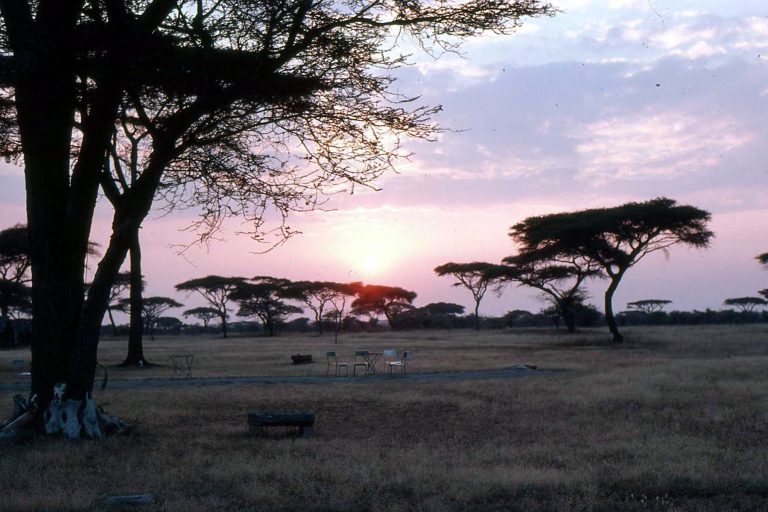
The landscape is open, treeless grassland broken by acacia stands, marshes and the soda lake at Masek. Ngorongoro District Council attributes the plains’ fertility to nutrient-rich volcanic soil originating in historic eruptions in the nearby Ngorongoro highlands, and the NCAA makes the same point about the short-grass plains generally: the ash that fell on them is why they carry very nutritious pasture and draw large concentrations of migratory animals. The grass is short, mineral-rich and poor grazing for most of the year — which is precisely why it matters for the few weeks when it is not.
The calving season
Ndutu is the wildebeest calving ground. The NCAA’s published season runs from the end of December, when the herds begin arriving from the north, through to April, when they start moving north again. Ngorongoro District Council gives a sharper version: more than 1.5 million wildebeest congregate here from December to March, the calving peaks in mid-February, and at the peak it estimates more than eight thousand calves are born daily.
Those numbers should be read as scale rather than as measurement. TANAPA frames the same event differently again — over 500,000 calves within a two to three week period in the southern Serengeti and the conservation area — and the two accounts are not reconcilable arithmetic. What both agree on is that the births are compressed into a very short window, which is the whole reason the spectacle exists.
What the calving does to the plains is difficult to overstate and easy to oversell, so two things are worth separating. The calving is tightly synchronised, which means the density of newborn animals over a short period is extraordinary. It is also weather-dependent: the herds come when the rain has greened the southern plains, and in a year when that rain is late they are somewhere else. The window is a probability, not a booking. The great migration safari guide sets out why, and what the rainfall regimes underneath it actually do.
The practical consequence of calving is predators. Lion, cheetah, spotted hyena and jackal concentrate where the herds are, and the ground is open enough that nothing is hidden. The NCAA monitors the Ndutu and Masek area as one of its two lion strongholds. For anyone weighing the calving season against the river crossings further north, the trade is reliable daily predator activity in the south against a single dramatic set piece in the north that may or may not happen while you are watching.
What is here when the herds are not
Ndutu is not empty in the other eight months. The NCAA lists giraffe, impala, elephant, dik-dik, lion, cheetah, leopard, hyena, bat-eared fox, genet, jackal and wildcat as year-round residents. Bat-eared fox in particular are a Ndutu speciality, and the acacia stands around the lakes hold a different bird list from the open plains beyond them.
The area also carries a piece of the human record. UNESCO’s cultural citation for the conservation area names an early form of Homo sapiens found at Lake Ndutu among the finds that support the property’s inscription.
Why the boundary matters
Two authorities meet here, and the distinction is not academic.
On the Serengeti side, the ground is a national park under Tanzania National Parks, with park gates, park rules and park permits. On the Ngorongoro side it is a multiple land use conservation area under the NCAA, with its own gates, its own rules and its own permits.
The question everyone asks is about off-road driving, and the honest answer runs against the received wisdom. Neither authority publishes an off-road exemption for Ndutu. TANAPA’s own park rules state that driving off the road is strictly prohibited and instruct drivers to follow directional signs. The NCAA publishes a single unqualified rule for the whole conservation area: off-road driving is not permitted within the NCA unless authorised by the Conservation Commissioner, and visitors are told to keep to designated roads and tracks. Its tourism copy tells photographers to bring a telephoto lens for exactly that reason.
The idea that Ndutu is a place where vehicles may leave the track because it is not the national park is therefore operator practice rather than published policy. It may reflect authorisations granted case by case — the NCAA’s rule explicitly allows for them — but the exemption itself is not something either authority publishes. Anyone choosing a camp or an itinerary on that basis should ask the operator what authorisation applies rather than assume the rule is different here.
What the boundary does change, unambiguously, is administration. A trip that crosses between the two needs the permissions for both, and camps in the area are licensed by one authority or the other. It is worth knowing which side a given camp sits on before building a plan around it.
It also decides what you pay. The Ngorongoro Conservation Area Authority publishes an entry permit of US$70.80 per non-East African adult, valid for one entry within twenty-four hours; the Serengeti side is TANAPA ground, charged at US$70 per adult per day in peak season under the 2023/24 booklet. An itinerary crossing the boundary pays both authorities, and re-entry is a fee event rather than a free transit. The guide to how Tanzania’s two conservation authorities charge sets out each tariff and the VAT question hanging over them.
What you do at Ndutu
The NCAA lists game drives, photography and bird watching as the area’s activities. Ndutu is one of the best photographic safari locations in Tanzania during the calving period, for reasons that have more to do with the terrain than the animals: low horizons, open ground, no vegetation between the lens and the subject, and dramatic wet-season light. Game drives here are driven across a plain rather than along a river, which changes the rhythm of the day.
Balloon flights within the conservation area operate mostly over the Ndutu plains and the Olduvai area — see balloon safaris. Bird watching works well around the lakes and the marsh. Walking is not among the activities the NCAA lists for Ndutu, though the area does appear in its site-wide list of walking destinations; any walk in the conservation area must be accompanied by an armed ranger and booked in advance.
Getting there and staying
Ndutu is reached by road from the Ngorongoro Conservation Area — the NCAA’s own recorded wildlife routes run from the crater via Malanja, and via Misigyo and Endulen — or from the Serengeti through the Ndutu entry point. There is an airstrip in the area, which is how most people arrive for a short calving-season stay, since the drive from the crater rim is long.
Accommodation in the NCAA’s own listing for the Ndutu area is thin — a lodge and a small number of tented lodges — and the area’s real capacity comes from seasonal mobile camps that move in for the calving months and out again afterwards. That is the argument for a mobile camp here rather than a permanent one: in a season defined by where the grass grew, a camp that relocates is more often on the right ground. See camping safaris.
Two nights is the usual sell and three is better, for the same reason it is better anywhere: transfer days eat the hours when animals are active, and calving season rewards being out early on consecutive mornings. The wider arithmetic is in the guide to how long to spend in Tanzania.
Ndutu’s season is narrower than most of the country’s: the calving window runs from about late December into April, which is the wet half of the year and the opposite of the dry-season default set out in the guide to when Tanzania is at its best.
Common questions about Ndutu
Is Ndutu in the Serengeti or in Ngorongoro?
Both. The short-grass plains straddle the boundary between Serengeti National Park and the Ngorongoro Conservation Area, and the two are administered separately. The NCAA describes the Ndutu plains as lying within the conservation area, on the outskirts of the southern Serengeti plains.
When is the calving season?
The NCAA gives it as the end of December through to April, with the herds arriving from the north and leaving again when they move on. Within that window the concentration of births is short and synchronised, and its timing shifts between years with the rain.
Can you drive off-road at Ndutu?
Not as a published rule. The NCAA prohibits off-road driving throughout the conservation area unless the Conservation Commissioner authorises it, and TANAPA’s park rules prohibit it in the national park. Any looser practice is an operator matter and worth asking about directly.
Is Ndutu worth visiting outside the calving season?
It holds resident lion, cheetah, leopard, giraffe, elephant, bat-eared fox and a good bird list year-round, so it is not empty. But the reason it is sold as a separate destination is the calving, and outside that window most itineraries route through the central Serengeti instead.
Why is Ndutu sold separately from the Serengeti?
Because it is a two-night product with its own season, its own camps and, for part of it, its own authority. Treating it as a corner of the Serengeti leads to itineraries that arrive from the wrong direction at the wrong time of year.