
Beach Holidays on the Tanzanian Coast and Islands
How the Tanzanian coast actually works: which side of Zanzibar for what, how far the tide withdraws on the east, where the reef sits, and the mainland and lake shores beyond the archipelago.
Reef, lagoon, beach. Almost every beach in Tanzania works to that arrangement, and a tide that runs from about a metre at neaps to over three at springs decides what you can do on it. This guide covers how the coast actually functions, which side suits which kind of holiday, where swimming is possible, what low water reveals, and how lake swimming differs from the sea.
Safaris That Include Beach Holidays

8 Days Tanzania Safari and Zanzibar Holiday | Bush & Beach
by Kori Safaris Verified operator


15 Day Tanzanian Honeymoon Safari
by Insight Safari Holidays Verified operator

Savannah & Spice: Kenya, Tanzania & Zanzibar
by Ancient Africa Safaris Verified operator
From $9,990 per person
View Safari
5 Days Zanzibar Beach Holiday
by Kori Safaris Verified operator
4 Days Zanzibar Island Safari | Stone Town, Beach & Spice Tour
by Kori Safaris Verified operator

Serengeti & Zanzibar Honeymoon
by Ancient Africa Safaris Verified operator
From $8,400 per person
View SafariSee all 13 safaris that include beach holidays
Beach Holidays Guide in Tanzania
What a Tanzanian beach holiday actually is
Tanzania's coast is not a single strip of sand with hotels on it. It is an archipelago and a mainland shore with genuinely different characters, and the reason so many beach holidays here go slightly wrong is that people choose a photograph rather than a coastline.
Almost all of it works the same way underneath. A fringing coral reef sits offshore. Between the reef and the beach lies a shallow lagoon or reef flat. Twice a day a large tide fills and empties that flat. Whether you can swim, whether you can snorkel from the beach, whether a boat can leave and what the beach even looks like at two in the afternoon all follow from that one arrangement.
This part of the country sits beside Tanzania's safari regions rather than inside them. A week on the coast is its own holiday with its own rhythm, and the common pattern of following a safari with a beach week works because the two are so unalike, not because they are the same trip.
How this coast is built, and why it matters
Reef, lagoon, beach. That sequence is the key to the whole coast.
The reef is why the water is calm, why there is sand at all and why there is anything to snorkel over. The lagoon between reef and shore is shallow, often floored with seagrass rather than clean sand, and on many beaches it is the entire swimmable area. The beach itself is frequently spectacular and frequently not the point.
Where the reef sits close in and the water is deeper against the shore, as it is around the northern tip of Unguja, you get a beach you can swim off at any state of the tide. Where the reef sits far out and the flat is wide, as on most of the east coast, you get a lagoon that empties. Neither is better. They are different holidays, and the mistake is booking one while imagining the other.
The tide, in practical terms
Zanzibar's tides are semidiurnal, which means two high waters and two lows every day, roughly six hours apart, shifting later each day. The range is large. Around the neap tides it is close to a metre. Around the spring tides, at full and new moon, it exceeds three metres. A tidal exchange study of Chwaka Bay on the east side records an average depth of a little over three metres at spring high water across a bay covering about fifty square kilometres when full, which gives a sense of the volume involved.
Four things follow that nobody mentions in a brochure.
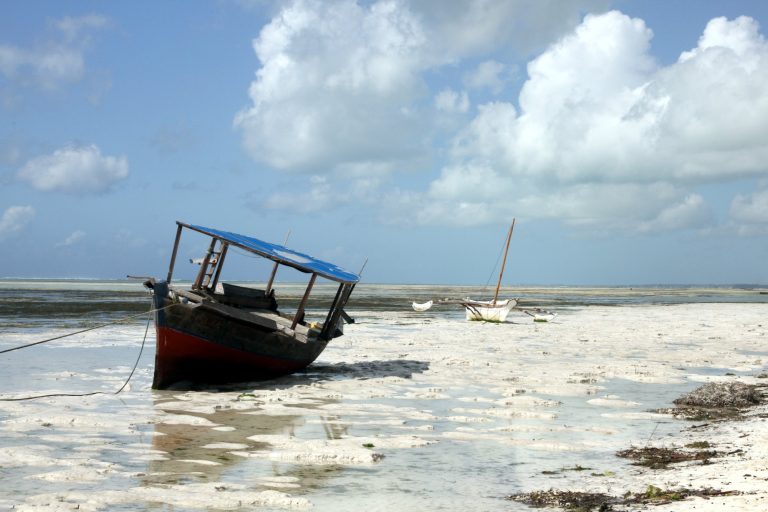
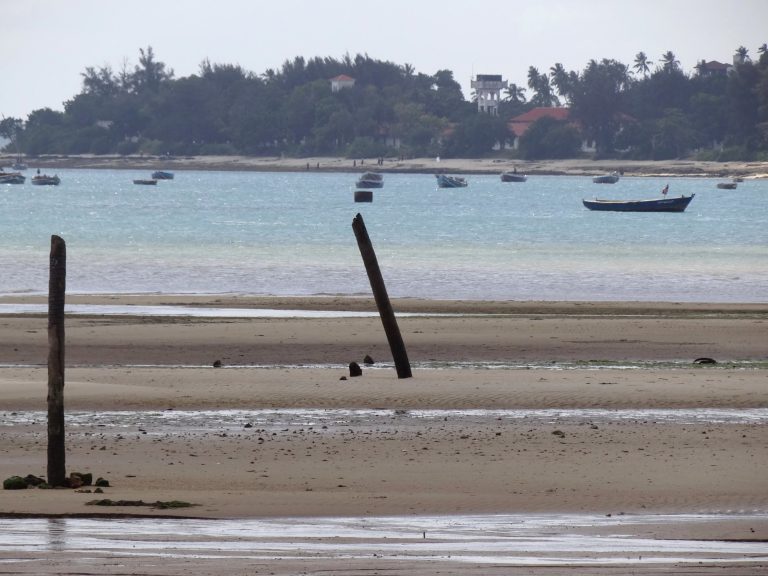
First, swimming on a wide-flat beach is a high-water activity. At low water the sea is a long way out across exposed sand, rock and seagrass, and what is left behind is ankle deep.
Second, boats on those beaches leave on the tide, not on the hour. A snorkelling trip, a dhow sail or a fishing morning may genuinely need to depart at dawn or at midday depending on the date, and an itinerary that ignores this will be rearranged for you.
Third, the pattern shifts. High water is roughly fifty minutes later each day, so the beach that was perfect at eleven in the morning on Monday is perfect at two in the afternoon by the end of the week. Over a fortnight you will see both spring and neap behaviour.
Fourth, none of this is a defect to be worked around. Low water is when the reef flat becomes walkable, when the seaweed farmers go out, and when a great deal of what is interesting about this coast becomes visible. Look at a tide table for your dates before choosing a beach; it is the single most useful ten minutes of planning available.
Which coast for which kind of holiday
Rather than describing beaches, which belongs to the destination guides, here is how the coastlines differ.
Northern Unguja. Deeper water close inshore and the smallest effective tidal problem on the island, which is why it is sold as the swimming end. Busier, more developed, more nightlife, more boat traffic. See Nungwi and Kendwa.
Eastern Unguja. Wide reef flats, enormous tidal movement, steady side-onshore wind, seaweed farming and the best kitesurfing in the country. Quieter, more village life, and a lagoon rather than a swimming pool. See Paje, Jambiani, Bwejuu, Matemwe, Pongwe and Michamvi.
Western and southern Unguja. Sheltered water facing the channel, sunsets over the sea, close to Stone Town and the islands off it. See Fumba and Kizimkazi.
Pemba. Hilly, green, far less developed, few beaches in the postcard sense and superb water. A beach holiday here is a quiet one by definition.
Mafia. A marine park, a sheltered bay, seasonal whale sharks and very little in the way of beach resort infrastructure. People come for the water rather than the sand.
The mainland coast. Long, largely undeveloped and historically far more interesting than the islands give it credit for. Bagamoyo, Pangani, Kilwa Masoko and Mikindani all combine a shoreline with serious history, and Saadani is the one national park on this coast where the beach and the game are the same place.
Swimming
Swimming in Tanzania is warm, calm and easy, with three caveats that are worth knowing in advance.
The first is the tide, covered above. On a wide-flat beach, plan swims around high water.
The second is what is on the bottom. Seagrass flats are alive, which is the good news, and they hold sea urchins, which is the bad. Black long-spined urchins sit in rock and rubble and are effectively invisible against dark seagrass. Reef shoes or any closed footwear solve the problem entirely, and stepping rather than shuffling is what causes it. Stonefish and scorpionfish exist on this coast, in small numbers and very well camouflaged, and the same footwear covers them.
The third is current. The open sea beyond the reef is a different proposition from the lagoon, and the channel gaps where the lagoon drains can run hard on a falling tide, particularly at springs. The general rule is to stay inside the reef line, not to swim out through a gap because it looks like an easy way to the reef edge, and to treat an outgoing spring tide with more respect than the flat water suggests.
Lifeguards are not a feature of this coast. Very few hotel beaches have one and no public beach does.
Beach walking at low water
When the flat drains, a different landscape appears, and walking it is one of the more rewarding hours available here.
What turns up in the pools and on the exposed sand: starfish in numbers, brittle stars, sea cucumbers, hermit crabs, small octopus, cowries and cone shells, urchins in the rock, and juvenile fish stranded in pools waiting for the water to come back. On the east coast you will also walk past the seaweed plots, rows of staked lines tended almost entirely by women, which are a working farm and a significant part of the local economy rather than scenery.
Three things to get right. Wear something on your feet, because urchins, fire coral and sharp rubble are all out there. Walk around the seaweed plots, not across them. Put back anything you pick up, the same way up, and do not collect shells, which on a protected coast is often illegal as well as unhelpful.
The other thing about low-water walking is that the tide comes back faster than people expect across a flat surface, and it comes back around you rather than towards you. Know when the turn is before you set off, and do not put a wide expanse of water between yourself and the beach.
Lake swimming, which is a different proposition entirely
Tanzania has three of the African Great Lakes and some genuinely beautiful freshwater beaches, and swimming in them needs to be thought about differently from swimming in the sea.
Lake Nyasa in the far south, with Matema as its best-known shore, has clear water, a mountain backdrop and sand beaches, and is the lake most often swum by visitors. Lake Tanganyika has extraordinary clarity and rocky shorelines, particularly along the Mahale coast. Lake Victoria is the largest and the most heavily used by people.
Two hazards decide whether and where you swim, and the first one is routinely understated in travel writing.
Schistosomiasis, and the advice that is actually current
Schistosomiasis, also called bilharzia, is a parasitic infection caught when larvae released by freshwater snails penetrate skin on contact with water. It needs no swallowing and no swimming; wading, paddling or washing is enough. It is not acquired in sea water.
The position taken by the United States Centers for Disease Control is narrower than most travel copy admits. CDC names only two categories of water as safe in a country where schistosomiasis is transmitted: the sea, and chlorinated swimming pools. Everything else fresh and unchlorinated should be treated as carrying risk, and CDC's own description of how transmission happens explicitly includes streams and rivers rather than only still water.
That last point matters because of a belief that circulates widely and has no support from either CDC or the World Health Organization: that fast-flowing water is safe. Neither body says it. It is worth discarding.
Tanzania's three great lakes have all produced documented infections in visitors. Lake Nyasa, which is Lake Malawi, is the cautionary case in the literature: a CDC investigation published in The Lancet in 1996 examined a lake widely believed at the time to be free of schistosomiasis and found transmission, and a further study in Emerging Infectious Diseases in 2019 reconfirmed it and called for international travel advice to be revised. On Lake Tanganyika, a 2013 report in the Journal of Travel Medicine described eight of sixteen fieldworkers infected at Kigoma, two of them with no symptoms at all. On Lake Victoria, a 2011 report in the same journal described sixty-six of seventy-seven visitors infected after a retreat near Mwanza.
Two practical notes. Drying yourself vigorously with a towel is sometimes offered as a preventive measure; CDC advises drying well but says explicitly not to rely on it. And infection frequently produces no obvious early symptoms, which is why travellers who have been in fresh water commonly arrange a test some weeks after returning. The World Health Organization notes that infections in travellers are rising with eco-tourism and are sometimes severe, and identifies praziquantel as the recommended treatment.
Neither CDC nor WHO ranks Tanzania's lakes against each other for risk, and this guide will not either. What either body can tell you, and what a travel health professional can advise on for your own itinerary, is worth considerably more than a lodge's reassurance about its own beach.
Crocodiles and hippos
Crocodiles and hippos are present in parts of all three lakes, overwhelmingly in vegetated shallows, river mouths and bays rather than on open rocky shorelines. Local knowledge about a specific stretch of water is genuinely decisive here, in a way it is not for schistosomiasis, so ask and take the answer seriously, including when it is inconvenient.
None of this means the lakes are off limits, and Lake Tanganyika in particular holds some of the clearest fresh water in the world. It means that lake swimming is a decision with a known health consequence attached, and that the decision belongs to you and a travel health professional rather than to a brochure.
Seasons and weather
Two monsoons set the year. The kaskazi, the north-easterly, blows roughly December to March and is the lighter wind, with hot, humid, generally settled weather. The kusi, the south-easterly, blows roughly June to September, stronger and cooler, and is the windier half of the year.
Rainfall does not follow one pattern along this coast, and that catches people out. The northern coast and the islands, which includes Tanga, Dar es Salaam, Unguja, Pemba and Mafia, have two rainy seasons: the long rains, the masika, which the Tanzania Meteorological Authority puts at March to May, and the short rains, the vuli, which it puts at October to December. A good number of coastal lodges and water-sports operations close for part of the long rains.
The far south, Lindi and Mtwara, is on a different calendar entirely. It has a single rainy season running from around November through to April or May, with the second half of it the wetter. A trip to the southern coast planned off a Zanzibar rainfall pattern will be planned against the wrong year. Which destinations sit on which of the country's two rainfall calendars maps the boundary, and it runs through the middle of a good many itineraries.
For a straightforward beach week with calm water, the months either side of the long rains are the reliable ones. For wind sports the calculation is the opposite, and it is covered in the kitesurfing guide. Sea temperature is comfortable all year and is not a factor in choosing when to come.
Dress, Ramadan and behaviour outside the hotel
Zanzibar is overwhelmingly Muslim and so is much of the Tanzanian coast. Beachwear is unremarkable on a hotel beach and conspicuous everywhere else, and the distinction is well understood locally and worth observing.
In villages, in Stone Town, in markets, on public transport and walking between hotels, covering shoulders and knees is the norm and is appreciated rather than demanded. A kanga or kikoy bought locally solves this in one item. Topless sunbathing is not acceptable anywhere, including on hotel beaches.
During Ramadan the coast changes noticeably. Many local restaurants close during daylight, hours shift, and eating, drinking or smoking in public in daytime is inconsiderate in a way it is not at other times. Hotels continue to serve guests normally. The dates move each year, so check them against your travel dates.
On the beach you will meet people selling excursions, carvings and fruit. A firm, friendly no is understood and respected. For anything involving money or a boat, deal through your accommodation or a licensed operator rather than on the sand, which is a point about recourse rather than about anybody's honesty.
Putting a beach week next to a safari
The logic that makes this combination work is contrast: dust, early starts and long drives, then nothing to do. It is also easy to get wrong logistically.
Flights to Zanzibar connect from Arusha, Kilimanjaro and Dar es Salaam, and Mafia and Pemba from Dar, so the coast usually sits at the end of a trip rather than the middle. If diving is on the plan, the surface interval before a long-haul flight home matters and is covered in the diving guide. If you are combining the coast with the northern circuit, remember the two halves have different packing, different weather and different dress expectations. Zanzibar is also its own immigration administration, with an entry check and a compulsory inbound insurance policy that applies even to travellers arriving on a domestic flight from the mainland: what Zanzibar requires on top of the Tanzanian visa.
The coast also has its own wildlife and its own history, which is a better reason to come than sand alone. Turtles, dolphins, whales, mangroves and the ruined Swahili port cities are all part of the same week if you want them to be.
Common questions about beach holidays in Tanzania
Which is the best beach in Zanzibar?
There is no single answer and anyone offering one is describing a preference. The north swims at any tide and is busier, the east has enormous tides, steady wind and village life, the west faces the channel and the sunset. Choose by what you want to do, then read the destination guide for that beach.
Why does the sea go out so far?
Zanzibar has a semidiurnal tide with a range from around a metre at neaps to over three metres at springs. On the east coast a wide reef flat separates the beach from the reef, and at low water that flat drains. It is normal and it comes back roughly six hours later.
Can I swim at any time of day?
On the north coast, generally yes. On the east coast, swimming is a high-water activity. High water moves about fifty minutes later each day, so the good swimming hour shifts across your stay.
Do I need shoes in the water?
On seagrass and reef flats, yes. Long-spined sea urchins sit in rock and rubble and are nearly invisible, and closed footwear removes the problem entirely.
When is the rainy season on the coast?
It depends which coast. The northern coast and the islands have two: the long rains, or masika, from around March to May, when many coastal lodges and water-sports operations close, and the short rains, or vuli, from around October to December. The far south, Lindi and Mtwara, has a single rainy season instead, running from about November through to April or May.
What should I wear away from the beach?
Shoulders and knees covered in villages, towns, markets and on public transport. Beachwear belongs on the hotel beach and nowhere else, and topless sunbathing is not acceptable anywhere.
Is it safe to swim in the lakes?
Treat all fresh, unchlorinated water as carrying a schistosomiasis risk. The CDC names only the sea and chlorinated swimming pools as safe categories in countries where the parasite is transmitted, and its description of transmission includes streams and rivers as well as lakes. All three of Tanzania's great lakes have produced documented infections in visitors, including Lake Nyasa, which was long assumed to be free of it. The belief that fast-flowing water is safe has no backing from CDC or WHO. Crocodiles and hippos are a separate hazard, concentrated in vegetated shallows and bays, and there local knowledge does decide the answer. Talk to a travel health professional about testing after any freshwater contact.
Is it worth visiting the coast during Ramadan?
Yes, and many people find it the most interesting time to be there. Expect local restaurants to close in daylight hours and shift your own eating and drinking out of public view during the day. Hotels serve guests as usual.