
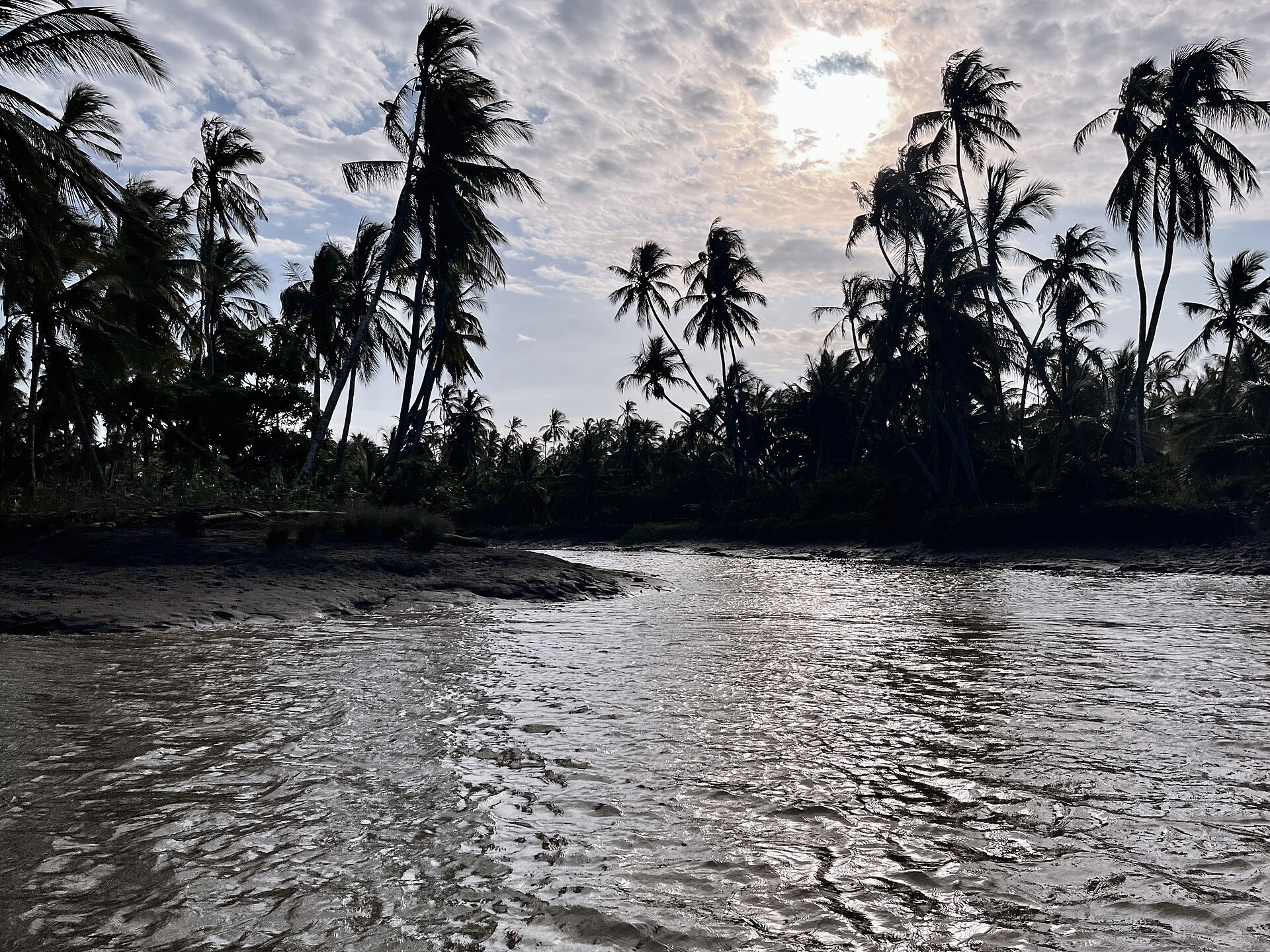
A river mouth, an old town and a very quiet coast
Pangani is a small town at the point where the Pangani River — one of the larger rivers of northern Tanzania, draining the flanks of Kilimanjaro and Meru — finally reaches the Indian Ocean. It is 47 kilometres south of Tanga city, on a coast with almost nothing built on it, and it was once a significant Swahili and then German trading port. The old town still carries that: carved doors, coral-rag walls, a German-era administrative building, a customs post, a few mosques and a waterfront that has been a crossing point for as long as anyone has records for.
The whole district holds fewer than eighty thousand people across 1,830 square kilometres, at a density of roughly thirty people to the square kilometre, and effectively all of it lies between sea level and a hundred metres. That emptiness is the appeal. Pangani is where you go on this coast if you want long, unpeopled beaches within a half day of an international airport, and are content with modest infrastructure in exchange.
What there is to do
The beaches run north and south of the river mouth and are the main reason people come — wide, palm-backed, and empty by the standards of anywhere else on the Tanzanian coast. The guide to beach holidays sets out how the different stretches of coast compare and what tidal range means for swimming.
The river is the other half. Boat trips run upstream from the town into a channel lined with mangrove, coconut and riverine forest, with birds, crocodiles and hippos in the lower reaches. See boat safaris and mangrove tours. The river mouth also puts a freshwater and an estuarine fauna within a few hundred metres of a reef, which is an unusual combination and good for bird watching.
The town is walkable in an hour and rewards a guide, in the same way Bagamoyo does. Interpretation on the ground is thin at present — as of September 2026 the National Museum of Tanzania, the Antiquities Division and the district administration were still in the process of identifying and documenting the district’s heritage sites with a view to developing and promoting them. That is worth knowing in advance: Pangani’s history is real and largely unlabelled. See historical walking tours and Swahili cultural tours.
The water. Reefs lie offshore and snorkelling and diving trips run from the beach hotels — see snorkelling and scuba diving. Maziwe, a low sand island that surfaces on the falling tide a few kilometres out, is the standard half-day boat excursion and is covered under sandbank and island hopping. It should be said that Maziwe is a diminished place ecologically: the Tanga Coelacanth Marine Park’s management plan records that it no longer supports nesting populations of marine turtles, and cites it as an example of habitat loss. Pangani District as a whole, south of that park’s boundary, is still regarded as an important feeding and nesting area for turtles — see sea turtle watching.
Fishing villages and farms line the coast road in both directions, and village tours here are genuinely low-key rather than packaged.
Where Pangani sits
Pangani District runs from the Indian Ocean west to Handeni, north to Muheza and south to Bagamoyo District in Pwani Region. That southern boundary matters: the district’s Mkwaja division takes in the northern sector of Saadani National Park, and the road south from Tanga through Pangani and Mkwaja is the standard approach to Saadani’s Madete gate — about 146 kilometres from Tanga according to the park’s own brochure.
Northward, Pangani’s coast forms the southern end of the Tanga Coelacanth Marine Park, which begins just north of the Pangani River estuary and runs a hundred kilometres up to the edge of Tanga city.
Pangani is a road destination, reached from Tanga or up the coast from Saadani, and the guide to road journeys in Tanzania covers how the northern coast connects to the circuits inland. Inland, the Usambara Mountains rise within a couple of hours — the same region, a completely different climate — which makes a beach-and-mountains week here unusually easy to put together.
When to go
Pangani is in the northern coastal zone, which the Tanzania Meteorological Authority classifies as bimodal. Vuli runs from October to December and Masika from March to May. The district council’s own figures fit that closely and add a third, minor rainfall period: Vuli around 500–800 millimetres, Masika 1,000–1,400 millimetres, and a light rain the district calls mchoo in July and August delivering roughly 100 millimetres. Annual rainfall across the district is between 1,000 and 1,500 millimetres.
The practical reading: June to early October and January to February are the reliable stretches, with July and August carrying occasional light rain that will not spoil a beach day. The country’s seasonal guide sets the coastal pattern against the safari circuits’ one. March to May is the season to avoid if the sea and the river are the point of the trip.
Expectations
Pangani is not a resort destination. Accommodation is limited and mostly small, the town has few services aimed at visitors, and heritage interpretation is still being put in place. Travellers who want an organised beach week with a choice of restaurants are better served on Zanzibar. Travellers who want an empty coast, a river, an unrestored old town and the option of driving into a national park or up into the mountains in the same week will find very little on the Tanzanian mainland that matches it.
Common questions
How far is Pangani from Tanga?
The district headquarters lies 47 kilometres from the regional headquarters at Tanga, on the coast road south. Tanga is roughly 350 kilometres north of Dar es Salaam and 250 kilometres south of Mombasa.
Can you get to Saadani from here?
Yes — south through Mkwaja, which is in Pangani District, to Saadani’s Madete gate. TANAPA gives the distance from Tanga via Pangani and Mkwaja as about 146 kilometres. A high-clearance vehicle is sensible and necessary in the rains.
Is Maziwe worth the boat trip?
As a sandbank day out, yes — it is a classic tidal-island excursion with snorkelling over the surrounding reef. As a wildlife site it is a shadow of what it was; the Tanga Coelacanth Marine Park management plan records that turtles no longer nest there and cites it as a case of nesting-habitat loss.
Are there crocodiles and hippos in the Pangani River?
Both occur in the river. Boat operators know the reaches to work and the ones to avoid. Do not swim in the river or near its mouth.