
Swahili Culture and Stone Town Tours
The coast’s own civilisation on its own terms: the language, the trade networks, the carved doors and coral-rag architecture, the music and the daily rhythm of the old towns.
Swahili culture is the urban, trading, Indian Ocean culture of the East African coast, and Stone Town is its best preserved example. This guide covers what a cultural walk actually shows you, what UNESCO protects and why it is not the carved doors, which buildings are open and which are closed, and how to dress and behave.
Safaris That Include Swahili Cultural Tours
 Photograph by Christoph Strässler from Oberdorf BL, Schweiz, licensed under CC BY-SA 2.0

15 Day Tanzanian Honeymoon Safari
by Insight Safari Holidays
 Photograph by Marco Zanferrari from Doha, Qatar, licensed under CC BY-SA 2.0

8 Days Tanzania Safari and Zanzibar Holiday | Bush & Beach
by Kori Safaris
 Photograph by Chen Hualin, licensed under CC BY-SA 3.0

Savannah & Spice: Kenya, Tanzania & Zanzibar
by Ancient Africa Safaris
From $9,990 per person
View Safari Photograph by Jang Woo Lee, licensed under CC BY 3.0
Serengeti & Zanzibar Honeymoon
by Ancient Africa Safaris
From $8,400 per person
View Safari Photograph by Adam Jones from Kelowna, BC, Canada, licensed under CC BY-SA 2.0
4 Days Zanzibar Island Safari | Stone Town, Beach & Spice Tour
by Kori Safaris
Swahili Cultural Tours Guide in Tanzania
What Swahili culture actually is
Swahili culture belongs to the coast: a strip of eastern Africa running through Tanzania, Kenya and Mozambique, with Zanzibar, the Comoros and the other offshore islands, reaching inland in places as far as Malawi and eastern Congo. It is urban, mercantile, literate and Muslim, and it was built by trade across the Indian Ocean. Something like a hundred and seventy-three settlements flourished along this coast and its islands between the ninth and seventeenth centuries, among them Kilwa, Zanzibar, Gedi, Pate and Malindi.
A Swahili cultural tour, in practice, means walking a stone town with someone who can explain what you are looking at: the layout of the blocks, the way the houses turn inward, the carved doors, the baraza benches built into the walls where men sit in the evening, the mosques, the market, the food, the music. Stone Town in Zanzibar is where most people encounter it, and it is the best preserved example, but it is not the only one.
Kiswahili itself is the thread. It is a Bantu language, of the Sabaki branch, which absorbed vocabulary from Arabic, Persian, Gujarati, Portuguese, German and English across a thousand years of trade, and it is now the language of a hundred million or more people across East Africa. Learning ten words of it will change how a week on this coast goes.
Where the Swahili came from, and why the answer is contested
This sounds academic and it is not, because you will be told a version of it on any guided walk, and the versions differ enormously.
The colonial-era reading treated Swahili-speaking people as essentially an Arab diaspora, a foreign civilisation established on an African shore. The postcolonial reaction argued the opposite, that medieval Swahili culture was entirely African in origin, pointing out that the stone towns' architecture was distinct from anything foreign and that the language is plainly Bantu.
A study of ancient DNA from medieval Swahili coast burials, published in 2023, found mixed African and Asian ancestry, including Persian and Indian, going back around a thousand years. It settles the century-old argument in favour of neither pole.
The formulation worth carrying, and the one the current literature supports, is that Swahili culture is African in its language and its roots and cosmopolitan in its making. What is worth resisting is the phrase "Arab-African fusion", which sounds even-handed but quietly casts African as the raw material and Arab as the civilisation. Scholars working on this coast have specifically warned that its heritage narratives tend to reproduce a colonial template of Arab slave owner, African slave and European emancipator, and that the reality was considerably more tangled.
One more thing you will hear. Guides commonly describe Persian princes arriving from Shiraz to found the coastal dynasties. The Shirazi story is a documented origin tradition, recorded in a fifteenth-century chronicle from Kilwa, rather than a documented migration. It is genuinely interesting as a tradition. It is not history in the way it is usually presented.
Stone Town, and what UNESCO actually protects
Stone Town was inscribed on the World Heritage List in 2000 under three criteria: as an outstanding material manifestation of cultural fusion, as an exceptional illustration of centuries of seaborne trade between Asia and Africa, and for its symbolic importance in the suppression of slavery, both as a major slave-trading port and as the base from which opponents of the trade ran their campaign.
What UNESCO says the value actually resides in is worth knowing, because it is not what tours emphasise. The listing locates it in the character of the assemblage of blocks and buildings, the layout of the town, the relationship of buildings to open spaces, streets and gardens, the character of the littoral edge seen from the sea, and the nature of access to the sea from the land.
In other words, the town is the monument. The carved doors are a detail of it. This is a useful thing to hold in mind on a walk, because the most rewarding hour in Stone Town is usually the one spent getting lost in the alleys rather than the one spent photographing doors.
Two things follow that almost no tour page mentions. The protected property covers ninety-six hectares, with a buffer zone of a further eighty-five, and that buffer zone includes the historic part of Ng'ambo, the other side, along with part of the modernist Michenzani blocks. Ng'ambo is where most Zanzibaris actually live and it is part of the World Heritage setting; a walk that never crosses into it has seen half the town. And UNESCO has named the Malindi port development, including the loss of two historic warehouses and new port facilities of inappropriate scale built without prior approval, as a precedent threatening the property's integrity.
Coral rag, and the state of the buildings
Almost everything in Stone Town is built of coral rag: a local limestone quarried from ancient reef, laid with mortar. It is why the town looks as it does, and it is also why it is falling down.
Coral rag deteriorates quickly under salt air, humidity and heavy rain, and peer-reviewed work on Zanzibar's stone masonry describes rapid deterioration under severe environmental impact. Poor modern repairs make it worse: cement renders trap moisture against stone that needs to breathe, and a badly repaired building can fail faster than a neglected one.
The Stone Town Conservation and Development Authority is the responsible body. Its director of control and monitoring stated in April 2026 that around twenty buildings had undergone major renovation, some government funded and others through public-private partnerships, and that specialist materials for the highest grade heritage buildings are not available locally and must be imported, with cast iron for the House of Wonders sourced abroad on shipping timelines of six or seven months. Even traditional materials such as mangrove poles can be hard to procure consistently.
The same official made a point worth carrying into any walk: most properties in Stone Town are privately owned, and the government's role is primarily to regulate and monitor while ownership and stewardship remain with residents. These are homes. The scaffolding you walk under belongs to somebody.
Those figures and assessments are the authority's own statements, reported by a state news agency, rather than independently audited findings.
The House of Wonders
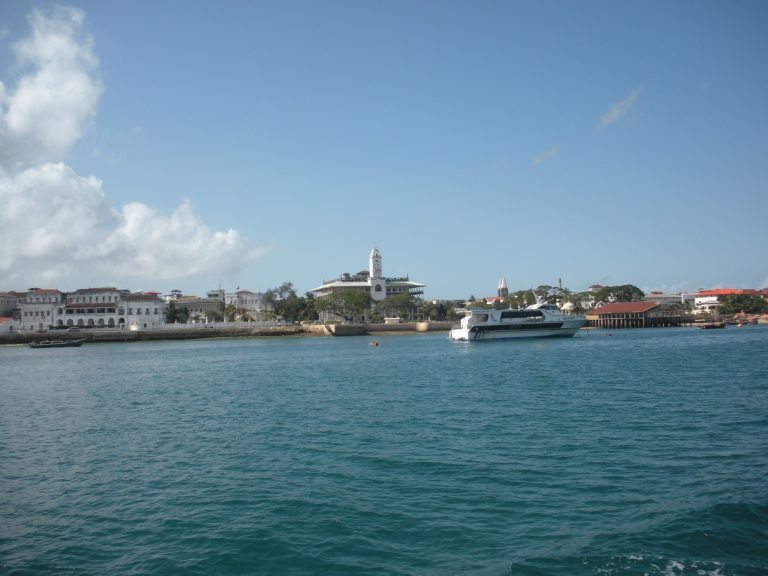
Beit al-Ajaib, the House of Wonders, is the building on every photograph of the Stone Town seafront, and it is closed. Anyone planning a visit around it should know that before arriving.
It was built in 1883 by Sultan Barghash as part of a wholesale redevelopment of the waterfront: a ceremonial palace with wide verandas carried on cast-iron columns forged in England, and ceilings deliberately higher than anything in the enclosed Swahili and Omani facades around it. The clock tower was added in 1897, after the British bombardment of the seafront the previous year destroyed the lighthouse that had stood on the shore. Its chandeliers were lit by the first electric generator in sub-Saharan Africa, and it held East Africa's first elevator, which is how it got its name: Zanzibaris called it a marvel of modernity.
Its later history is the island's history in one building. Ceremonial palace through the 1880s, Secretariat of the British colonial government from 1913 into the 1960s, then after the 1964 revolution an Afro-Shirazi Party ideological training college and party museum with an exhibition created by North Koreans in the Great Leader tradition, and finally the National Museum of Zanzibar in the early 2000s.
Part of it collapsed on 2 December 2012, leaving the structure weakened. On 25 December 2020 a major collapse brought down the clocktower and killed two people who were inside. Restoration is under way and the conservation authority stated in April 2026 that it was about sixty per cent complete. There is no publicly confirmed reopening date.
What is open, what is not, and what could not be confirmed
Stone Town's sites are in an unusually fluid state, and several widely listed ones could not be confirmed as currently open.
- The Old Fort, Ngome Kongwe, is the oldest building in the town, built by the Portuguese in the seventeenth century and rebuilt by the Omanis in the eighteenth. It served as garrison and prison, was the terminal of the Zanzibar railway between 1905 and 1928, gained a guardhouse in 1947 and an amphitheatre in the 1990s, and is the headquarters of the Zanzibar film festival. It was under renovation through 2026.
- The Hamamni Persian Baths were built between 1870 and 1888 for Sultan Barghash and worked as public baths until 1920, with hot and cold rooms, shaving areas and a restaurant, fed by underground aqueducts. They are called Persian because the work was commissioned to Shirazi architects. They no longer function, but they are open to visitors, and you see only part of the complex because other parts are now private homes.
- The Old Dispensary on Mizingani Road, built from 1887, was leased to the Aga Khan Trust for Culture in 1990 and restored as the first major project in the rehabilitation of the seafront. It is the clearest demonstration in town of what good conservation of coral rag actually looks like.
- The Freddie Mercury Museum on Shangani Street occupies a house the museum states was his childhood home. Farrokh Bulsara was born in Zanzibar on 5 September 1946, and the museum covers his Zoroastrian family background and his schooling in India.
Could not be confirmed as operating, and therefore should be checked before you build a day around them: the Princess Salme Museum, and the palace ruins at Mtoni and Maruhubi. The Zanzibar museums authority's own website could not be reached at all during this research, so treat these as unverified rather than closed. Maruhubi and Mangapwani are covered, in their own context, under spice tours and slave trade history tours.
The rest of the Swahili coast
Stone Town is the most complete surviving Swahili town, not the only one, and the others are emptier in every sense.
Kilwa Kisiwani and Songo Mnara, off the southern coast, are the ruins of what was for centuries the most powerful city on the coast, and they are inscribed as World Heritage in their own right. Bagamoyo has the caravan-terminus fabric and a much older Swahili settlement at Kaole nearby. Pangani, Mikindani and Tanga each retain a walkable old quarter. On Pemba, the ruins at Ras Mkumbuu, Pujini and Chwaka are substantially older than most of Stone Town.
These are covered as sites under archaeological tours and as walks under historical walking tours. What they offer that Stone Town cannot is quiet. What they lack is interpretation, so a guide matters far more at Kilwa than it does in Zanzibar.
Taarab and the sound of the coast
Taarab is the music of the Swahili coast: Arabic, Indian and African elements in an orchestral form built around a sung poem in Kiswahili, where the lyric carries layers of allusion and rebuke that even fluent speakers argue about. It is performed at weddings above all, and a wedding is where you would really hear it.
For visitors there is a music academy in Stone Town teaching taarab and other Zanzibari forms, and an annual festival of music from the region which has moved its dates recently: the month it is held in has changed, so check the festival's own listing rather than a third-party page, several of which are now wrong.
Live performance for visitors is covered more fully under traditional music and dance, including the honest question of how much a hotel show has to do with the occasions this music belongs to.
Dress, Ramadan and conduct
Zanzibar is overwhelmingly Muslim and conservative, and this is the one place in Tanzania where dress is not merely a courtesy question. British government travel advice records that Zanzibari authorities can impose a fine for clothing they consider inappropriate in public.
- Cover shoulders and knees away from the beach and hotel grounds. This applies to men as well as women.
- Beachwear belongs on the beach. Walking through Stone Town or a village in swimwear causes real offence and is the specific thing the rules are aimed at.
- Ask before photographing people, and do not photograph inside mosques or at funerals.
- Public displays of affection are not well received, and same-sex relationships are criminalised in Tanzania, which is a serious practical consideration for some travellers.
- Alcohol is served in hotels and tourist restaurants and is otherwise not part of daily life.
During Ramadan, most local restaurants close during daylight and eating, drinking or smoking in the street in front of people who are fasting is discourteous. The town also comes alive after sunset in a way it does not at any other time of year, so it is a trade rather than a straightforward drawback.
Questions travellers ask
Can I visit the House of Wonders?
No. It has been closed since the partial collapse in December 2020 that killed two people, and restoration was stated to be around sixty per cent complete in April 2026, with no publicly confirmed reopening date. Pages that describe visiting the museum inside it are out of date.
Do I need a guide for Stone Town?
For the first walk, yes, both for orientation and because the layout is the thing that needs explaining. After that, getting deliberately lost is the better use of an afternoon. At Kilwa and the mainland sites a guide matters far more, because there is little interpretation in place.
Is it Arab culture or African culture?
Neither framing survives contact with the evidence. The language is Bantu and the roots are African; the making of it was cosmopolitan, and ancient DNA from medieval burials on this coast shows mixed African and Asian ancestry going back a thousand years. Guides will offer you a firmer answer in one direction or the other, and both are inherited arguments rather than findings.
What should I wear in Stone Town?
Shoulders and knees covered, for men and women, away from the beach and hotel grounds. This is not only etiquette: authorities can fine people for clothing judged inappropriate in public. Light, loose and long is also simply more comfortable in the humidity.
How long do I need?
Two days gives the town time to stop being a set of monuments. One day covers the main sites and misses the point. If you can, include an evening, because the alleys change completely after dark and the town is at its best then.
Is it safe to walk around?
Generally yes, and the alleys are pedestrian by necessity since most will not take a car. Ordinary city sense applies: petty theft and persistent touts are the common complaints rather than anything worse, and the seafront and Forodhani area at night draws the most attention.
Should I visit during Ramadan?
It is a trade. Daytime is quieter and many local places are shut, eating in public is discourteous, and some tours run differently. Evenings are extraordinary. Go in knowing which of those matters more to you.
What is the best part of Stone Town that people miss?
Ng'ambo, the other side, which is where most Zanzibaris live and which forms part of the World Heritage buffer zone including the modernist Michenzani blocks. It is not on the standard circuit, and a walk that stays inside the postcard misses how the town actually works.