A safari timed and routed around the wildebeest and zebra migration as it moves through the Serengeti ecosystem across the year. Where the herds are decides which part of the park an itinerary uses.
A great migration safari in Tanzania's Serengeti works by matching your travel month to the part of the ecosystem the herds usually occupy: the Ndutu and southern plains for calving from about December to March, the central and western Serengeti from April to June, and the Mara River in the far north for crossings from about July to October. Since the herds stay in Tanzania most of the year, the real choice is the phase and the base.
Where the Herds Are: Month by Month
Pick the month you can travel to see where the herds usually are, what is happening, and how to base a trip around it. Or pick a stage of the migration to see which months it usually falls in.
Travel month
Or start from a stage
Schematic, not to scale. The dotted line shows the usual clockwise circuit.
01Southern plains and Ndutu
02Central Serengeti: Seronera and Moru Kopjes
03Western corridor and the Grumeti River
04Northern Serengeti: Kogatende, Lamai and the Mara River
05Eastern Serengeti: Lobo and the Loliondo side
January · CalvingHerds settled on the southern plains
The herds are spread across the short-grass plains around Ndutu, and the first calves are born towards the end of the month.
High. The herds are usually on the southern plains, though exactly where shifts with the rain.
Suggested stay
3–4 nights on the southern plains
Where to base
A mobile camp near Ndutu, or a lodge on the Ngorongoro side of the plains.
Getting there
By road from the Ngorongoro highlands, or by light aircraft to the Ndutu or Seronera airstrip.
Whose rules apply
Ndutu lies partly in the Ngorongoro Conservation Area, so NCAA rules and fees apply on that side of the boundary and TANAPA rules inside Serengeti National Park.
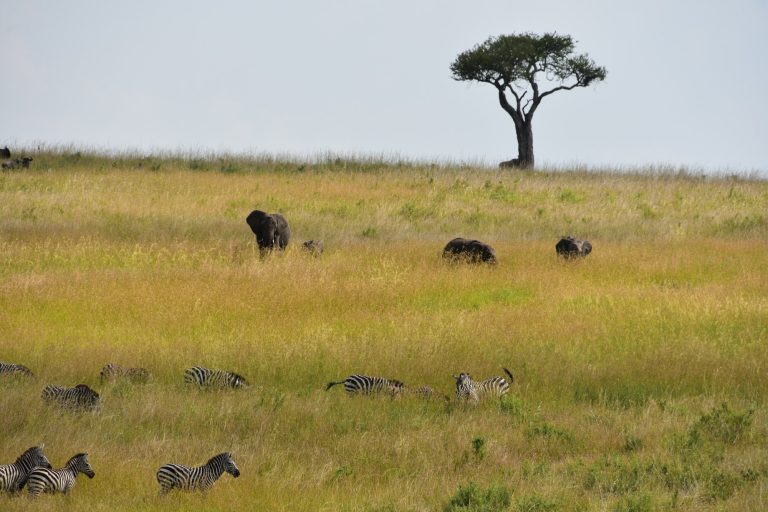
Wildebeest and plains zebra grazing together on a long grass slope.
February · CalvingCalving at its peak
Most calves are born within a few weeks, usually peaking in February. Lion, spotted hyena and cheetah gather where the herds are, on open ground with little cover.
High. February is the most dependable month for calving on the southern plains.
Suggested stay
3–4 nights on the southern plains
Where to base
A mobile camp near Ndutu, which moves with the herds; permanent lodges can be an hour or more from the animals.
Getting there
By road from the Ngorongoro highlands, or by light aircraft to the Ndutu or Seronera airstrip.
Whose rules apply
Ndutu lies partly in the Ngorongoro Conservation Area, so NCAA rules and fees apply on that side of the boundary and TANAPA rules inside Serengeti National Park.
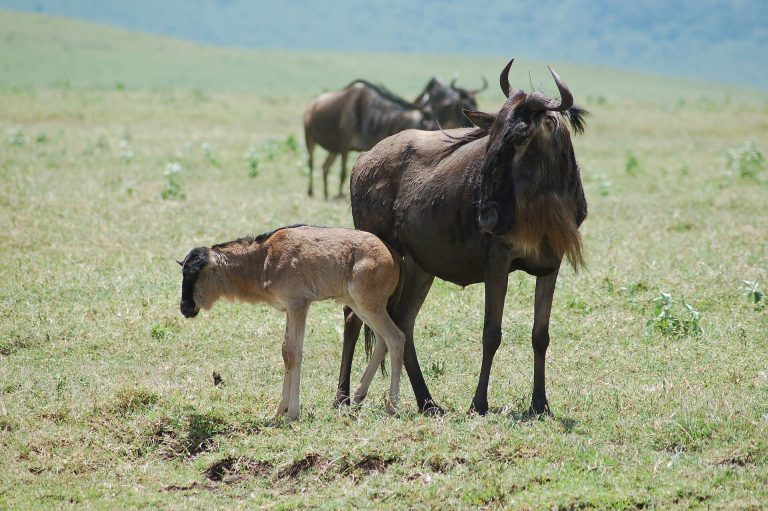
A wildebeest cow with her newborn calf on short grass.
March · CalvingLate calving, herds still in the south
Calving tails off and the calves are strong enough to travel. The herds stay on the southern plains while the grass holds, then start to gather for the move north.
Fairly high. In a dry year the herds may start moving north before the month is out.
Suggested stay
3–4 nights on the southern plains
Where to base
A mobile camp near Ndutu, or a lodge on the Ngorongoro side of the plains.
Getting there
By road from the Ngorongoro highlands, or by light aircraft to the Ndutu or Seronera airstrip.
Whose rules apply
Ndutu lies partly in the Ngorongoro Conservation Area, so NCAA rules and fees apply on that side of the boundary and TANAPA rules inside Serengeti National Park.
A wildebeest cow with her newborn calf on short grass.
April · Moving northHerds breaking up and moving north-west
As the southern plains dry, the herds break up and drift north-west past the Moru Kopjes towards central Serengeti. The long rains fall in this period, which makes some roads hard going.
Moderate. The herds are on the move and spread out, so where they are depends on that year's rain.
Suggested stay
3–4 nights, split between the south and Seronera
Where to base
A lodge in central Seronera, where resident game is good whatever the herds are doing.
Getting there
By road via Seronera, or by light aircraft to the Seronera airstrip.
Whose rules apply
Serengeti National Park (TANAPA).
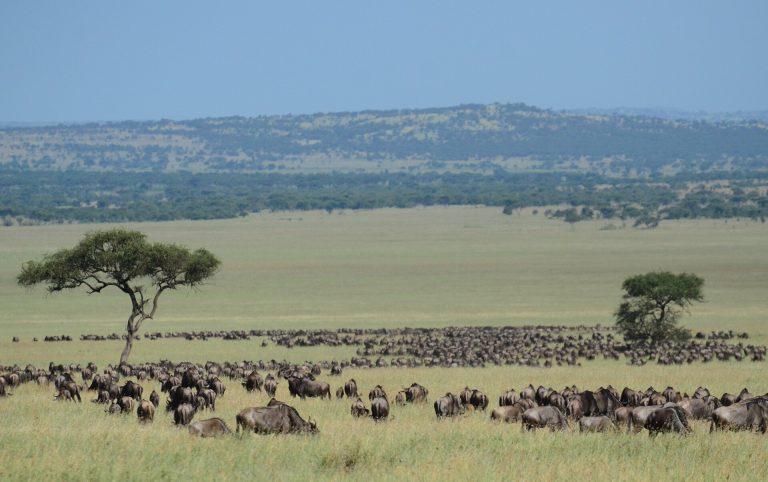
A column of wildebeest strung out across open plains below a wooded escarpment.
May · Moving north, Grumeti crossingsLong columns through central Serengeti
The herds move in long columns through central Serengeti, and much of the population heads into the western corridor. In some years the first Grumeti crossings start late in the month.
Moderate. The herds are moving fast and their route varies from year to year.
Suggested stay
3–4 nights between Seronera and the western corridor
Where to base
A lodge in Seronera, or a camp in the western corridor once the herds have arrived.
Getting there
By road via Seronera, or by light aircraft to the Seronera airstrip.
Whose rules apply
Serengeti National Park (TANAPA).
A column of wildebeest strung out across open plains below a wooded escarpment.
June · Grumeti crossingsGrumeti River crossings
The herds gather in the western corridor and cross the Grumeti River. The crossings are smaller than the Mara's and spread across many points and several weeks, but there are far fewer vehicles.
Moderate. June is the usual month, but crossings can start in late May or run into July.
Suggested stay
3–4 nights in the western corridor
Where to base
A camp in the western corridor or the Grumeti area.
Getting there
By road via Seronera, or by light aircraft to a western corridor airstrip.
Whose rules apply
Serengeti National Park (TANAPA); the Grumeti and Ikorongo areas to the north are game reserves run as concessions, with different rules on what is allowed.
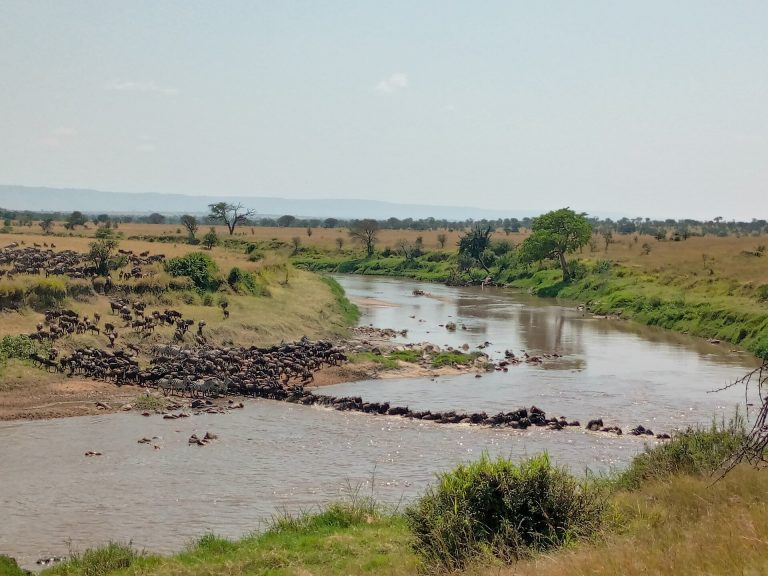
Wildebeest strung out across a shallow river, with more massed on the near bank.
July · Grumeti crossings, Mara crossingsThe front reaches the north
The last herds leave the western corridor as the front of the migration reaches the northern Serengeti. Mara River crossings can begin, usually from mid-month.
Moderate. Early July can still be quiet on the Mara; the later in the month, the better the odds.
Suggested stay
3–4 nights in the north, late in the month
Where to base
A camp near Kogatende or in the Lamai wedge.
Getting there
Usually by light aircraft to Kogatende; the drive from Seronera takes most of a day.
Whose rules apply
Serengeti National Park (TANAPA). The Masai Mara across the border is Kenya: nights there need Kenyan entry.
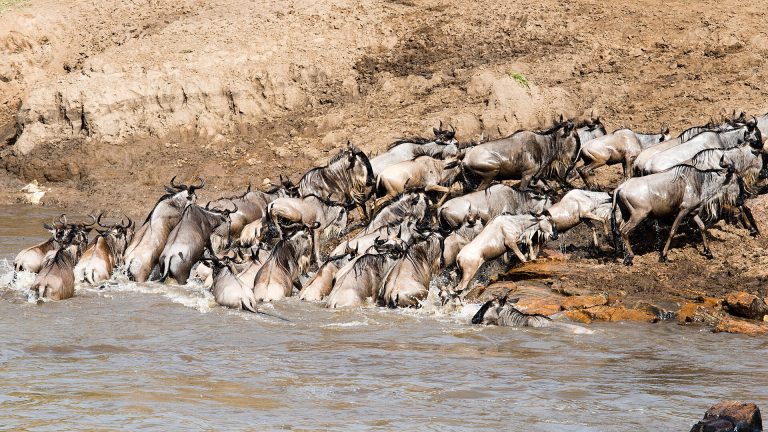
Wildebeest crossing the Mara River below a steep earth bank.
August · Mara crossingsMara River crossings
The herds are in the northern Serengeti and on the Kenyan side, crossing and recrossing the Mara River. Crossings cannot be scheduled: herds can mass on a bank for hours or days before going.
Moderate. Timing depends on when the short rains start; early rain pulls the herds south sooner.
Suggested stay
3–4 nights in the north
Where to base
A camp near Kogatende or in the Lamai wedge.
Getting there
Usually by light aircraft to Kogatende; the drive from Seronera takes most of a day.
Whose rules apply
Serengeti National Park (TANAPA). The Masai Mara across the border is Kenya: nights there need Kenyan entry.
Wildebeest crossing the Mara River below a steep earth bank.
November · Return southThe return south
With the short rains, the herds leave the north and move south down the eastern side, through Lobo and the Loliondo side of the park. Camps are quieter and the herds are strung out over long distances.
Moderate. The herds' arrival on the plains depends on when the rain reaches the south.
Suggested stay
3–4 nights on the southern plains
Where to base
A mobile camp near Ndutu once the herds have arrived, or a lodge in Seronera.
Getting there
By road from the Ngorongoro highlands, or by light aircraft to the Ndutu or Seronera airstrip.
Whose rules apply
Ndutu lies partly in the Ngorongoro Conservation Area, so NCAA rules and fees apply on that side of the boundary and TANAPA rules inside Serengeti National Park.
Wildebeest and plains zebra grazing together on a long grass slope.
Typical windows, not dates. The herds follow the rain, which shifts by weeks from year to year, so no month here is a guarantee and no one can date a river crossing. Last checked October 2026. Sources: Ngorongoro Conservation Area Authority (Ndutu plains), Tanzania National Parks (Serengeti), Expert Africa and Africa Geographic migration guides.
Great Migration Safaris Guide in Tanzania
Researched and written in house. No operator contributed to this guide or paid to appear in it.
Where it happens. The Serengeti and Mara ecosystem, which takes in Serengeti National Park, the Ndutu plains inside the Ngorongoro Conservation Area, the Grumeti and Ikorongo game reserves and Kenya's Masai Mara.
Who runs the ground. Tanzania National Parks (TANAPA) inside the park; the Ngorongoro Conservation Area Authority (NCAA) at Ndutu; private concessions in Grumeti and Ikorongo.
The two headline windows. Calving on the southern plains, usually peaking in February, and Mara River crossings in the north, usually from late July into September.
Nights that change the odds. Three to four nights in the region where the herds are. One night in the right place is a gamble.
What nobody can promise. A crossing on a given day, or the herds in a given spot on a given date. Rain sets the timetable.
Migration Month by Month for Serengeti Safaris
Where the herds usually are in each month, where to base yourself and what to expect, so you can match your travel dates to the right part of the Serengeti.
Herds arrive on the green short grass ahead of calving
Seronera early in the month, Ndutu later
Arrival depends on rain reaching the south. Late December is the safer half of the month.
Typical windows, not dates. The herds follow the rain, which moves by weeks from year to year, so no month is a guarantee and no one can date a river crossing. Sightings are never guaranteed. Last checked November 2026. Sources: Tanzania National Parks (Serengeti), Ngorongoro Conservation Area Authority (Ndutu plains), UNESCO World Heritage listing for Serengeti National Park.
How the Great Migration Safari Circuit Moves Through the Serengeti
The herds never leave. That single fact explains more about planning a great migration safari than any map does, because it means there is no closed season and no month in which the animals have gone away. UNESCO's World Heritage listing describes over one million wildebeest, with hundreds of thousands of other grazers, on a roughly 1,000 kilometre circular trek that crosses between Tanzania and Kenya. The loop runs clockwise in an average year, and rain decides the pace.
Start the circle in the south. The short grass plains around Ndutu and the southern Serengeti sit on volcanic soils that grow a mineral rich grass, poor grazing for most of the year and exactly what a nursing wildebeest needs when the rains turn it green. The herds calve there.
When the plains dry out, usually from April, they break up and push north west through the centre of the park and into the western corridor, where the Grumeti River lies across their path. From July the front reaches the northern Serengeti and the Mara River, the border country with Kenya. As the short rains arrive, often in November, they swing south again down the eastern side through Lobo and arrive back on the southern grass.
How many animals make that loop is less settled than the round numbers suggest. TANAPA describes more than 1.5 million wildebeest. A satellite survey of the ecosystem, using deep learning to count animals in high resolution images taken during the dry season, found fewer than 600,000 wildebeest, well below the long repeated figure. The researchers have not claimed the older counts are simply wrong, and the debate is open. From a vehicle on the plains the difference is invisible: either way the herds stretch to the horizon.
Zebra travel with them, roughly two hundred thousand of them, along with Thomson's gazelle and eland. Lion, leopard, elephant, buffalo, giraffe and hippo stay put, which is why a Serengeti trip in a month when the herds are three hundred kilometres away still delivers strong game viewing.
Region
Usual months
Main event
Vehicles
Ndutu, south
Dec to Mar
Calving
Moderate
Central
Apr to May
Columns north
Low
Western corridor
May to Jul
Grumeti crossings
Low
Northern
Jul to Oct
Mara crossings
High
Eastern, Lobo
Oct to Dec
Return south
Low
Read every row as a tendency. The Serengeti sits across the seam between two rainfall patterns, one with two rainy seasons and one with a single long one, and they fail or arrive early independently of each other. That is why the same month can put the herds in different places in consecutive years.
Calving Season Safaris on the Ndutu Plains
If predators matter more to you than rivers, the calving season safari is the stronger trip. From about late January through February the herds give birth on the open plains around Ndutu and the southern Serengeti plains, and the births are tightly bunched into a few weeks. Calves stand within minutes and run within the hour. Lion, spotted hyena and cheetah gather where the herds are, and with almost no tree cover the hunts play out in full view of the vehicle.
February is the most dependable month. January often has the herds settled on the plains with the first calves arriving late in the month; March brings strong young calves, heavier rain and a herd starting to look north. December is arrival month, and its second half is the safer bet.
One boundary trips people up. Ndutu lies largely inside the Ngorongoro Conservation Area, not the national park, so a different authority sets the rules and the fees on that side of the line. Ask your operator which side of the boundary each camp and each game drive sits on.
Base matters more here than anywhere else in the cycle. Mobile camps move onto the Ndutu plains for the calving months, so you wake up where the animals are. A permanent lodge on the edge of the area can leave you an hour or more from the herds each morning, which costs the best light of the day. Trip reports from this season mention the same practical points again and again: green grass and dramatic skies, short sharp showers, mud on the tracks after rain, and far fewer vehicles at a kill than anyone sees at a Mara crossing.
Video: 500,000 Wildebeest Born in 3 Weeks — The Great Migration Calving Season at Ndutu, from Nate Solo Travels on YouTube.
The calving season also suits families. Children tend to engage more with newborn animals than with a long wait on a riverbank, and drives on open plains are shorter and less bumpy than the run to the north.
Central Serengeti Game Drives as the Herds Move North
April and May belong to the long rains. As the southern plains dry, the herds break into long columns and move north west past the Moru Kopjes towards the Seronera Valley. The rut starts around this time, and the noise of it carries at night.
Game drives in central Serengeti during these months work because Seronera's resident game does not depend on the herds. Big cats hold territory along the river valleys whatever the wildebeest are doing. Some tracks turn heavy after rain, and a few camps close for the wettest weeks, so check that your chosen camp is open before you fix dates. Prices drop, the grass is tall and green, and vehicle numbers are the lowest of the year.
Plan a split: two nights in Seronera and two further west in late May, so you cover the herds wherever that year's rain sends them.
Grumeti River Crossing Safaris in the Western Corridor
The western corridor is the arm of the park reaching towards Lake Victoria, and in June it holds much of the migration. Grumeti River crossing safaris are smaller and less theatrical than the Mara ones: the river is a chain of channels and pools, and the herds filter over at many points across several weeks. Nobody piles up at one spot for long, so you will rarely see the huge single crossings of the north.
What you gain is space. Vehicle numbers in the western corridor are a fraction of those at the Mara in August, and the Grumeti River holds very large Nile crocodiles that time their feeding to the herds. Riverine forest along the banks adds black and white colobus and a different bird list.
Video: Wildebeest crossing Grumeti river in the western corridor of Serengeti, from Amitava Chattopadhyay on YouTube.
North of the corridor lie the Grumeti and Ikorongo game reserves, run as private concessions. Their rules differ from the park's, and some camps there offer guided walks or night drives that the national park does not allow; the sibling guides on night game drives and walking safaris cover those in detail. Timing is the weak point. The usual window is late May into early July, it can shrink to a couple of weeks in a given year, and forum threads from June travellers warn that trying to catch Grumeti and then race north for the first Mara crossings in one short trip feels rushed.
Mara River Crossing Safaris in the Northern Serengeti
This is the scene most people picture: thousands of wildebeest massed on a steep bank, a long hesitation, then a sudden plunge into brown water while crocodiles move in. Mara River crossing safaris take place in the northern Serengeti around Kogatende and the Lamai area, usually from mid to late July into October, with August and September the peak.
It cannot be scheduled. Herds gather at a crossing point and then decline to cross for hours or days. They cross, then cross back the next morning, which is normal behaviour rather than a failed migration. A crossing may last four minutes or more than an hour, and a vehicle can spend an entire day at a promising bank and see nothing. Operators who plan these trips every season describe guests who saw three crossings in four days and others who sat in prime position for four days and saw none.
Video: Crazy Great Migration Mara River Crossing in Serengeti - Tanzania Safari, from Ella McKendrick on YouTube.
What moves your chances of seeing a Mara crossing, roughly in order of effect.
Nights at the river. Three or four nights in the north give a realistic chance of at least one crossing. One night, with half a day lost to transfers, gives very little.
Camp position. A camp near Kogatende or in Lamai puts the main crossing points within a short drive. A lodge in central Serengeti is most of a day's drive away.
A flexible vehicle. A private vehicle lets you sit out a gathering herd for three hours, leave before dawn and skip the lunch break back at camp.
Late rather than early. Early July can be quiet on the river. Late July to mid September carries the strongest odds.
Patience at the bank. Guides who know the river park back from the likely exit and wait with the engine off.
Crowding is the honest cost of this region. Travellers on safari forums describe crossings spoiled by vehicles lined along the far bank, and a few first timers say they booked fewer northern nights for exactly that reason. Etiquette here has consequences. A vehicle parked too close to the water, or on the bank where the animals want to climb out, can turn a herd back, and a herd that turns back may not try again that day. Good guides hold position away from the likely exit and wait.
The river is not a gentle spectacle. Animals drown and break legs in the crush, crocodiles take their share, and carcasses wash downstream for weeks. Travellers who arrive expecting a wildlife film without the cuts are sometimes unsettled by it, so it helps to know that going in.
Two practical points finish the picture. Getting there usually means a light aircraft to the Mara River area via the Kogatende airstrip, since the drive from Seronera takes most of a day and costs a full game drive each way. And the Masai Mara lies directly across the border, with herds crossing it freely. Nights on the Kenyan side are Kenyan nights, with Kenyan entry rules, so an itinerary that adds them becomes a two country trip.
When the odds come together, the crossing earns its reputation. When they do not, the north in August still holds massed herds, lion and leopard working the edges, and some of the best general game viewing in East Africa.
Return South Safaris Through Lobo and the Eastern Serengeti
From October into December the herds turn and trickle south down the eastern side of the ecosystem through Lobo, following the short rains. This is the least watched phase of the circuit. The herds string out over long distances, camps are quiet and the light is often very good.
November is the hardest month to call. In a dry year the herds hold in the north for weeks longer than expected; in a wet one they reach the southern plains early. A central base around Seronera hedges that bet, with Lobo as a second stop if the guides report herds in the east.
Choosing a Migration Safari Camp by Region
On most safaris the lodge is a comfort decision. On a migration safari it is a position decision, because drive time to the herds sets how many hours you actually spend with them.
Mobile tented camps relocate two or three times a year, usually to Ndutu for calving and to the north for the crossings. They are comfortable rather than lavish, with proper beds and en suite bucket showers, and their advantage is simple: they sit where the animals are that month. For many travellers they are the right choice at any budget. The sibling guide on camping safaris covers the simpler public campsite option, which is a different thing.
Permanent lodges offer bigger rooms, pools and more reliable electricity, but they cannot move. A fixed lodge in Seronera is excellent from April to June and in November, and a long way from the Mara River in August. Private concessions in Grumeti and the north add privacy, off road access in some areas and activities the park forbids, at the top end of the price range.
Book early for the two headline windows. Operators commonly advise eight to twelve months ahead for well placed camps on the Ndutu plains in February and in the north from late July to September, because those camps have few tents and sell out first. Outside those windows a few months' notice is usually enough.
Planning Nights, Routes and Flights for a Migration Trip
Three decisions do most of the work. Pick the phase, not the date. Give that phase enough nights. Then choose how to move between regions.
Typical shapes for a migration trip, built around three or more nights where the herds are.
Five to six days. Fly in, three or four nights in one migration region, plus one night at the Ngorongoro Crater if you drive. Little time lost to transfers.
Seven to nine days. Tarangire or Ngorongoro, two nights in central Serengeti, then three or four in the region the herds occupy. The comfortable length for most first visits.
Ten days or more. Two migration regions, such as Seronera and the western corridor in June, or the north plus a beach stay in Zanzibar afterwards.
Driving is the norm on the northern circuit, and Arusha to central Serengeti by road takes most of a day with game viewing on the way. The light aircraft earns its place on the long legs: Arusha to Kogatende in the crossing season, or back from the north at the end of a trip, which would otherwise mean a full day in the vehicle. Short hops between Serengeti airstrips are often under an hour. The guide to getting around Tanzania and how many days you need work through those trade offs in full.
A hot air balloon flight at dawn over the herds is the most common add on, running from launch sites in central Serengeti and, in the calving months, from the Ndutu side; the sibling guide on balloon safaris covers it. Photographers often prefer calving to the crossings for open ground and longer sittings, a point the photography safari guide develops.
For a first trip with fixed summer dates, choose the north from late July and four nights near Kogatende. For a first trip with flexible dates, February at Ndutu gives the most predictable herds of the year and fewer vehicles at each sighting. You can compare operator trips built around each window in the great migration safari listings.
Tanzania or Kenya for a Migration Safari
The question comes up in almost every planning thread for late August. Kenya's Masai Mara is smaller, closer to Nairobi and holds the herds from about August to October, with crossings on the same river. Tanzania holds the herds for the rest of the year, including calving, which does not happen in Kenya at all, and the northern Serengeti tends to see fewer vehicles at a crossing than the busiest points of the Mara Reserve. The cost of that quiet is distance: Kogatende is a flight from Arusha, while parts of the Mara are a short drive from Nairobi.
If your dates fall between December and July, Tanzania is the only answer. From August to October both work, and combining them means two sets of entry rules; check the Tanzania travel requirements first, then Kenya's own rules for the second leg.
Great Migration Safari FAQ
When is the best time for a great migration safari in Tanzania?
Late July to September for the Mara River crossings in the northern Serengeti, and late January to February for calving on the Ndutu and southern plains. Both are strong; they suit different travellers. June in the western corridor and November in the east are quieter alternatives with the herds still in view. The best time to visit Tanzania guide sets this against weather and the rest of the country.
Can a river crossing be guaranteed?
Nobody can guarantee one. Crossings depend on the herds' behaviour and cannot be predicted for a particular day or place. Three or four nights near Kogatende between late July and September give a realistic chance; no operator can promise one.
What do park fees add to a Serengeti migration safari?
TANAPA's published conservation fee for a non East African adult in Serengeti National Park is US$70 per person per day in the peak period from 16 May to 14 March and US$60 from 15 March to 15 May, with children aged five to fifteen at US$20. TANAPA's tariff booklet states its charges exclude 18% VAT, which takes a US$70 day to US$82.60. Lodges and camps inside the park also pay a concession fee of US$60 per person per night from July to September and US$50 for the rest of the year, usually built into the room rate. At Ndutu, the NCAA charges non East African adults US$70.80 per person, and a permit covers one entry within 24 hours, so leaving and re entering costs again. Fees change without much notice, so ask your operator to state the current figures and the VAT basis in writing. The Tanzania safari cost guide breaks the rest down.
How many days does a great migration safari need?
Six days is a workable minimum, with at least three nights in the region where the herds are. Seven to nine days is the comfortable length and leaves room for the Ngorongoro Crater or Tarangire.
How much does a balloon flight over the migration cost?
Serengeti balloon operators widely quote about US$599 per person, which includes the TANAPA ballooning fee, the lodge transfer and a breakfast in the bush. Book it with the safari, because flights in the crossing and calving months fill early.
Is a migration safari worth it outside the crossing months?
Yes for most travellers. The herds are somewhere in the ecosystem every month, and the resident lion, leopard, elephant and buffalo do not migrate. Calving season often gives better predator viewing than August, with fewer vehicles.
Is the Serengeti migration suitable for children and older travellers?
Yes, with the right base. Calving season suits children well, since drives on the southern plains are short and there is always something happening. For older travellers or anyone with back trouble, flying to the north saves a full day on rough roads.
Tanzania Safari.travel lists migration safaris from independent, verified Tanzanian operators and lets you enquire with them directly, with no booking fee and no payment taken on the site. Compare the trips built around calving at Ndutu or the Mara crossings in the north, then ask the operator the questions in this guide: which region, how many nights there and which side of each boundary your camps sit on. Browse great migration safaris or contact the Tanzania Safari.travel team with your dates.