
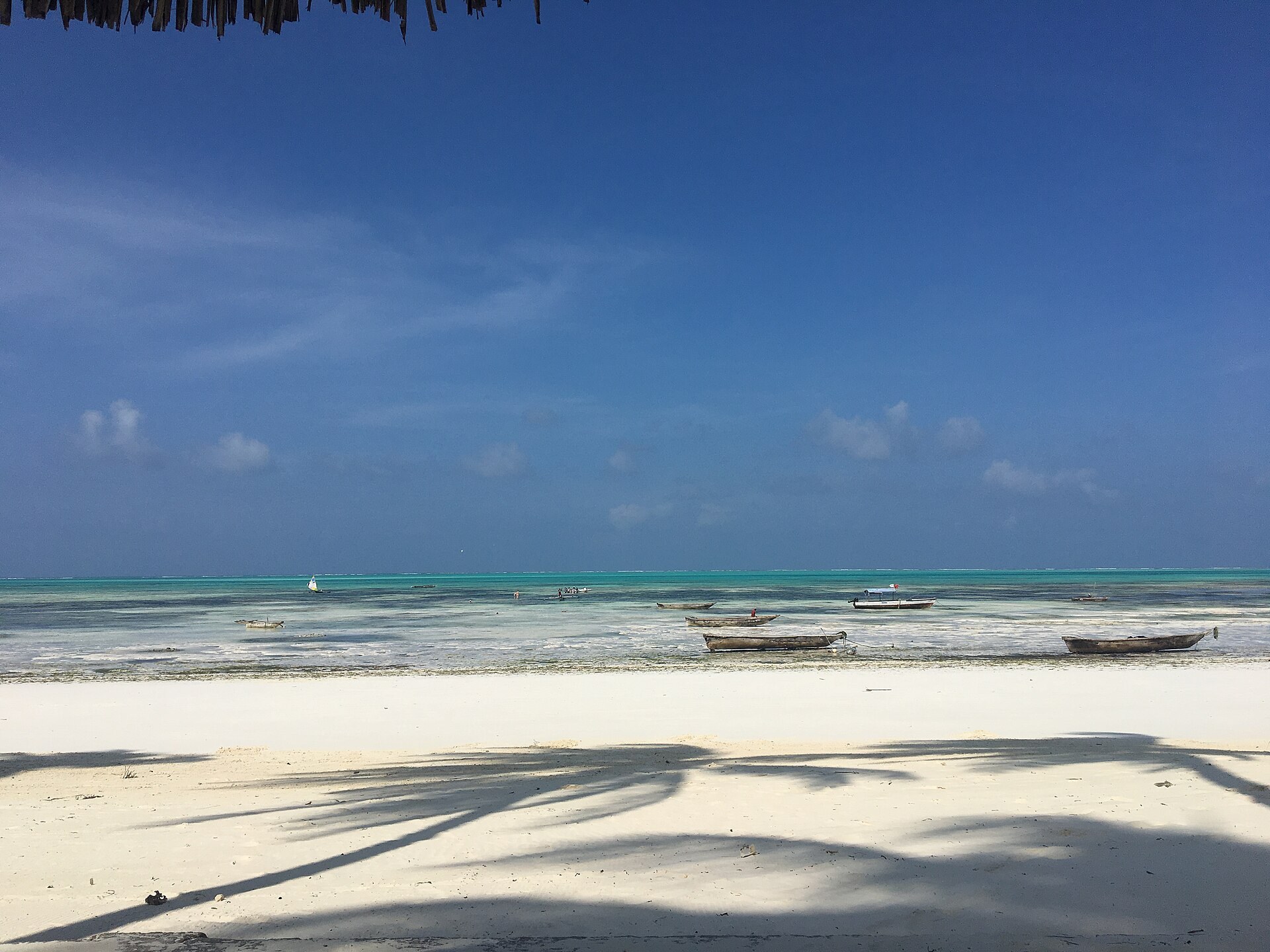
Where Jambiani is
Jambiani is a long, strung-out village south of Paje on the same south-east coast of Unguja and on the same lagoon. It runs for several kilometres along the shore, with guesthouses and small hotels threaded between houses, shops and boatyards rather than gathered into a strip.
It is slower and more residential than Paje, and that is the reason to choose it. The wind and the lagoon are much the same; the number of people on both is not.
The tide, which is the defining fact
Jambiani sits behind a wide reef flat, and the island’s tidal range — close to a metre at neaps, over three metres at springs — empties it twice a day. The sea withdraws a long way here, further than at most places on the island, leaving several hundred metres of wet sand, seagrass and rock between the beach and the water.
At high water it is a warm, shallow, turquoise lagoon and swimming is easy. At low water it is not a swimming beach at all. High water arrives roughly fifty minutes later each day, so the usable hour moves across a stay, and boats leave on the tide rather than on the hour.
This is not a defect and it is not a surprise to anyone who knows the coast — it is how the east side of Unguja works, and it is when the seaweed plots are tended and when reef walking is possible. But it is the single thing most likely to disappoint someone who booked from a photograph. If swimming at any time of day is what you want, that is the northern tip at Nungwi and Kendwa. The beach holidays guide covers the whole coast.
Kitesurfing without the crowd
Jambiani has the same side-onshore monsoon wind and a similar lagoon to Paje, with markedly fewer kites on it. For a rider who wants the conditions without the traffic, it is the obvious answer on this coast.
The two seasons are the kaskazi, the lighter north-easterly, roughly December to March, and the kusi, the stronger south-easterly, roughly June to September. Between them the wind is unreliable, and a large number of kite and beach operations close for part of the long rains. The kitesurfing guide covers the wind, the right-of-way rules and how the tide governs a session.
Seaweed, and the work behind it
The flats at Jambiani are farmed, and the rows of staked lines that appear at low water are a working crop tended almost entirely by hand and almost entirely by women. Commercial cultivation began in these islands in 1989 with strains brought from the Philippines, and around eighty per cent of Tanzania’s roughly thirty thousand seaweed farmers are women, with research focused on Zanzibar putting the figure at eighty to ninety.
The industry is under real pressure. The higher-value crop, cottonii, cannot grow effectively above about thirty-five degrees and the shallow lagoons now reach thirty-eight, which has pushed farmers onto the cheaper species; the work causes documented musculoskeletal injury and eye damage; and about ninety-nine per cent of Tanzania’s seaweed is exported raw, with farmers realising something in the region of thirty to forty per cent of the export price. The seaweed farm tours guide sets all of that out, along with how to visit without making it worse.
If you walk the flat at low water, walk around the plots rather than across them.
Other things here
Jambiani has documented cooking classes, which is unusual outside Stone Town. One caution that applies across the island: classes here are routinely sold as being run by a women’s cooperative, and no named, currently operating cooperative cooking group could be verified in Jambiani or in the other villages where the phrase is used. That does not mean nobody is cooking for visitors and being paid for it — plenty are — it means the phrase is used far more often than it is documented, and it is worth asking what the arrangement actually is.
Fishing village visits are widely advertised here, and the same caution applies: no named community programme running them could be verified as currently operating. The village tours guide explains what that means in practice.
Inland from this coast, a round sinkhole roughly fifty metres across sits in forest near Jambiani, with a freshwater pool about three metres deep and deeper connected passages leading off it. It is covered in the cave exploration guide.
Sea kayaking works on the lagoon at high water. The Jozani-Chwaka Bay national park, with the red colobus forest and the Pete-Jozani mangrove boardwalk, is a short drive inland and is covered in the forest walks and mangrove tours guides.
Practical notes
Reef shoes are not optional on the flat. Urchins sit invisibly in rubble, the bottom is sharp with shell and coral fragments, and stonefish sit camouflaged in exactly the shallows being walked.
Jambiani is a village rather than a resort strip, and the village is present throughout. Beachwear belongs on the hotel beach; shoulders and knees covered elsewhere is the norm and is appreciated. During Ramadan many local places close in daylight.
Because the village runs for several kilometres, “Jambiani” covers a lot of ground. Check where along it a place actually sits before assuming you can walk to anything. Reaching the island and crossing it are both covered in the guide to getting to Zanzibar and moving around it.
Rainfall is bimodal: long rains, masika, about March to May; short rains, vuli, about October to December — October, not the November of the tourism shorthand. The seasonal guide to Zanzibar and the coast sets that calendar against the mainland’s.
Common questions about Jambiani
Can I swim at Jambiani?
At high water, yes, in a shallow warm lagoon. At low water the tide withdraws a long way — further than at most Zanzibar beaches — and swimming is not possible. The high-water hour moves about fifty minutes later each day.
Jambiani or Paje?
Paje has the infrastructure: schools, kit, rental, rescue, repairs and other riders. Jambiani has the same wind and lagoon with far fewer people, and is more of a village and less of a kite town. Learners are generally better served at Paje; anyone who already rides, or who wants quiet, is better served here.
Is Jambiani good for a non-kiting beach holiday?
It can be, provided you go in knowing that swimming is tied to high water and that the beach is a working shore with seaweed plots and boats on it rather than a private strip. People who want that find it one of the more likeable places on the island. People who want to swim whenever they like should look at the northern tip instead.
Are the cooking classes run by a women’s cooperative?
That is how they are frequently sold, and no named, currently operating cooperative cooking group could be verified here or in the other villages where the phrase is used. Plenty of Zanzibari women do cook for visitors and are paid for it. Ask what the arrangement actually is rather than taking the phrase at face value.
How far is Jambiani from Stone Town?
It is on the opposite coast, a straightforward drive across the island — nothing on Unguja is more than a couple of hours from anything else. Transfers are almost always arranged through accommodation.