
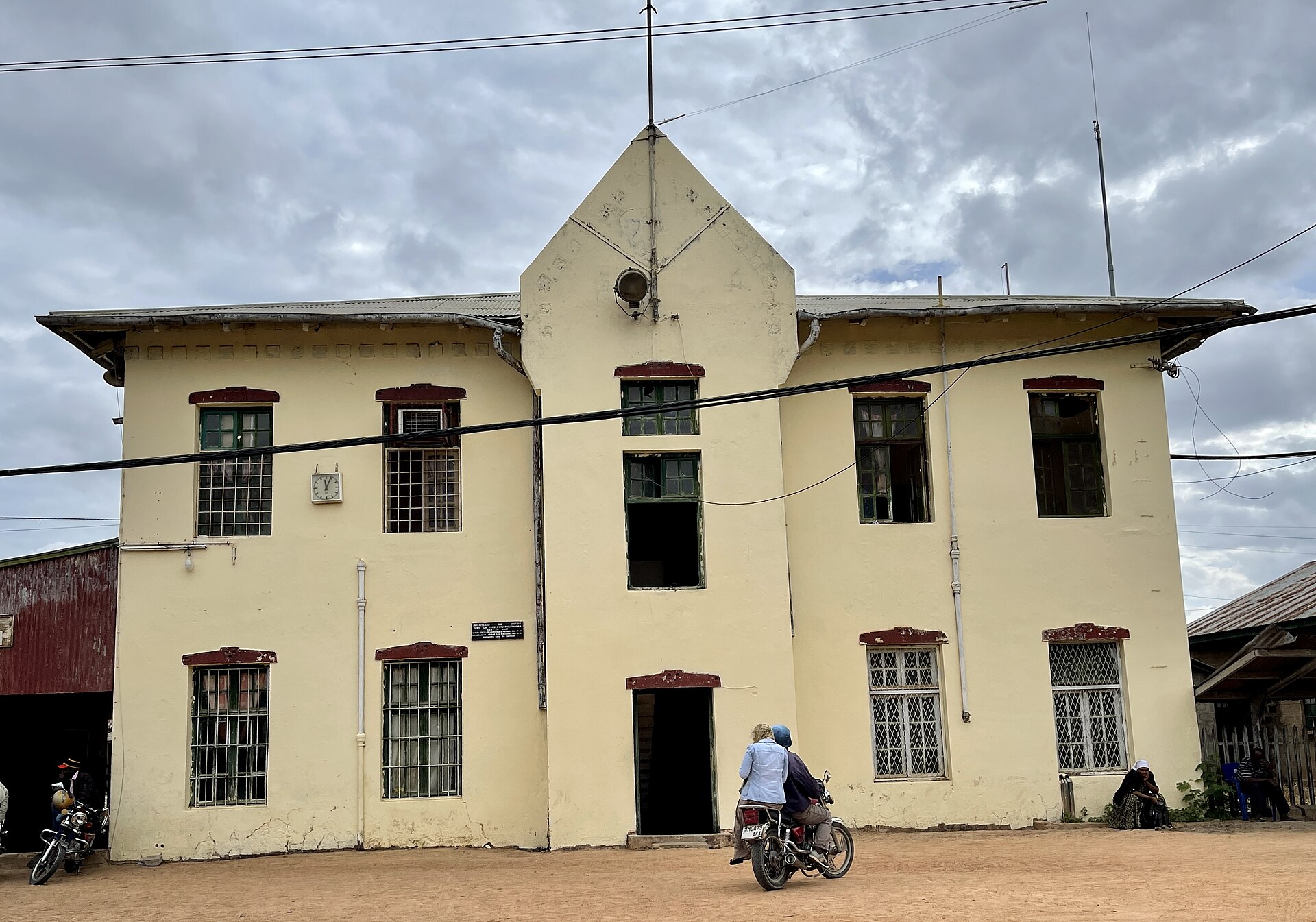
The crossroads of the interior
Tabora is where the caravan routes met, and it is still where the railway lines meet. It sits in the miombo woodland of central-western Tanzania, in the largest region in the country by land area: Tabora Region’s own government gives it approximately 76,151 square kilometres, around nine per cent of Tanzania’s land surface, bordering Shinyanga, Geita and Simiyu to the north, Singida to the east, Mbeya and Katavi to the south, and Kigoma to the west.
This is not a safari destination and it does not present itself as one. It is a place with a history that is genuinely important to understanding western Tanzania, and a rail junction that makes it a natural stop on a long journey rather than a detour.
Kazeh
The town’s original name was Kazeh. Tanzania’s UNESCO tentative list submission for the Central Slave and Ivory Trade Route records that it was established in 1852 by traders in the East African slave and ivory trade, on land given to them by Chief Fundikira of Unyanyembe. It grew quickly, sitting where the trading routes to the coast crossed those running further inland to the Congo and north towards what is now Burundi. The submission estimates its population at 5,000 by 1871 and around 20,000 by the 1890s.
Tabora Region’s own account describes the same place as the vital commercial link between the coast of Zanzibar and the Great Lakes region, through which honey, ivory and slaves passed. Kazeh is one of the six centres identified along the route, which ran over 1,200 kilometres from Ujiji on Lake Tanganyika to Bagamoyo on the coast.
The Kwihara tembe
The UNESCO submission is blunt about what survives: “The only building of significance that has survived is the Kwihara Livingstone Tembe.” It records that the tembe — a flat-roofed, thick-walled Arab-style house — was built by a wealthy Arab slave trader in 1857 and given by its owner to David Livingstone. It was declared a historical monument a century later, in 1957, when major repairs were carried out. Other evidence in the area includes a mosque and residence near the tembe, a well, and mango, coconut and date plantations.
See the slave trade history tours and historical walking tours guides.
The Nyamwezi, and Chief Isike
Tabora is the ancestral home of the Nyamwezi, whom the regional government describes as renowned for their endurance in long-distance travel and the caravan trade, historically governed under a system of chiefs, the watemi. Nyamwezi porters carried the trade that built Kazeh, and Nyamwezi communities appear all along the route and on the coast.
The region’s own history singles out Isike Mwanakiyungi, who led resistance against German colonial intrusion and who, in 1893, rather than surrender to German forces, blew himself up with gunpowder in his fortress at Itetemia.
Railways and education
The Germans established the Tabora Boma and extended the Central Railway Line to the region in 1912, which is the reason the town remains the rail crossroads of the Tanzanian interior. Tanzania Railways Corporation’s route list shows the Central Line running from Dar es Salaam through Dodoma to Tabora and on to Kigoma, with a branch north from Tabora through Isaka and Shinyanga to Mwanza, and another running south-west through Kaliua to Mpanda for Katavi. TRC also lists Makutupora–Tabora and Tabora–Isaka among its standard gauge railway projects.
For anyone travelling by train, that junction is the practical fact about Tabora: it is where you change for the lake or for the western parks. See the rail and ferry journeys guide.
Under British administration Tabora became an educational centre. The regional government describes Tabora School, boys’ and girls’, as the intellectual cradle for a generation of East African leaders — Julius Nyerere was educated here — and the town as a strategic headquarters for TANU’s clandestine organising in the run-up to independence in 1961.
Honey, tobacco and miombo
Tabora is known nationally as the honey region and is Tanzania’s leading tobacco producer. The surrounding country is miombo woodland and fertile plains, with a tropical climate the region gives as 23 to 30 degrees Celsius. Beekeeping is a serious regional industry rather than a curiosity, and the farm tours guide covers beekeeping visits among other agricultural tourism. The regional government also identifies sunflower and groundnut oil processing and horticulture as growth sectors, which is a reasonable indication of what the countryside around the town is actually doing.
Tabora Municipal Council gives the municipality an area of 1,092.26 square kilometres at roughly 1,000 to 1,500 metres above sea level.
Tabora as a stop
Tabora is best understood as a place you spend a day in because you are already passing through, and it repays that.
The town is the administrative centre of a region of seven districts — Tabora Municipal, Uyui, Nzega, Igunga, Urambo, Sikonge and Kaliua — with a population the 2022 census put at around 3.3 million. The regional government describes a culture of peace and religious harmony, which in practice is one of the more noticeable things about the place for anyone arriving from the tourist circuits.
The miombo woodland that surrounds it runs for hundreds of kilometres in every direction, and it is the same habitat that defines Katavi to the south-west. Miombo is not dramatic country and it is not what most visitors come to Tanzania for, but it is what most of western Tanzania actually is, and a train journey across it is the easiest way to understand the scale of the region.
Practically, Tabora has the services of a regional capital and it is the last substantial town on several long journeys. If you are heading to Katavi by rail, or to Kigoma, or north to Mwanza, this is where the route divides. Tabora is the clearest reason to read the guide to travelling Tanzania by rail and road, because the Central Line is one of the few places in the country where rail is genuinely the sensible option.
Seasons
Tabora is in the Tanzania Meteorological Authority’s unimodal zone: one wet season running from around November into April or May, then a long dry period. TMA’s Vuli forecasts, which cover Tanzania’s two-season areas, do not include Tabora Region. The split between the one-season and two-season halves of the country is set out in when to travel in each part of Tanzania.
Common questions about Tabora
What was Tabora called before?
Kazeh. Tanzania’s UNESCO tentative list submission dates its foundation to 1852, on land given to traders by Chief Fundikira of Unyanyembe.
Is there anything left from the caravan era?
The UNESCO submission states that the only building of significance to survive is the Kwihara Livingstone Tembe, built by an Arab trader in 1857, given to Livingstone, and declared a historical monument in 1957. A mosque, a residence, a well and old plantations survive nearby.
Why is Tabora important for the railway?
It is the junction of the Central Line. Trains from Dar es Salaam divide here for Kigoma, for Mwanza via Isaka and Shinyanga, and for Mpanda via Kaliua. The Germans extended the line to the region in 1912.
Is Tabora a safari destination?
No. It is a historical and transport town in miombo country. Its value to a traveller is the caravan-route history, the rail connection and the miombo landscape, not game viewing.
How large is Tabora Region?
Approximately 76,151 square kilometres, which its own government describes as the largest region in Tanzania by land area, around nine per cent of the country.
Who was Chief Isike?
Isike Mwanakiyungi, a Nyamwezi leader who resisted German colonial intrusion and who in 1893, rather than surrender, blew himself up with gunpowder in his fortress at Itetemia.