
Bush Dining in Tanzania: Breakfasts, Picnics, Dinners and Sundowners
Breakfast cooked in the open after a dawn drive, lunch under a tree, drinks at a viewpoint at dusk or dinner laid out away from camp. A staple of the lodges and mobile camps.
Bush dining covers every meal eaten outside the vehicle: the breakfast laid out after a dawn drive, the lunch box at a picnic site, the long table set in the open for dinner, and the drink at sunset that gives sundowners their name. All of it is shaped by one regulation — inside a Tanzanian national park you may only get out of the vehicle in designated places — and the 18:00 driving limit means the evening versions work differently from the daytime ones. Knowing which meals can happen where is most of what there is to understand.
Safaris That Include Bush Dining


7 Day Fly in Safari Serengeti Tanzania
by Insight Safari Holidays Verified operator

8 Days Luxury Tanzania Safari | Premium Wildlife & Migration Experience
by Kori Safaris Verified operator
7 Day Safari Tanzania Holiday
by Insight Safari Holidays Verified operator
A Guide to Bush Dining in Tanzania
What Bush Dining Covers
Bush dining is any meal taken outside the vehicle and outside a building: a breakfast set up after the dawn game drive, a picnic lunch on a full day out, a dinner laid in the open, and the sundowner that marks the end of the driving day. Tanzanian camps and lodges sell these as separate set pieces, but they are one activity answering one question — where are you allowed to stand still and eat?
That question has a regulatory answer, and it is worth having before you plan around any of it.
The Rule Underneath All of It
Inside Tanzania's national parks and the Ngorongoro Conservation Area, you may not simply stop where the view is good and get out. The NCAA states the position plainly: except in designated areas or places, all visitors must remain in their vehicles at all times. TANAPA applies the same principle across the national parks, with picnicking permitted only at designated picnic sites.
Two further rules shape the day:
- Driving is permitted between 06:00 and 18:00. Beyond those hours, permission must be obtained.
- Keep your distance. NCAA asks for at least 25 metres from animals, and feeding wildlife is prohibited everywhere.
Put those together and the shape of bush dining falls out of them. Breakfast and lunch are easy, because designated sites exist and the day is young. Dinner and sundowners are harder, because sunset in Tanzania comes shortly after six and the driving day ends at eighteen hundred. That tension is why the evening versions of bush dining usually happen somewhere other than the middle of a national park — and why the marketing photographs rarely explain themselves.
Bush Breakfast
The most reliably good version of bush dining, for a reason that has nothing to do with food: you have been out since first light, you are cold, and the meal arrives at exactly the point in the morning when the game has gone quiet and you want to stop.
A bush breakfast is usually laid at a designated site or at a spot the camp has cleared and has permission to use. Expect a folding table, a cloth, coffee from a flask, fruit, eggs cooked over a fire or a gas burner, and a crew that drove out ahead of you. It takes an hour or so, and it is normally pre-arranged rather than decided on the morning.
The simpler version — a flask and a box, eaten standing beside the vehicle at a designated stop — is far more common and is not a lesser thing. Much of what makes a bush breakfast good is the hour and the place, not the linen.
Breakfast is also what follows a balloon safari, laid on as part of the flight, which is a different product and covered in its own guide.
Safari Picnics and Bush Lunch
This is the version almost every visitor actually experiences, and it deserves an honest description rather than the aspirational one.
On a full-day game drive your camp packs a lunch box and you eat it at a designated picnic site around the middle of the day. Designated sites are the places inside the park where getting out of the vehicle is permitted — they have shade, usually a lavatory of some kind, sometimes a table, and in the busy parks they have a great many other vehicles doing exactly the same thing at exactly the same hour.
Three things worth knowing:
- Watch the birds. At the busier Northern Circuit picnic sites, black kites have learned to take food from raised hands, fast and from behind. Eat under cover where cover exists, and do not hold a sandwich up while looking elsewhere. This is the single most common minor mishap of a Tanzanian safari day.
- Do not feed anything. Not the kites, not the ground squirrels, not the vervets. It is prohibited, and at picnic sites it is also the reason the problem exists.
- The box is what it is. Lunch boxes are functional and repetitive. If you have dietary requirements, they need to be given to the camp the day before, not on the morning.
The upgraded version — a table set in shade at a private spot, food brought hot — exists, generally on private land or as an arranged extra from a camp. It is genuinely better. It is also not what "picnic lunch included" means on a standard itinerary, and it is worth checking which you have been sold.
Sundowners
A sundowner is a drink taken somewhere with a view while the sun goes down, and it is as much a fixture of safari as the game drive itself. NCAA lists sundowning among its tourism activities in the conservation area.
The timing problem is real and mostly unspoken. Sunset across Tanzania falls shortly after six for most of the year, and the driving day inside the parks ends at eighteen hundred. A sundowner watched from a track deep in a national park would therefore leave you driving back in the dark without permission to do so.
The ways this is resolved, in descending order of how common they are:
- At the camp or lodge. Drinks on the deck, at the fire, or at a viewpoint within the property. No driving involved, so no conflict. This is the great majority of sundowners.
- At a designated site close to camp. Short run out, short run back, inside the hours.
- Outside the national parks. On private concessions, in wildlife management areas, in the wider conservation area and on community land, the driving limit is set by the landholder rather than by TANAPA. This is where the classic open-plain sundowner with the vehicle parked behind you usually happens.
If a sundowner on a hilltop far from camp is important to you, that is a question to ask about the land you will be on, not about the drinks.
Bush Dinner
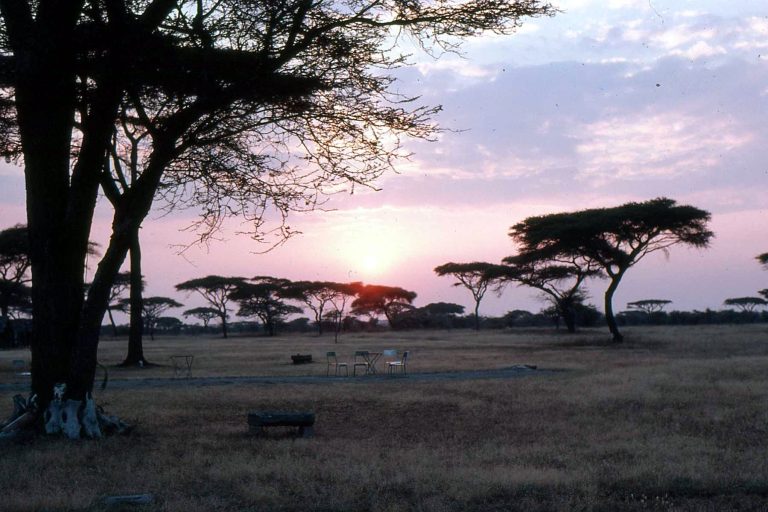
The full set piece: a table in the open, lanterns or storm lamps, a fire, a cooked dinner and staff. It is the most photographed form of bush dining and the least frequently delivered in the middle of a national park, for the driving-hours reason above.
Where it does happen, it is almost always within walking distance of the camp, or on the camp's own ground, or on private land. The lanterns are doing real work — there is no other light — and the fire is doing more than atmosphere.
Two realities worth setting against the photograph. It is often cold; at altitude on the Ngorongoro rim or in the Serengeti in the dry months, a bush dinner needs a jacket rather than the linen shirt in the brochure. And it is weather-dependent in the extreme, so it is arranged as an intention rather than a fixture and gets moved indoors without ceremony when the wind turns.
The compensation is the sky. Away from any town, with the lamps low, the night sky over a bush dinner is the best thing on the table — see stargazing.
Where Bush Dining Works Best
Anywhere unlit and open, which in practice means the drier parks and the higher ground.
- Serengeti — kopjes give elevation and shade, and the space around them is the point.
- Ngorongoro Conservation Area — the authority lists bush dining and sundowning among its activities, and the land outside the crater floor gives more freedom than the crater itself.
- Tarangire — baobabs and the river make natural settings, and the park is quieter than its neighbours.
- Ruaha and Nyerere — sand rivers and low visitor numbers; dinner in the open here feels less staged.
- Lake Natron — open, stark, and with the volcano on the skyline, which is a setting nowhere else offers.
Practicalities Worth Asking About
- Is it included? A picnic lunch on a full-day drive normally is. A staged bush breakfast or dinner is normally an addition to a camp or lodge stay. Ask which you have, in writing, before you arrive.
- Dietary requirements. Give them at booking and repeat them at check-in. A bush meal is cooked away from the kitchen and cannot be adjusted on the spot.
- Children. Daytime picnics are straightforward. Evening set pieces in unfenced country vary by property and some do not take young children at all.
- Weather. Every outdoor meal has an indoor fallback. Expect it to be used during the rains.
- Waste. Everything goes back in the vehicle, including fruit peel. Organic waste at a picnic site habituates animals exactly as badly as a sandwich does.
Questions Travellers Ask
Can I get out of the vehicle for a picnic anywhere in the park?
No. You may leave the vehicle only at designated places — picnic sites and designated stopping points. NCAA states that visitors must otherwise remain in their vehicles at all times, and TANAPA applies the same rule across the national parks.
Why do so many sundowners happen at the lodge rather than out in the park?
Because driving inside the parks is permitted between 06:00 and 18:00 and sunset comes shortly after six. Watching the sun set from deep inside a park would mean driving back after hours, which requires permission. Sundowners on open ground far from camp usually take place outside national park boundaries, where the landholder sets the rules.
Is a bush dinner safe in unfenced country?
It is run with staff present, lighting, a fire and usually an escort back to your tent, and dinners are sited close to camp for that reason. Follow the property's instructions, do not wander beyond the lit area, and accept the escort when it is offered.
What actually comes in a safari lunch box?
Functional packed food — typically a sandwich or a piece of chicken, fruit, something baked, a drink. It is repetitive across a long trip. Dietary requirements must be given to the camp the day before.
Why are the birds a problem at picnic sites?
Black kites at the busier sites have learned to take food from people's hands. They approach fast and from behind. Eat under cover where it exists, keep food low and covered, and never feed them — feeding is prohibited and is what created the behaviour.
Can I arrange a private bush meal for an occasion?
Most camps and lodges will arrange one given notice, subject to weather, to where they are permitted to set up, and to park hours. Ask at the time of booking rather than on the day, since a site may need clearing with the park authority.
Will it be cold?
Frequently, in the evening. The Ngorongoro rim and the Serengeti in the dry months get genuinely cold after dark despite warm days. Take a jacket to any evening meal in the open.