A shallow caustic lake below a live volcano
Lake Natron lies in the far north of Arusha Region, close to the Kenyan border, in a hot trough of the Rift Valley below the volcano Ol Doinyo Lengai. It is administered by the Tanzania Wildlife Management Authority as the Lake Natron Game Controlled Area, covering 3,000 square kilometres and designated by government notice in 1974, and it has been a Ramsar wetland of international importance since 4 July 2001, listed as site 1080 covering 224,781 hectares.
The lake itself is enormous and almost nothing. TAWA gives its maximum extent as 57 kilometres long by 22 kilometres wide, roughly 1,254 square kilometres, and less than three metres deep; the Ramsar information sheet gives the basin as about 930 square kilometres with a maximum depth of about two metres and eight large saline lagoons covering some 80 square kilometres between them. Those figures differ because the lake does: it expands and contracts with the water coming into it, and what is lake one month is crusted soda flat the next.
The water arrives from a catchment of around 17,000 square kilometres, of which some 7,600 lies in Kenya and drains through the southern Ewaso Ng’iro. The Engare Sero and Pinyinyi rivers feed it from the Tanzanian side, along with hot and cold springs — the Ramsar sheet records 28 alkaline springs sampled in 1949 and 1950 at temperatures between 32 and 50 °C. Nothing flows out. Everything that comes in evaporates, and what it leaves behind is sodium carbonate.
The result is water TAWA gives a pH of between 9.5 and 12. It is one of the most alkaline bodies of water on Earth, and almost nothing lives in it.
Clearing up what the lake does and does not do
Lake Natron has acquired a reputation, largely from photographic essays, as a lake that turns living animals to stone. It does not, and no authority that publishes on the lake makes any such claim. What the chemistry does is preserve: an animal that dies in or beside the caustic, mineral-laden water is calcified and desiccated rather than decomposing, and the results photograph extraordinarily well. That is a fact about carcasses, not about live birds.
The lake is genuinely dangerous to skin and eyes, and it is genuinely hot — TAWA says temperatures at the lake are frequently above 40 °C, that January and February can exceed that, and that the average range is 20 to 35 °C. Rainfall runs from under 500 millimetres in the lowlands to around 900 millimetres at elevation. This is not a place to arrive unprepared, and it is the main reason visits here are short. The month-by-month guide to the northern circuit covers how that heat and the rains move through the year.
The flamingos
Lake Natron is the reason there are lesser flamingos in East Africa. TAWA calls it the world’s most important breeding site for the species, and BirdLife International’s position is narrower and starker: it is East Africa’s only regular breeding site. The region holds something between 1.5 and 2.5 million lesser flamingos, about three quarters of the world population, and most of them hatched here.
The mechanism is the chemistry. The birds nest on mud mounds out on the soda flats, on ground that is hostile enough to keep terrestrial predators away, and they feed on the blue-green alga Spirulina platensis that the alkaline water grows in enormous quantity. Nowhere else in the region combines the two reliably.
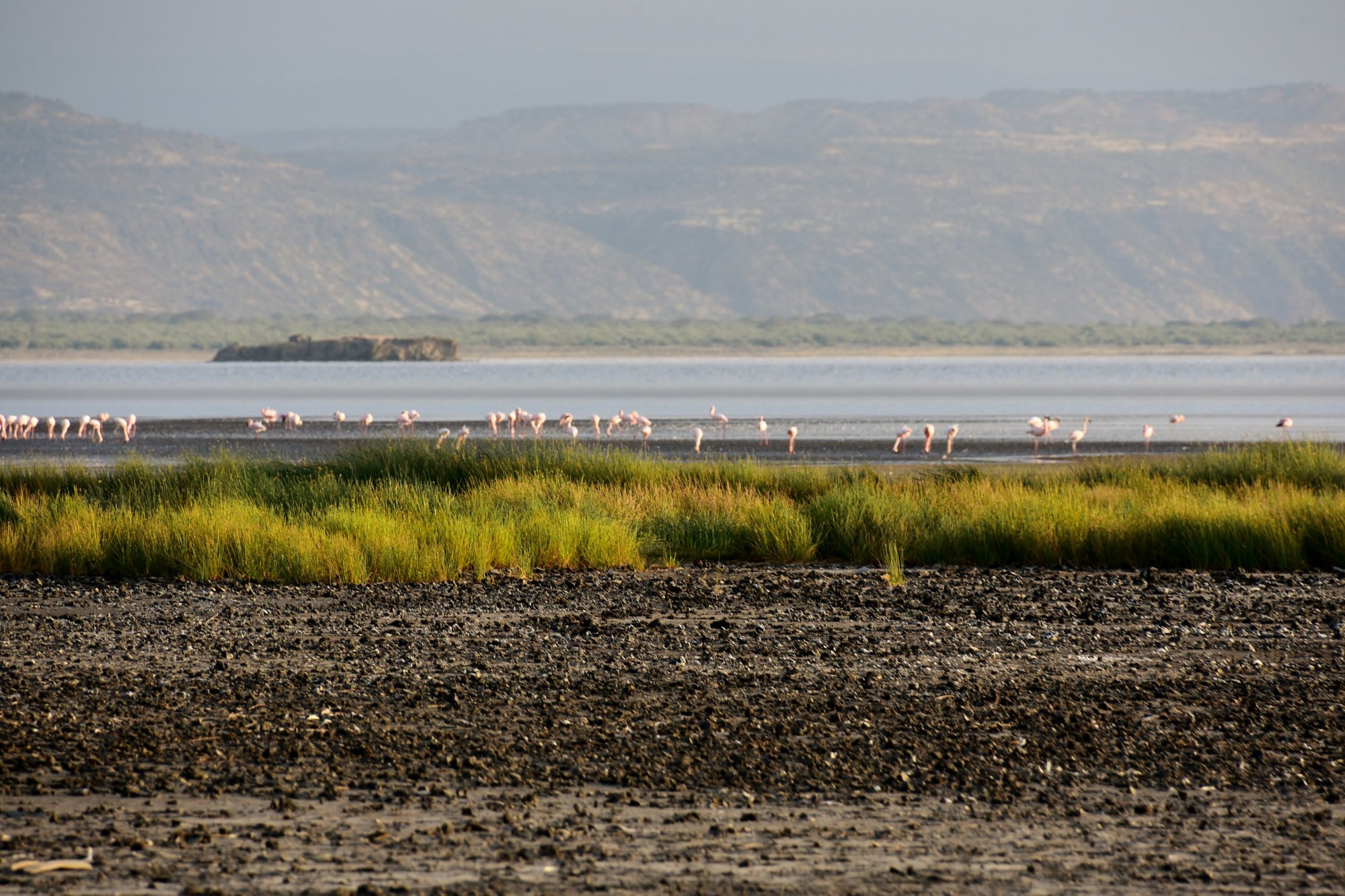
Three qualifications belong with that, and they are why an honest page is more useful than an enthusiastic one. Lesser flamingos do not breed every year, and skip breeding altogether when conditions are wrong; BirdLife is explicit on this. TAWA describes breeding here as erratic, with most of it occurring in January and October but capable of happening at any time if conditions allow. And the breeding colonies are far out on the flats and are not approachable — they are protected by their inaccessibility, and getting close would defeat the purpose of the place. What a visitor sees is birds on the shallows and in the air, in numbers that vary enormously with water level.
The historic counts give a sense of scale without pretending to be current: the Ramsar sheet records aerial counts in 1957 and 1991 indicating around 500,000 breeding pairs or nests, and a January 1995 waterbird count of 105,730. No recent census is published. The flamingo watching guide covers how to think about numbers that move this much, and the lesser flamingo’s Near Threatened status on the IUCN Red List.
The lake also has endemic fish, which surprises people who have been told nothing lives in it. Small alkaline-tolerant tilapia of the genus Alcolapia survive in the cooler spring-fed margins, including A. latilabris and A. ndalalani, which are found here and nowhere else.
Ol Doinyo Lengai
The volcano standing south of the lake is Ol Doinyo Lengai, the Mountain of God to the Maasai, at 2,962 metres. It is the only volcano on Earth known to erupt natrocarbonatite lava, which flows at around 510 °C — cool enough that the lava appears black in daylight rather than glowing — and weathers to white within a short time, which is why the cone is streaked pale.
It is also erupting. The Smithsonian’s Global Volcanism Program records continuous eruption since 9 April 2017, still ongoing in its most recent records. TAWA’s own Lake Natron page says the volcano “lastly erupted in 2006”, which is out of date by two eruptive episodes; where the two disagree, the volcanological database is the better source. The climb is a single overnight push rather than a trek, and it has its own treatment in the climbing Ol Doinyo Lengai guide, including the British Geological Survey’s blunt finding that there are no rescue measures in place on the mountain. Gelai, the other large volcano on the lake’s eastern side, stands at 2,942 metres.
What else there is to do here
Natron is a two-night destination at most, and the days are built around walking rather than driving. Where those nights come from in a northern itinerary is worked through in the guide to how long a Tanzanian trip needs.
The Engare Sero waterfalls are reached on foot up the river gorge from the village, and TAWA describes falls of roughly ten and five metres in the escarpments of the Lepalakash at Engaresero, used for swimming. The Ramsar sheet separately names walking to scenic waterfalls on the Ngare Sero and Peninj rivers as an established visitor activity. It is a wade-and-scramble rather than a path. See waterfall hiking and day hiking.
The Engare Sero footprints are a short distance away: the largest assemblage of human fossil footprints found in Africa, with over 400 prints from at least twenty individuals, dated between roughly 6,000 and 19,000 years old. See archaeological tours.
Natron is also one end of the multi-day walking route down from the Ngorongoro highlands, which the NCAA describes as a two to four day walking safari through to Ol Doinyo Lengai and Lake Natron taking in Empakaai on the way — see mountain trekking. The country is Maasai, and community visits here are covered in Maasai cultural visits. Birders will want bird watching, and camping safaris covers what accommodation at this end of the country is actually like.
What protection here does and does not mean
One thing is worth saying plainly, because it is not obvious from the Ramsar designation. When the lake was listed in 2001, the information sheet recorded its conservation status in these terms: the lake is unprotected, and its status as a game controlled area means that only hunting is regulated. TAWA’s own current page for the area lists both sport and tourist hunting and photographic and eco-tourism among its activities. A game controlled area is not a national park, and a Ramsar listing is a commitment to wise use rather than a prohibition on anything.
The threat that has defined the lake’s recent history is soda ash. A proposal to extract 660,000 tonnes of refined soda ash a year from the lake drew sustained international opposition on the grounds that it would end the flamingo breeding. In August 2025, according to BirdLife International, Tanzania’s deputy minister for minerals announced that large-scale soda ash extraction at Lake Natron would not be permitted and that only traditional surface collection along the lake’s edge is allowed. The Ramsar sheet separately names the Ewaso Ng’iro hydropower and irrigation scheme on the Kenyan side of the catchment, and disturbance by low-flying aircraft, as the other pressures on the site. See conservation tours.
Because this is a game controlled area under TAWA rather than a national park, what you pay to be here does not come from the TANAPA tariff booklet either. TAWA’s published non-consumptive schedules cover game reserves and conservation areas, carry no effective date and no Government Notice number, and no rate for the Lake Natron Game Controlled Area could be verified for this guide, so none is quoted. Ask for the area charge as a separate itemised line, and see the guide to what a Tanzanian trip costs beyond the ground arrangement.
Common questions about Lake Natron
Does Lake Natron turn animals to stone?
No. The water is strongly alkaline and preserves and calcifies animals that die in it, which is where the photographs come from. No authority publishing on the lake claims it petrifies living creatures.
Are flamingos a certainty?
Usually, in some number, but the scale varies enormously with water level and the birds do not breed every year. The breeding colonies themselves are far out on the salt flats and cannot be approached. Anyone expecting the solid pink lake of the photographs should treat it as a possibility rather than a plan.
How many nights does Natron need?
One or two. It is a hot, remote and physically demanding place, and the activities — the waterfall walk, the footprints, the lake shore, and the Lengai climb for those doing it — fit into that. It is usually combined with the Ngorongoro highlands on one side or the northern Serengeti on the other.
Is Ol Doinyo Lengai active?
Yes. The Smithsonian’s Global Volcanism Program records it as in continuous eruption since April 2017. TAWA’s own page for the area gives a much older last-eruption date, which has not been updated.
Can you swim in the lake?
No. The water is caustic and hot enough to injure skin and eyes. The swimming here is in the waterfall pools on the Engare Sero river, which is fresh water, and TAWA describes those falls as used for swimming.
Is Lake Natron a national park?
No. It is a game controlled area under TAWA and a Ramsar site. The Ramsar documentation is explicit that game controlled area status regulates hunting rather than protecting the lake as a whole, and TAWA lists both hunting and photographic tourism among the area’s activities.