
Flamingo Watching in Tanzania
Lesser and greater flamingos on the Rift Valley soda lakes. Lake Natron is East Africa’s single most important breeding site and draws trips in its own right.
Tanzania has two flamingo species and one lake that matters more than the rest. Lake Natron, under the volcano Ol Doinyo Lengai, is East Africa's only regular breeding site for the lesser flamingo, and BirdLife International puts the numbers it sustains at around three quarters of the global population. The colonies themselves cannot be visited, the birds do not breed every year, and numbers on every soda lake swing with the water. This guide sets out what can actually be seen, where, and how to plan a Natron trip that works even when the flamingos do not.
Safaris That Include Flamingo Watching


6 Days Northern Explorer Tanzania Safari
by Oree Safaris Verified operator


8 Days Big Five & Wildebeest Migration Photo Safari Tanzania
by Insight Safari Holidays Verified operator


6 Days Northern Tanzania Safari | Wildlife Tour Package
by Kori Safaris Verified operator

2 Days Lake Manyara Safari
by Tranquil Safaris Verified operator

11 Days Tanzania Wildlife Safari & Wildebeest Migration
by Insight Safari Holidays Verified operator

10 Days Tanzania Safari & Zanzibar Holiday, Beach & Wildlife
by Kori Safaris Verified operator
See all 20 safaris that include flamingo watching
A Guide to Flamingo Watching in Tanzania
Two species, and telling them apart
Tanzania has two flamingo species and they are frequently conflated, which matters because they behave differently and use the lakes differently.
The lesser flamingo is the small, deeply pink one that occurs in the vast flocks. It filters cyanobacteria from the surface of alkaline water with a specialised deep-keeled bill held upside down, and it is the species that makes a soda lake look pink from a distance. Its bill is dark, almost black at a glance, and it is classified as Near Threatened on the IUCN Red List.
The greater flamingo is noticeably larger, paler, and takes invertebrates from soft mud, so it works the shallows and margins rather than the open water. Its bill is pink with a black tip. Greaters occur in far smaller numbers and are often mixed in among lessers at the edges of a flock.
The pink comes from carotenoid pigments in the food, which is why birds in captivity fade without supplementation and why the intensity of colour varies between individuals and across a season.
Lake Natron
Lake Natron, in the Rift Valley north of the Ngorongoro highlands and under the volcano Ol Doinyo Lengai, is the reason flamingo watching in Tanzania is a subject rather than a footnote.
It is East Africa's only regular breeding site for the lesser flamingo. BirdLife International describes the lake as sustaining nearly 1.5 to 2.5 million flamingos, representing around 75 per cent of the species' global population, and it has been listed as a Ramsar wetland of international importance since 2001. In practical terms, most of the lesser flamingos seen anywhere in East Africa were hatched here.
Breeding is not annual. Lesser flamingos often skip breeding altogether when conditions are unfavourable, which means a successful season at Natron is both irregular and disproportionately important. This is the single fact that most travel coverage of the lake omits, and it is the one that should shape expectations.
Why Natron and nowhere else
The answer is chemistry. Natron is fed by mineral-rich springs and hot springs and has no outlet, so evaporation concentrates sodium carbonate and other salts to the point where the water is strongly alkaline and the surface temperature can be extreme. Very little can survive in it.
For a nesting flamingo that hostility is protection. Colonies are built on mud cones on salt flats far out in the lake, surrounded by water that no terrestrial predator will cross. The chicks walk, sometimes for many kilometres, to fresher water at the lake margins once they can travel.
The lake also supports a cyanobacterium that thrives in exactly these conditions and is the lesser flamingo's food, so the chemistry that excludes everything else also provides the diet.
One thing should be corrected because it circulates constantly. Lake Natron does not turn living animals to stone. Its caustic, highly alkaline water preserves and calcifies the carcasses of birds and bats that die in or over it, and a well-known photographic series of those preserved bodies has been widely misread as showing animals petrified on contact. The lake is genuinely dangerous to skin and eyes and it is not a myth-making machine.
What a visit to Natron is actually like
This needs saying plainly, because the gap between expectation and experience is wider here than anywhere else in this cluster.
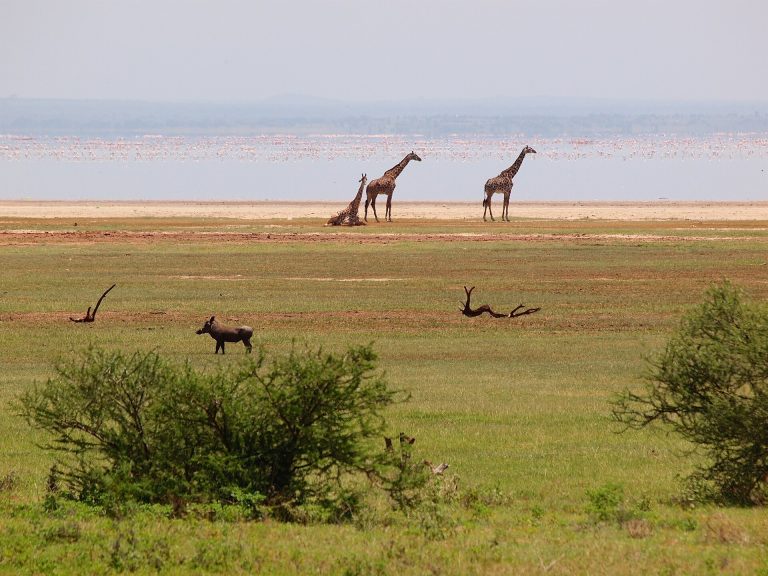
The breeding colonies cannot be visited. They sit far out on salt flats that cannot be walked to or driven to, and approaching them would be both impossible and damaging. What a visitor sees is flamingos feeding and loafing along the accessible southern shore, sometimes in enormous numbers spread across the shallows, sometimes in modest ones, and occasionally a distant pink band shimmering in heat haze that a spotting scope resolves into birds.
Natron sits outside the national park system, in community land in the Ngorongoro district near Engaresero village, so access is arranged locally rather than through a park gate and local guides accompany visits to the lake shore. The walk out across the flats is hot, flat and glaring, and it is best done very early.
Most people come for more than the birds. Ol Doinyo Lengai, the only active carbonatite volcano in the world, stands immediately south and is climbed overnight, as covered in the Ol Doinyo Lengai climb guide. The Engare Sero waterfalls, in a gorge behind the village, are a short walk and an antidote to the heat. Ancient human footprints preserved in volcanic ash near the lake are among the most significant of their kind.
The drive in from the Ngorongoro highlands is long, rough and spectacular, dropping off the escarpment into Rift Valley floor country. Accommodation is limited and simple, and the heat is severe. Natron is a one or two night stop on a northern circuit for travellers who want landscape and something unusual, not a comfortable add-on.
The other flamingo lakes
Flamingos occur on soda and alkaline lakes across northern Tanzania, and several are far easier to reach than Natron.
Lake Manyara is the most accessible. TANAPA's own description is of rafts of pelicans and "literally millions of flamingos at some times of the year", and the qualification in that sentence is the important part: Manyara's flamingo numbers depend entirely on water level and can swing from spectacular to almost nothing. When the birds are in, they are usually a long way out on the flats and a scope earns its place.
The Momella Lakes in Arusha National Park offer the best close views in the country. TANAPA notes that the game viewing track winding around the lakes is a good way to get close to both lesser and greater flamingo, and because these are small crater lakes rather than a vast soda pan, the birds are within sensible range of a vehicle or a canoe. For anyone who wants to look at flamingos properly rather than at a pink smear on the horizon, this is the place.
Lake Magadi, on the Ngorongoro Crater floor, holds flamingos in varying numbers and is seen by almost every crater visitor without any special arrangement.
Lake Eyasi and Lake Burunge hold birds seasonally and are usually visited for other reasons.
Anyone building a birding trip more broadly should read the bird watching guide, which covers the wider wetland and soda lake circuit.
When to go
Water level governs everything, and water level is not a calendar.
Broadly, numbers build on the soda lakes after rain has refreshed them and concentrate as they shrink, and the lakes can empty of birds when levels are wrong in either direction. A lake that was covered in flamingos one year can be almost bare the next in the same month. No published forecast exists.
Breeding at Natron, when it happens, tends to follow good rains, but since lesser flamingos skip breeding in poor conditions there is no season that can be booked. The honest planning advice is to treat flamingos as a variable and to build the Natron leg around the landscape, the volcano and the walk, so that a poor flamingo showing does not waste the trip. What can and cannot honestly be timed in a Tanzanian year takes the same line on the breeding cycle.
For reliable close viewing rather than spectacle, the Momella Lakes are the better bet in any month.
The threat to the lake
Lake Natron has been under proposal for industrial soda ash extraction for many years, and the conservation case against it is that industrial disturbance, water abstraction and altered chemistry at the only regular East African breeding site for a Near Threatened species would be difficult to reverse.
In August 2025 Tanzania's deputy minister for minerals announced that large-scale soda ash extraction at Lake Natron would not be permitted, and that only traditional surface collection of naturally occurring soda ash along the lake's edge is allowed. The decision followed a proposal to extract hundreds of thousands of tonnes of refined soda ash annually.
This is a significant outcome and it does not make the question permanently settled. Visitors interested in the conservation dimension can pursue it through the conservation tours guide.
Photography and practical notes
Flamingos are a long-lens subject on the big lakes and a moderate-lens subject at Momella. Heat haze is the defining problem at Natron: from mid-morning the shimmer across the flats destroys resolution at any distance, so the only usable window is the first two hours of light and the last.
Massed flocks work better as pattern than as portrait. A tight crop of hundreds of birds in a band across the frame says more than an individual does, and the reflections on a still soda lake at dawn are the reason photographers come.
Practically: the water is caustic and should not be walked in or touched, and anything that does get into it should be rinsed. The salt flats reflect heat upwards as well as down, so a broad hat, high-factor sunscreen, sunglasses and far more water than seems necessary are not optional. Footwear that can be rinsed is better than open sandals. Take a dust blower for camera gear, because the flats produce a fine alkaline dust that gets everywhere.
Common questions about flamingo watching
Can the flamingo breeding colonies at Lake Natron be visited?
No. The colonies are built on salt flats far out in the lake, surrounded by water that cannot be crossed, which is precisely why the flamingos nest there. Visitors see feeding and loafing flocks along the accessible shore.
Is the lake always pink with flamingos?
No. Numbers depend on water level and vary enormously between years and within a season, and lesser flamingos do not breed every year. A visit should be planned so that the landscape, the volcano and the waterfalls justify it on their own.
Where is the easiest place to see flamingos close up?
The Momella Lakes in Arusha National Park, where TANAPA's own material notes that the game viewing track gives close views of both lesser and greater flamingo. The lakes are small enough that the birds are within reasonable range of a vehicle or a canoe.
Does Lake Natron really turn animals to stone?
No. The water is caustic and strongly alkaline and it preserves and calcifies the carcasses of birds and bats that die in it. A widely circulated photographic series of those preserved bodies has been misread as showing living animals petrified on contact.
How do you get to Lake Natron?
By road from the Ngorongoro highlands or from Arusha, on a long and rough drive that descends the Rift escarpment. The lake is on community land rather than inside a national park, so visits are arranged locally and local guides accompany walks to the shore.
What is the difference between the two flamingo species?
Lesser flamingos are smaller and deeper pink with a dark bill, filter cyanobacteria from open alkaline water and form the huge flocks. Greater flamingos are larger and paler with a pink black-tipped bill, feed on invertebrates in soft mud and occur in much smaller numbers.
Is flamingo watching worth a dedicated trip?
Lake Natron is, for travellers who want a genuinely remote Rift Valley landscape with a volcano, a gorge and ancient footprints alongside the birds. For flamingos alone, adding Lake Manyara and Arusha National Park to an existing northern circuit delivers most of the viewing with none of the effort.