
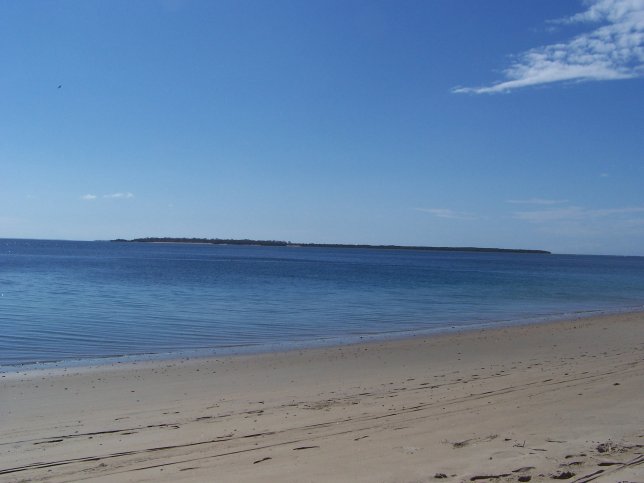
The last marine park before Mozambique
Mnazi Bay–Ruvuma Estuary Marine Park occupies the final 45 kilometres of the Tanzanian coast, running from the headlands at Ras Msangamkuu south to the Ruvuma River on the Mozambican border. It was established in 2000 and covers about 650 square kilometres, taking in Mnazi Bay itself, the northern portion of the Ruvuma estuary, and three islands — Namponda, Membelwa (also called Mongo) and Kisiwa Kidogo.
It is administered by the Marine Parks and Reserves Unit, not by TANAPA, which matters for anyone trying to plan a visit through the usual national-park channels. Its own management plan calls out one distinguishing feature: the ratio of land to sea inside the park is the highest of any marine protected area in East Africa, because a wide strip of coast was deliberately included to act as a buffer against activities that would otherwise reach the water.
Seventeen villages and some 44,000 people live inside the boundary. This is not an empty reserve; it is an inhabited coast with protection over it, and most of what a visitor sees is worked landscape.
The whale season, which is the reason to time a trip
This is the one place on the Tanzanian mainland with a documented, seasonal whale run. The park’s general management plan records that humpback and sperm whales and dolphins are frequently observed in Mnazi Bay and off the Msimbati and Ruvula channel, and that whales typically visit the park’s waters from July to November, during their annual migration to and from the colder water of the southern Indian Ocean.
The Marine Parks and Reserves Unit corroborates the same window independently and adds detail: the animals move into this zone because the water is warm in that period; they stay roughly four months; and they come to feed and to calve and raise their young in sheltered water. The Unit puts the annual migration at around 8,000 kilometres. One caveat on that account — it describes the animal as the largest in the world, which is true of the blue whale rather than the humpback, so read the species identification from the management plan rather than from the press notice.
The season has grown a festival around it. The Unit has run a Nyangumi (whale) festival tied to the July-to-November period; the 2025 edition opened at the Mashujaa grounds in Mtwara on 10 to 12 September and closed on the park’s beaches at Msimbati village on 13 and 14 September. An earlier Unit listing gave the Msimbati season as August to November. Dates and format are set annually and should be confirmed locally rather than assumed. The wider picture is in the guide to whale watching, and dolphins under dolphin watching.
What else is there
The beaches. The management plan describes the shore of the Msimbati peninsula, from Msimbati village to Ruvula, as some of the most scenic in all of Tanzania. They are undeveloped. See beach holidays.
The reefs. The park’s corals are described as highly productive and relatively undisturbed. Snorkelling and diving go on the reefs off Msimbati, along the beach at Ruvula and at Msangamkuu, and around Namponda and Membelwa islands. See snorkelling and scuba diving.
The estuary. Large tracts of mangrove forest surround the Ruvuma delta, and the plan records hippos in the Ruvuma River, along with crocodiles, monkeys, wild pigs, bush babies, birds and bats, and banks carrying rare endemic plants. See mangrove tours and bird watching.
Sandbanks of a kind described as rare in East Africa appear across the park’s seagrass beds — see sandbank and island hopping.
The activities recorded in the park to date are snorkelling, scuba diving, bird watching, camping, windsurfing and sun bathing. Turtles nest on this coast and are one of the species of concern the park was created to protect — see sea turtle watching — and the pressures the park exists to manage, from destructive fishing to coral mining and mangrove cutting, are the subject of the guide to conservation tours.
Getting there, and what to expect
The base is Mikindani or Mtwara. The park’s own plan states that most visitors make a day trip from hotels in those two towns, that there are no conventional tourist hotels inside the park beyond a small campsite and thatched bungalows at one lodge on the peninsula, and that the road in is a graded dirt track requiring an off-road vehicle for much of the year. That was written in 2011 and conditions may have improved; it is the most recent official description available and it should set your expectations rather than a brochure.
Visitor numbers are low. The plan records the level of tourist visitation as low, with most of the few visitors being resident expatriates and missionaries based in Mtwara and Lindi, and it notes that sites for tourist development had at that point still to be identified and publicised. The Unit’s own per-park web pages carry no visitor information. Arrangements are best made through accommodation in Mtwara or Mikindani, and confirmed before you drive.
One more thing to know about this stretch of coast: natural gas was discovered in Mnazi Bay in 1982, wells operate in the bay supplying a power plant in the Mtwara–Mikindani area, and deep-water hydrocarbon exploration has taken place offshore. It is a protected area with an energy industry inside it, and the management plan is explicit about the tension.
Entry is charged by Tanzania’s Marine Parks and Reserves Unit, a separate authority from TANAPA and TAWA with its own schedule, so a national park tariff tells you nothing about what is payable here. The Unit publishes no figure on its per-park pages, and none is invented here — it is worth asking for as a named line rather than assuming it is inside a tour price. The guide to how Tanzania’s conservation charges are set explains the three separate regimes.
When to go
Mtwara Region falls in the southern coastal zone, which the Tanzania Meteorological Authority classifies as unimodal — one rainy season a year, running from November into April or May. This is not the northern coast’s pattern: there is no October-to-December Vuli here and no dry window in January and February.
That makes the decision unusually simple, and unusually different from the rest of the country’s calendar as set out in the seasons across Tanzania. June to October is the dry season, the road is at its best, and July to November is the whale window. The overlap from July to October is the time to come.
Getting here is the real constraint: this is the far south-eastern corner of the country, reached by a flight to Mtwara or a very long drive, and the guide to reaching Tanzania’s far corners covers what that journey involves.
Common questions
Is this a TANAPA park?
No. Marine parks in Tanzania are administered by the Marine Parks and Reserves Unit under separate legislation from the national parks. TANAPA channels, fees and booking systems do not apply.
How likely are you to see whales?
The management plan describes humpbacks, sperm whales and dolphins as frequently observed in the bay and the Msimbati/Ruvula channel during the season, which is a stronger statement than is made for anywhere else on the Tanzanian mainland. It is still a wild animal in open water. Come inside the July-to-November window and give yourself more than one day on the water.
Can you visit independently?
You can, but the access road has historically required a high-clearance vehicle and facilities inside the park are minimal. Basing in Mtwara or Mikindani and arranging boats and guides from there is the normal approach.
How does it compare with Mafia?
Mafia has established diving infrastructure, a seasonal whale shark aggregation and regular flights. Mnazi Bay has almost no infrastructure, far fewer visitors, and the only documented mainland whale season. They are not substitutes for one another.