
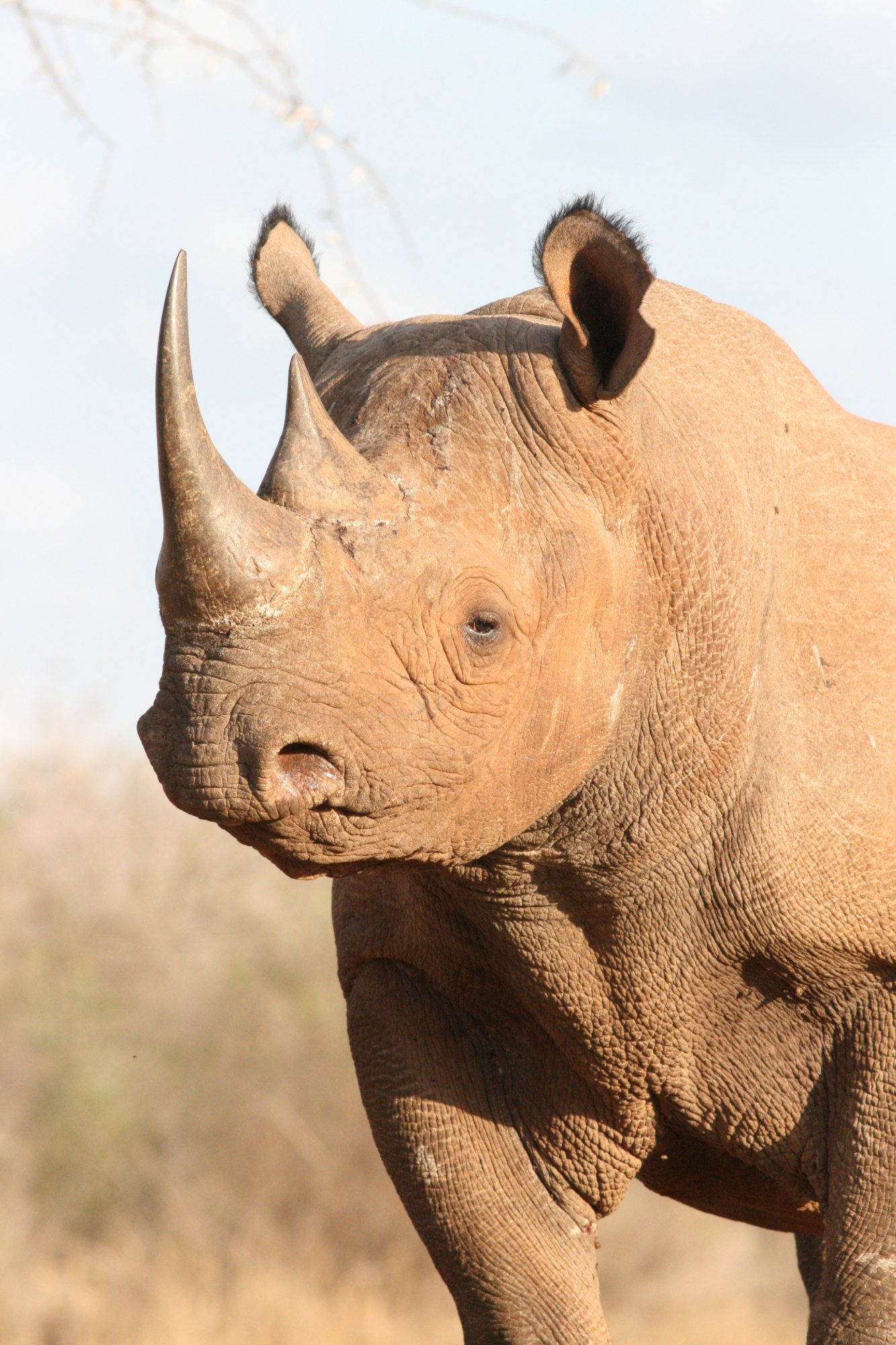
If you want black rhino and wild dogs on a northern Tanzania safari without queues of vehicles, Mkomazi National Park is the park built for that trip. Mkomazi covers 3,245 square kilometres of thornbush on the Kenyan border, joined to Tsavo West, and its main gate sits 6 km from Same town, about 112 km from Moshi. Entry is USD 30 per adult per day plus VAT on the current TANAPA tariff.
Animals You Can See in Mkomazi
Mkomazi holds eastern black rhino in a guarded breeding area and free ranging African wild dogs. Elephant, buffalo and the big cats live here too, alongside a set of dry country antelope that the better known northern parks mostly lack. TANAPA records more than 450 bird species. Game density is lower than in Tarangire or the Serengeti, so the reward here is rarer species and quiet roads rather than big herds at every turn.
The park is the southern tip of the Somali and Sahel dry belt. That geography explains the wildlife list: animals of northern Kenya and Ethiopia reach the edge of their range here, which is why a Mkomazi game drive feels different from a day in Ngorongoro.
Black Rhino in the Mkomazi Rhino Sanctuary Area
Black rhino viewing in Mkomazi happens inside fenced and guarded sanctuary land, not on open plains. Every resident rhino was lost to poaching by the late 1980s. The George Adamson Wildlife Preservation Trust built a fenced area between 1995 and 1997, first 45 sq km and later 55 sq km, and brought in 15 eastern black rhino from South Africa, England and the Czech Republic. The Trust reports that 34 rhino lived there when it handed the project to TANAPA.
Sightings on a booked visit are very likely, yet not certain: the rhino are wild animals in thick bush, and some visitors see them at a distance. Binoculars help more than a long lens. Rhino viewing is an activity with its own fee, covered under safari activities and park costs.
African Wild Dog Tracking in Mkomazi
Mkomazi ran East Africa’s first captive breeding and release programme for African wild dogs, starting in 1995 with 25 pups from three packs on the Maasai Steppe. By the time the Trust handed over to TANAPA, more than 200 dogs had been released into the Mkomazi and Tsavo ecosystem, and packs now den in the wild. Wild dogs range over huge distances, so a sighting on any given day is luck. Sightings are reported more often from July to October, when the bush thins.
Gerenuk, Oryx and Lesser Kudu in the Dry Bush
Three antelope set a Mkomazi wildlife safari apart: gerenuk, fringe eared oryx and lesser kudu. Gerenuk browse standing upright on their hind legs. Oryx cross the open grass in small herds, while lesser kudu keep to thicker commiphora bush. Few Tanzanian parks offer all three, and none in the northern circuit offers them as reliably. Grant’s gazelle, eland and hartebeest fill out the plains game, with giraffe and zebra near water.
Elephants, Lions and the Tsavo Crossing
Elephant numbers show the park’s recovery best. According to the Trust, only 11 elephants remained in 1989, and up to 600 were counted in the wet season of 2010. Herds move freely across the Kenyan border from Tsavo West, so numbers rise in the rains and fall in the dry months. Lions are present but less habituated than in the Serengeti, and leopards are hard to find: travellers who want a big cat sighting should plan a second park.
Birdwatching Species in Mkomazi
Mkomazi’s bird list of more than 450 species includes dry country birds at the southern edge of their range, among them the violet wood hoopoe, Friedmann’s lark, the Somali long billed crombec and the yellow vented eremomela. Vulturine guineafowl and kori bustard turn up often on game drives, along with ostrich and secretary bird. Palearctic migrants arrive from November to April.
When to Go to Mkomazi for Rhinos and Game Viewing
June to October is the best time to visit Mkomazi for game viewing, because the grass dies back, water shrinks to a few dams and animals gather where guides can find them. The rhino area is open all year, so a rhino visit works in any month.
TANAPA describes the climate in two rainy seasons: the long rains from March to May and the short rains in November and December. The hottest stretch runs from October to April, and the coolest from May to September. The park sits between roughly 800 and 1,200 metres, so nights cool down even in the hot season.
Wet months have a real case too. From November to April the bush turns green, migrant birds arrive and the few lodges see almost nobody. The trade off is dispersal: with seasonal pools everywhere, elephants and plains game no longer need Dindira Dam, and finding them takes longer. The Mkomazi Wilderness Retreat describes most park roads as all weather, though a high clearance vehicle is wise after heavy April rain.
Safari Activities in Mkomazi National Park
The main safari activities in Mkomazi National Park are game drives, the booked rhino viewing visit, guided walking safaris with a ranger and birding, with camping and bush meals as add ons. Each activity is arranged through TANAPA at Zange gate or by your operator, and most carry a fee on top of daily park entry.
Game Drive Safaris on the Dindira and Zange Circuits
A Mkomazi game drive covers the western circuit between Zange gate and Dindira Dam, with longer loops toward Maore and Kisima. Morning drives give the best light and activity, and TANAPA closes the gates at 18:00. Vehicle numbers stay very low. One traveller report describes seeing a single other safari vehicle across four days, and one operator puts the August peak at up to about ten vehicles across the whole park.
Rhino Viewing Tour in the Mbula and Kisima Sanctuaries
A rhino viewing tour is the reason many travellers book Mkomazi, and it runs differently from a game drive. Visitors join a TANAPA ranger, often switch to a park vehicle at the sanctuary fence, and spend a set hour searching with trackers who know each animal. The current tariff lists Mkomazi special rhino viewing at USD 30 per adult and USD 10 per child aged 5 to 15 for one hour, plus VAT. Rhino viewing at the Kisima project is a separate line at USD 200 per person, and rhino tracking with trackers at USD 500.
Book the visit before you arrive, through your operator or the park, because ranger slots are limited. In the dry season, guides favour an early morning slot, when rhino are still feeding in the open.
Mkomazi Park Fee Calculator
Enter your group and plans to total the TANAPA fees for a Mkomazi visit, including 18% VAT. Accommodation, vehicle hire and guiding by your operator are not included.
USD 318.60
USD 159.30 per person in TANAPA fees, VAT included
| Fee | Basis | USD incl. VAT |
|---|---|---|
| Park entry | 2 adults × USD 30, 1 day | 70.80 |
| Rhino viewing | 2 adults × USD 30 | 70.80 |
| Vehicle entry | USD 150 per entry | 177.00 |
| Total TANAPA fees | 318.60 | |
Fee basis, exclusive of VAT, from the TANAPA tariff schedule: park entry USD 30 per adult and USD 10 per child per 24 hours; rhino viewing USD 30 and USD 10 for one hour; walks USD 20 (1 to 4 hrs) or USD 25 per adult; concession at a private camp USD 25 per adult and USD 10 per child per night; public campsite USD 30 and USD 5; special campsite USD 50 and USD 10; vehicle entry USD 40 up to 2,000 kg or USD 150 from 2,001 to 3,000 kg per entry, open vehicles 50% extra. Under fives enter free. TANAPA’s park web page shows a higher USD 70 adult figure, so confirm the current rate with TANAPA or your operator before paying. Figures are indicative. Last checked November 2026.
Walking Safaris with a TANAPA Ranger
Guided walking safaris leave from the main gate area with an armed ranger. TANAPA charges USD 20 per adult for a short walk of 1 to 4 hours and USD 25 for a longer walk, plus VAT, and sets child walk rates only from age 12. Walks focus on tracks and birds rather than big game.
Birdwatching Tours at Zange, Dindira and Maore
TANAPA names six strong birdwatching spots in Mkomazi: Zange, Maore, Mbula, Dindira, Norbanda and Ngurunga. A dedicated birding tour moves slowly, stops at dams and rocky outcrops, and works best with a guide who knows dry country calls. Birders who want the range edge specials should allow a full day.
Camping and Bush Meals Inside the Park
Camping is possible at the public campsite near Zange and at special campsites such as Dindira and Maore. A bush meal, listed on the TANAPA tariff as a per person activity, lets a group eat at a set site in the bush rather than returning to the gate.
Places to See in Mkomazi National Park
The key places to see in Mkomazi National Park are the two rhino sanctuaries, Dindira Dam, the Umba River in the south east and the mountain views along the western edge. Most visitors on a short stay see the western half between Zange and Kisima.
Dindira Dam and the Waterhole Plains
Dindira Dam is the main dry season water point in western Mkomazi, and elephants and buffalo gather there from July to October, often with giraffe and zebra. The Mkomazi Wilderness Retreat sits on Dindira Hill above it, and on clear early mornings Kilimanjaro shows to the north west.
Mbula and Kisima Rhino Sanctuaries
Mbula, in the north west near Dindira Dam, is the newer sanctuary area and the closer of the two to Zange gate. Kisima, deeper in the park, is the original project base, with its own airstrip and a TANAPA base camp.
Umba River and the Eastern Sector
The Umba River forms the south eastern boundary and is the only permanent river in Mkomazi; crocodiles live in its pools. The eastern sector is remote, reached through Umba gate by special arrangement only.
Pare and Usambara Mountain Views
The Pare Mountains rise along the west of the park and the Usambara range along the south, and these ridges are part of the Eastern Arc. Baobabs and granite inselbergs fill the foreground, which makes this edge of the park good ground for a photographic safari.
What Is Mkomazi National Park Known For?
Mkomazi National Park is known for its recovery story: a degraded game reserve turned into Tanzania’s leading black rhino and wild dog refuge. The area was protected as Mkomazi and Umba game reserves from 1951 and gazetted as a national park under TANAPA in 2008. The name comes from Pare words for a wooden spoon and water, a reference to how little water the land holds.
The recovery came at a cost. By July 1988 the government had evicted the herders, mainly Parakuyo and Maasai, who grazed cattle in the reserve. In 1998 the High Court found that one group’s eviction had not followed the law and ordered compensation for 15 plaintiffs, and the eviction is still debated. In 1989 the government invited Tony Fitzjohn and the George Adamson Wildlife Preservation Trust to rebuild roads and ranger patrols, work that ran for thirty years until TANAPA took over the rhino project.
How Mkomazi Differs from Tarangire National Park
Mkomazi differs from Tarangire by trading elephant density and easier big cat sightings for black rhino, wild dogs, dry country antelope and near empty roads, at a lower daily fee. Both sit on the same TANAPA tariff, so the fee gap below is like for like.
| Feature | Mkomazi | Tarangire |
|---|---|---|
| Adult entry | USD 30 + VAT | USD 50 + VAT |
| Concession | USD 25 a night | USD 40 a night |
| Black rhino | Booked visit | None listed |
| Main draw | Rare species | Big herds |
| Vehicles | Very few | Busy in July |
Tarangire suits a first safari where lions and large elephant herds matter most. Mkomazi suits a second park on the same trip, a post Kilimanjaro add on, or a traveller who has already done the Serengeti and wants something quieter. Tsavo West in Kenya shares Mkomazi’s border and dry country wildlife, but reaching it from the Tanzanian side means a border crossing and a separate Kenyan park fee. The Tarangire figures are the peak season rates on the TANAPA tariff.
Where Mkomazi Sits in Tanzania
Mkomazi sits in north eastern Tanzania, mostly in Same District of Kilimanjaro Region, with its eastern part in Lushoto and Mkinga districts of Tanga Region. Its long north eastern edge is the Kenyan border, and Tsavo West National Park lies across it, so wildlife moves freely between the two. Same is the nearest town, and Moshi is the nearest city.
Getting to Mkomazi by Road and Air
Most visitors reach Mkomazi by road from Moshi or Arusha to Zange gate, 6 km from Same on the tarmac highway to Dar es Salaam; charter flights can land at airstrips inside the park. No scheduled flights serve Mkomazi.
Road Transfer from Moshi and Arusha
TANAPA puts Zange gate about 112 km from Moshi and about 190 km from Arusha. Expect around 2 to 3 hours from Moshi and 4 to 5 hours from Arusha, depending on traffic through Same. From Kilimanjaro International Airport the drive is roughly 140 to 150 km, so a traveller can land and reach the park the same day.
Road Access from Tanga and the Coast
From Tanga, about 150 km away, or from Mombasa, travellers can approach the eastern side through Umba gate, but only by special arrangement with the park. Most coast routes still use the highway to Same and enter at Zange.
Charter Flights to Kisima and Kavateta Airstrips
Charter flights use the Kisima and Kavateta airstrips inside Mkomazi. Flights are arranged privately through an operator or charter company, and the lodge collects guests at the strip.
Mkomazi Lodges and Camps
Mkomazi has only a few places to stay: two small tented camps inside the park, TANAPA campsites and simple hotels in Same. Sleeping inside the park adds a TANAPA concession fee of USD 25 per adult per night plus VAT at a private camp. Rates below appear only where the property publishes them.
Tented Camps Inside the Park
Mkomazi Wilderness Retreat has seven tents on Dindira Hill, each facing the plains or the waterhole below, with walk in showers and full solar power; its restaurant looks toward the Pare Mountains and Kilimanjaro. Mkomazi View Camp, run by African View, is a newer camp with six en suite tents near Mbula and Dindira Dam, about 15 minutes from Zange gate. Neither camp publishes a public rate, so ask your operator for a quote.
TANAPA Campsites and Kisima Base Camp
TANAPA campsites suit self drivers and budget travellers. The tariff lists the public campsite at USD 30 per adult per night and special campsites at USD 50, plus VAT, with Kisima base camp at USD 200 per person per night. Bring water and food from Same.
Hotels in Same and the Usambara Mountains
Same, 6 km from Zange gate, has small guesthouses and hotels with no park concession fee. In the western Usambaras, MamboViewPoint eco lodge sits at about 1,900 metres above the park, around one and a half hours from the Kamakota entrance by its own account, a good pick for travellers combining Mkomazi with mountain hiking.
How Much It Costs to Visit Mkomazi National Park
Visiting Mkomazi National Park costs USD 30 per non East African adult per 24 hours in park entry, plus 18% VAT, so USD 35.40 in practice; children aged 5 to 15 pay USD 10 and under fives enter free. Activity, vehicle and overnight fees come on top. All figures below come from the TANAPA tariff schedule, which lists them exclusive of VAT.
| Fee | Adult (USD) | Child 5 to 15 |
|---|---|---|
| Park entry, 24 hrs | 30 | 10 |
| Rhino viewing, 1 hr | 30 | 10 |
| Walk, 1 to 4 hrs | 20 | 10 (12+) |
| Concession, per night | 25 | 10 |
| Public campsite | 30 | 5 |
A foreign or commercially registered vehicle pays USD 40 up to 2,000 kg tare weight and USD 150 between 2,001 and 3,000 kg, the band most safari Land Cruisers fall into; open sided vehicles pay 50% more. East African citizens pay TZS 5,000 per adult per day. A park guide costs USD 20 per group per day. The guide to what a Tanzania safari costs sets these park fees against vehicle, guide and lodge prices.
Reasons to Plan a Mkomazi Safari
The strongest reasons to plan a Mkomazi safari are a near certain black rhino sighting on a booked visit, the chance of wild dogs, three dry country antelope in one park, and lower fees and fewer vehicles than any other northern park. Mkomazi also fits neatly around a Kilimanjaro climb, since Moshi is the closest city.
The honest counterweight is density. A first time visitor who has never seen a lion should not make Mkomazi the only park on the trip, because big cats are harder to find and herds are smaller than in Tarangire. For travellers who have done the classic circuit, that same quiet is the point.
Mkomazi Safari Itineraries from One to Three Days
One day is enough for a first look at Mkomazi from Moshi, two nights cover the rhino visit and a walk without rushing, and three nights suit birders or travellers adding the Usambara Mountains. Every plan below starts at Zange gate; for the wider trip, see how many days you need in Tanzania.
One Day Mkomazi Rhino Safari from Moshi
Leave Moshi at about 06:00 and reach Zange gate by 08:30. Drive the Dindira circuit in the morning, take the booked rhino hour before lunch, then return to Moshi by early evening. The day is long, with roughly 5 hours on the road, but needs only one day of park fees.
Two Night Mkomazi Safari
Day one: drive from Moshi or Kilimanjaro airport, enter at Zange and take an afternoon game drive to camp. Day two: early rhino viewing, a ranger led walk and an afternoon drive toward Maore. Day three: a final morning drive, then continue to Moshi, Arusha or the coast.
Three Night Mkomazi and Usambara Mountains Trip
Spend two nights in the park for game drives, the rhino visit and birding at Dindira and Maore, then drive south to the western Usambaras for a night of mountain walking before heading on to Tanga, Lushoto or Dar es Salaam.
Questions Travellers Ask About Mkomazi
Can you see black rhinos in Mkomazi National Park?
Yes, black rhinos can be seen in Mkomazi National Park on a booked rhino viewing visit inside the fenced sanctuary, guided by a TANAPA ranger. The current tariff charges USD 30 per adult for one hour, plus VAT. Sightings are very likely but not guaranteed, and some rhino are seen at a distance in thick bush.
How far is Mkomazi from Moshi and Arusha?
Zange gate, the main entrance to Mkomazi, is about 112 km from Moshi and about 190 km from Arusha by TANAPA’s figures. That is roughly 2 to 3 hours from Moshi and 4 to 5 hours from Arusha on tarmac, which makes a day trip from Moshi practical.
Is Mkomazi National Park worth visiting?
Mkomazi National Park is worth visiting for travellers who want black rhino and dry country antelope with almost no other vehicles, especially as a second park or after Kilimanjaro. First time visitors focused on lions and big herds get more from Tarangire or the Serengeti, so pair Mkomazi with one of them.
How many days do you need in Mkomazi?
One full day in Mkomazi covers the Dindira circuit and a rhino visit. Two nights are better, because they allow early morning drives, a walking safari and a calmer rhino slot, and three nights suit serious birders.
Can you self drive in Mkomazi National Park?
Self drive is allowed in Mkomazi National Park, and the road to Zange gate is tarmac. A high clearance 4×4 is the safer choice inside the park, especially after rain, and the rhino visit still needs a TANAPA ranger and an advance booking.
Are there lions and leopards in Mkomazi?
All three big cats live in Mkomazi, but they are less habituated and harder to find than in the northern circuit parks. Leopard sightings in particular can take several days, so treat any big cat as a bonus.
What is the best month to visit Mkomazi?
September and October are the strongest months for Mkomazi game viewing, at the end of the dry season when animals crowd Dindira Dam and the bush is thinnest. For birding, November to April brings migrants and green bush.
Tanzania Safari.travel plans northern Tanzania safaris and can fit Mkomazi into your trip as a rhino day from Moshi, a two night stop after Kilimanjaro, or a quiet park between Tarangire and the coast. Tell us your dates and how many people are travelling, and we will build the route and price it with every park fee shown.