
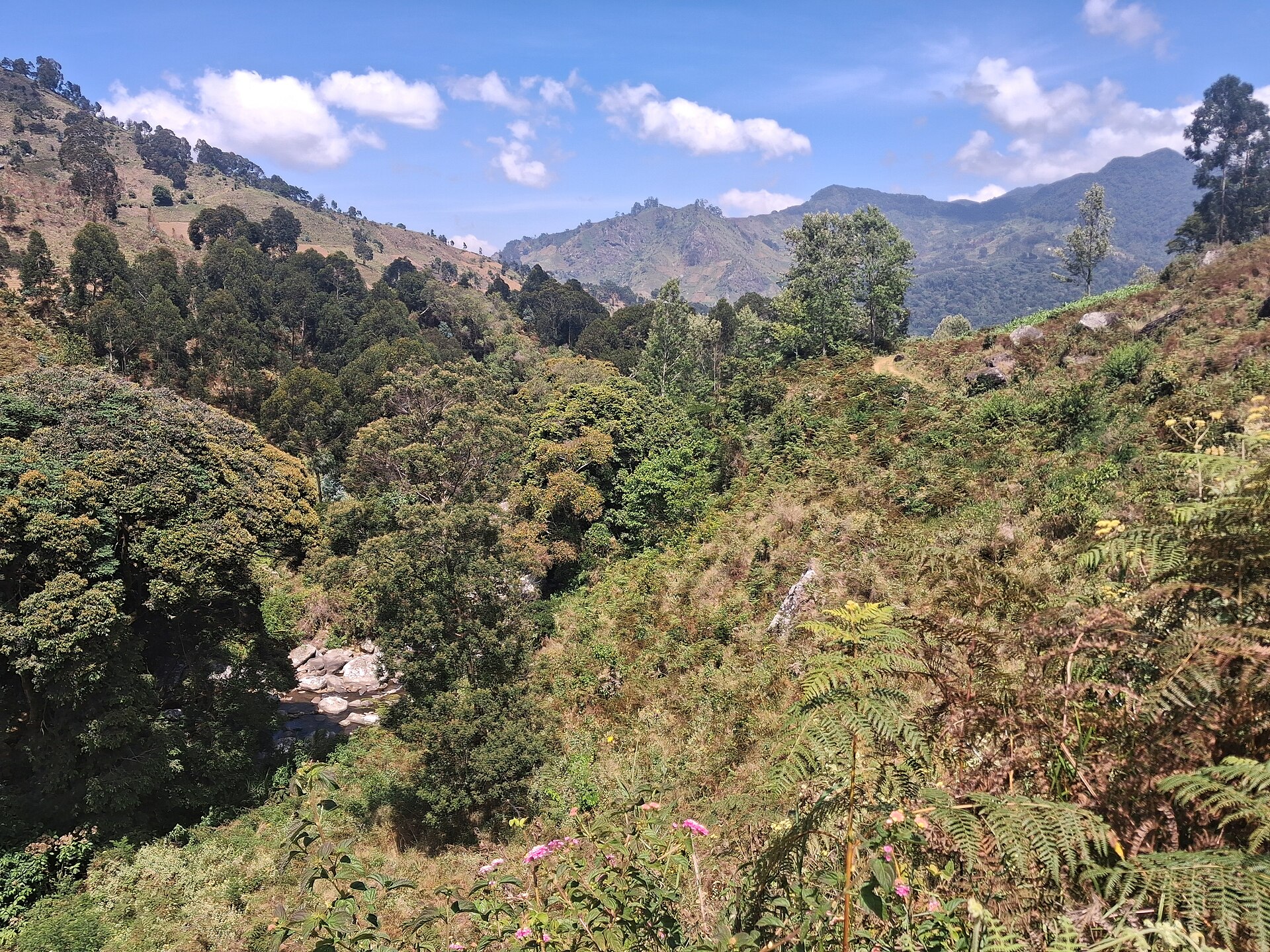
The protected core of the Ulugurus
The Uluguru Nature Forest Reserve is the formally protected forest at the heart of the Uluguru Mountains, above Morogoro. It is managed by Tanzania Forest Services rather than by Tanzania National Parks, which changes how it is visited, what rules apply and where the information comes from.
TFS gives the forested area as 24,115 hectares, stretching across Morogoro and Mvomero districts, and describes the reserve as part of the Eastern Arc Mountains, one of the world’s biodiversity hotspots. The agency’s own headline for the reserve is a bird: “A Home to Uluguru Bushshrike”.
What the reserve protects
The Uluguru bushshrike, known locally as kurumbizi, occurs in these mountains and nowhere else, and TFS uses it as the reserve’s emblem. Alongside it the agency names chameleons carrying one to three horns depending on species, and Panicum lukwangulensis, a grass found only on the Lukwangule plateau at the top of the range.
That pattern — a bird, a reptile and a grass, each confined to one massif — is what Eastern Arc endemism looks like. These ranges have been forest islands for millions of years, and the isolation has produced species with ranges measured in tens of square kilometres. The Ulugurus carry as deep a set as any of them.
TFS also lists wild berries and forest spices including cinnamon among the reserve’s attractions, which is a reminder that this is a forest people have used for a very long time rather than a wilderness.
What TFS lists as the attractions
Tanzania Forest Services names, for this reserve: swampy areas, mountain peaks, waterfalls, the headquarters of the Waluguru traditional leader Chief King’alu, the historical German settlements at Morning Side, the national agged grasshopper, wild berries and spices such as cinnamon, the horned chameleons, the Uluguru bushshrike, and the Lukwangule grasses.
The Hululu waterfalls and pond deserve a separate note. TFS lists swimming in Hululu pond among the reserve’s activities and, in the same sentence, meditation and worship at the Hululu waterfalls and ritual sites. These are places of religious significance to the Luguru as well as scenery, and the managing authority describes them that way. Visitors should follow that lead.
Activities
TFS lists bird watching, hiking, trekking, forest walks, camping, research, sunrise and sunset viewing, cultural tourism, photography, wild berry picking, swimming in Hululu pond, meditation and worship at the ritual sites, and picnics.
For birders this is one of the more significant Eastern Arc sites in the country and one of the least worked. For walkers it is day hiking at the lower end and mountain trekking once you commit to Lukwangule, which requires sleeping out.
Guides and rules
This is the practical difference between a nature forest reserve and a national park. In TANAPA parks a guide is compulsory by published regulation. For TFS nature forest reserves no compulsory-guide or armed-escort rule could be found in published material: guiding is arranged rather than mandated.
That is a statement about paperwork, not about whether you should take one. The paths here are farm paths and forest paths, unmarked and constantly forking, and local guides are engaged in Morogoro or in the villages on the approach routes.
Getting there
TFS describes four road routes into the reserve from Morogoro town: Morogoro to Kibaoni, Bunduki and Vinile; Morogoro to Morningside and Bondwa; Morogoro to Kinole; and Morogoro to Kibaoni, Nyandira and Tchenzema for Lukwangule. Which route applies depends entirely on which part of the range you are heading for.
The reserve offers camping facilities. Other accommodation is in Morogoro town, which is 195 kilometres from Dar es Salaam on the A7 and served by the standard-gauge railway.
The reserve is approached from Morogoro, which the standard-gauge railway and the A7 both reach — see the guide to reaching Tanzania’s regions. TFS names, as nearby attractions, Mkingu Nature Forest Reserve, the Southern Africa Freedom Fighters’ Camp at Mazimbu, and Mikumi and Nyerere national parks.
When to go
Northern Morogoro Region sits on the boundary between Tanzania’s two rainfall regimes — bimodal to the north-east, unimodal across the southern circuit — and the massif generates its own weather in any case. The drier months from June to September give the best footing and the best chance of a view; the wet months are better for amphibians, chameleons, fungi and flowering plants, and considerably harder on steep red soil. The month-by-month seasonal guide sets out the two rainfall regimes whose boundary runs through this massif.
Common questions
How big is the reserve?
Tanzania Forest Services gives the forested area as 24,115 hectares, across Morogoro and Mvomero districts. Figures in circulation that put the Uluguru reserve at around 1,990 square kilometres are repeating the area of Udzungwa Mountains National Park, which is a different place.
Is a guide compulsory?
No published rule requires one, unlike in the national parks. In practice the paths are unmarked and a local guide is what makes a walk here work. Guides are arranged in Morogoro or in the approach villages.
What is the one thing to look for?
The Uluguru bushshrike, which occurs only in these mountains and which Tanzania Forest Services uses as the reserve’s emblem.
Can you camp in the reserve?
Yes. TFS states that the reserve offers camping facilities, with other accommodation available in Morogoro town.
How is this different from the Uluguru Mountains guide?
This page covers the protected forest reserve and what its managing authority publishes about it. The Uluguru Mountains guide covers the wider massif — the peaks, the farmed slopes, the Luguru terracing and the walking out of Morogoro.