
Craft Workshops and Buying Craft in Tanzania
Working alongside makers: Makonde and Zaramo carving, Zanzibar batik, basketry and mat weaving, and the Tingatinga painting school in Dar es Salaam.
Tanzanian craft runs from Makonde ebony carving and Tingatinga painting to plaited palm baskets and the printed proverbs on a kanga. This guide covers what the pieces actually mean, the difference between a workshop tour and a workshop class, where you can genuinely make something, and how to buy without being sold an imitation.
Safaris That Include Craft Workshops
 Photograph by kiwiexplorer, licensed under CC BY-SA 2.0

5 Days Tanzania Cultural Experience
by Insight Safari Holidays
 Photograph by D. Gordon E. Robertson, licensed under CC BY-SA 3.0
8 Days Tanzania Culture & Wildlife Safari
by Insight Safari Holidays
Craft Workshops Guide in Tanzania
What a craft workshop in Tanzania actually is
There is a distinction at the heart of this activity that almost nobody draws, and drawing it will save a good deal of disappointment. A workshop tour means walking through a place where people are working and watching them do it. A workshop class means sitting down and making something yourself. In Tanzania, the first is common and the second is rare.
Almost everything sold as a craft experience here is a retail setting with production visible behind it: a carvers' market where men are working while you browse, a gallery where painters are at their boards, a cooperative shop with a workroom attached. That is genuinely worth doing. It is not a class, and being clear about which you are buying is the single most useful thing in this guide.
Only one organisation in the country could be confirmed as publishing a visitor programme on its own site, and what it publishes is explicitly a tour of working workshops. One art centre in Dar es Salaam runs genuine participatory public workshops. Everything else named in the standard lists is either a market, a shop, or an organisation whose current operation could not be verified at all.
So the honest framing for this whole category is: the dominant Tanzanian craft experience is buying and watching. If you want to make something with your hands, say so explicitly when you enquire, and expect it to be arranged specially rather than joined.
Makonde carving, and what the figures mean
Makonde sculpture is the Tanzanian craft most worth understanding properly, because the difference between knowing what you are looking at and not is enormous, and because almost everything said about it in shops is wrong.
The Makonde live across southeast Tanzania, northern Mozambique and into Kenya, and the culture developed on the Mueda plateau in Mozambique, with the Ruvuma river now dividing the Tanzanian and Mozambican Makonde. Traditionally they carved ornamental boxes and pipes, ritual objects, and above all mapiko masks, used in coming-of-age dances, with beeswax patterns on the surface representing scarification. That work was in soft njala wood.
The commercial art everyone recognises is a colonial product with a traceable date. The first documented exhibition was in the 1930s. Portuguese forced labour and taxation pushed carvers in Mozambique beyond traditional work, Portuguese buyers began ordering pieces, and carvers moved from soft wood to the hardwoods now associated with the form, ebony and pau-rosa.
Three styles are worth being able to name.
- Shetani, the spirit figures, distorted and elongated, often with a single eye, an open toothless mouth, a body bent backwards. The abstract shetani figure was created in the early 1950s by a master carver, Samaki Likankoa, and driven commercially by his patron, a curator in Dar es Salaam, from then into the 1970s. The essence of shetani is held to take five forms: human, mammal, fish, bird and reptile.
- Ujamaa, the towering interlocked columns of figures, which has a proper name: Dimoongo, meaning power of strength, or tree of life. It was brought to Tanzania in the late 1950s by a carver who left Mozambique. Traditionally the composition showed clusters of interlocked wrestlers holding a victor aloft; over time the central figure became a chief, or simply a person held up by family and community. Whatever sits at the centre, the meaning is the same: one figure supported by others, expressing communal unity and reverence for ancestors. Knowing that turns a curio into an object with an argument in it.
- Binadamu, naturalistic scenes of Makonde social life, most often men smoking and women at household work, which expanded partly to suit Western taste.
The political history is real and is almost never told in a shop. Makonde sculptors displaced into Tanzania supported the anti-colonial struggle: as early as 1959, Makonde people in Dar es Salaam helped create the nationalist organisation that later became part of FRELIMO, and Makonde sculptors formed cooperatives and funded the liberation struggle by selling their work. Recent scholarship explicitly rejects the picture of modern Makonde carvers as isolated rural traditionalists, calling it a paternalist fiction. These have been urban, organised, commercial and political artists for seventy years.
Painting, and the Tingatinga question
The Tingatinga style, flat enamel colours on masonite, crowded with animals, is the painting everyone brings home. It is painted in several layers of bicycle enamel, and the small format exists because buyers had to carry the work home. It has been dismissed as airport painting, and forgeries of all the famous works exist.
The style is named for Edward Saidi Tingatinga, who began painting in the late 1960s and died in 1972, and his followers organised into a cooperative afterwards. Whether that cooperative is currently trading where it is usually said to be could not be confirmed. Two Tingatinga-branded websites turned out not to be the cooperative at all: one is an international e-commerce store and the other a gallery trading under a different name with a foreign phone number. Neither is named here, and neither should be mistaken for the artists' organisation.
Contemporary Tanzanian art, as against tourist painting, is covered under museum tours, along with the one confirmed art space in Dar es Salaam that runs participatory workshops.
Kanga, and the rule about reading one
The kanga is a printed cotton cloth, roughly a metre and a half by a metre, lighter than kitenge, sold in pairs. It has a border on all four sides, the pindo, and a central field, the mji, of different design. The name comes from the guinea fowl, whose speckled plumage the earliest pattern resembled. The commonly repeated derivation from a verb meaning to close is not correct.
Two origin accounts are documented and both are worth knowing. One traces the kanga to merikani, unbleached American cotton imported into Zanzibar, worn by enslaved men round the waist and by enslaved women under the arms, dyed dark with indigo and despised for exactly that association. Freedwomen seeking a place in Swahili society decorated it by resist-dyeing, block printing and hand painting, and after abolition in 1897 the kanga became a marker of personal wealth and self-assertion. The other traces it to kerchief squares brought by Portuguese traders, which women in Zanzibar and Mombasa stitched together six at a time to make one large wrap.
The proverb printed on a kanga is called the jina, literally its name. These began appearing in the early 1900s, when a Mombasa trader started marking his cloths and adding a Swahili proverb, at first in Arabic script and later in Roman letters.
Which produces the most important rule in this guide: read the message before you give a kanga as a gift. The jina can be a riddle, a compliment or a barbed proverb, and kanga have been given at weddings specifically to express the view that the couple should not marry. Get someone to translate it for you, and make sure they are actually reading it rather than being polite.
Some other things worth knowing. Kanga are given to bereaved families as part of a michengo, a collection into which the community puts money to support them. Kishutu is one of the earliest designs, given to young brides as part of a dowry and used by healers, and because of that ritual function kishutu do not always carry a proverb at all. Kikoi is traditionally worn by men. Kanga have been printed in Morogoro since the 1950s as well as in India, the Far East and Europe. And they are used deliberately as a medium of political and non-verbal communication, particularly by women during campaigns.
Batik is widely sold in Zanzibar as a visitor craft, and no organised batik class could be confirmed as operating. If one is offered to you, ask who runs it and where.
Baskets, mats and pots
The plaited work sold everywhere in Tanzania has a precise vocabulary, and the Zaramo tradition around Dar es Salaam is the best documented.
Baskets divide by job. A pakacha is made from fresh palm leaves for a day or two's use, to carry a small load to market, and is made by ordinary people rather than specialists and thrown away afterwards. A tenga is bamboo, larger and sturdier, for heavy loads. Ungo are winnowing trays, kikota small beer vessels, and kawa are the decorated food covers made from the wild date palm, often carrying Swahili proverbs along with fruit and flower designs. Vipepeo are fans.
Mats divide the same way: mkeka for sitting, msala oval for prayer, jamvi large and sturdy for covering a porch, vitanga smaller versions of the same, and kumba matting used for fences and walls.
The plaits themselves have names, which is the detail worth asking a seller about: jicho la kuku, the eye of the chicken, pacha, the crossroads, and vinyota, stars. Dyes come from plants, black from mdaa roots and red-orange from mzingefuri berries. The only tools needed are a paring knife and a needle. Weavers are called fundi kusuka, masters of plaiting, and it is normally learned through family and done part-time rather than as a full-time trade, with men typically working bamboo, women palm leaf, and men usually doing the decorating.
Pottery is women's work and is made without a wheel: pinch-pot for small vessels, coiling for large ones, dried for a few days and then fired on an open wood fire rather than in a kiln, for two or three hours, with the colour applied immediately afterwards. Incised decoration is cut with comb-like tools called biiki.
One practical consequence follows from how pottery is organised. Potters often work to commission rather than selling in markets, and many learn during a period of seclusion in which girls are taught domestic skills. So a visitor is unlikely to find this pottery on a market stall, and a pottery workshop is not a documented visitor product in Tanzania.
Beadwork and metal
Maasai beadwork is the most visible craft in northern Tanzania, sold at every roadside and in every market, and the colours and patterns carry meaning about age, status and occasion rather than being decorative alone. Buying directly from the woman who made it, at a homestead visit or a market stall rather than from a shop, is both the better transaction and the better conversation. The context is covered under Maasai cultural visits.
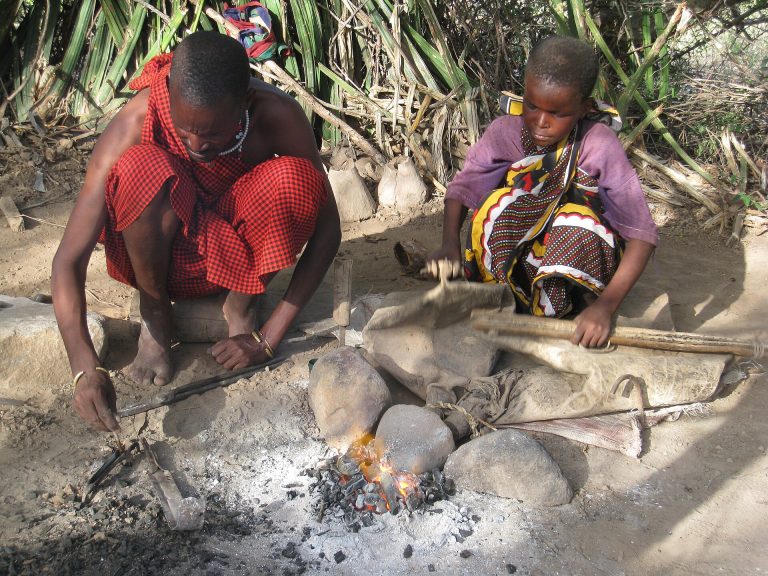
Datoga metalwork is the other craft tradition a visitor is likely to encounter, around Lake Eyasi, where smiths work scrap metal over a charcoal fire with hand bellows to make arrowheads, bracelets and knives. It is recognised by the conservation authority for the area as one of the cultural practices of the region. That visit, and the questions worth asking at it, are covered under Datoga cultural visits.
Where you can actually make something
This section is short, deliberately, because the honest answer is short.
Neema Crafts Centre in Iringa is the one craft organisation in the country confirmed as publishing a visitor programme on its own site. It is a social enterprise employing deaf and disabled people, and by its own account it provides training and employment for over a hundred people with disabilities, runs eight workshops, began in 2003, and has built houses for staff. It describes the stigma attached to disability in Tanzania and its aim of changing it. Alongside the workshops it runs a café, a guesthouse, a shop, a physiotherapy unit and a conference facility. Those figures are the organisation's own rather than independently audited, though its existence and character are corroborated by independent NGO directories.
What it offers a visitor is a tour of the working workshops, from weaving to screen printing, on weekdays, with the shop and café open longer. It is a tour, not a class, and the site says so.
For participatory work, one art space in Dar es Salaam runs genuine public workshops, though it is a contemporary art centre rather than a craft cooperative.
Beyond those two, a hands-on session is something to arrange rather than to book. Village tourism enterprises around Arusha and the Usambaras commonly include craft production in a day's programme and will often let a visitor try, and that is the realistic route. See village tours for which of those could be confirmed as operating.
Buying well
- Buy from the maker where you can. It is the only point in the chain where you can be certain who is paid.
- Ask what a piece means. With Makonde carving in particular, a seller who can tell you whether a figure is shetani or ujamaa, and what the composition is saying, is telling you something about the piece's provenance as well.
- No fair-trade certification could be confirmed for any Tanzanian craft organisation in this research. Treat the phrase, used without specifics, as marketing.
- Check what your country allows in. Wood is subject to import restrictions in many places, and ebony and other hardwoods may be regulated. Ask about the species.
- Haggle politely and not too hard. The margin you are pushing against is a craftsperson's day.
- Gemstones are a different kind of purchase entirely, with their own fraud patterns and paperwork, and are covered under buying tanzanite.
- Mass-produced imitations exist for every craft on this page, including carvings finished with shoe polish to look like ebony. Weight, and the colour inside a scratch, are the usual tells.
Questions travellers ask
Can I actually take a craft class in Tanzania?
Rarely, as a bookable product. One craft centre publishes a workshop tour, which is watching rather than making, and one art space in Dar runs participatory workshops. Otherwise a hands-on session is something arranged through a village tourism enterprise or your accommodation rather than joined.
What is the difference between shetani and ujamaa carvings?
Shetani are spirit figures, distorted and often single-eyed, a style created in the early 1950s. Ujamaa, properly Dimoongo, are the towering columns of interlocked figures supporting one central person, expressing communal unity. They are different traditions, not different sizes of the same one.
Is it safe to give a kanga as a gift?
Only once you know what it says. The printed proverb, the jina, can be barbed, and kanga have been given at weddings specifically to signal disapproval of the match. Have it translated by someone willing to be blunt.
How do I know a carving is really ebony?
Weight is the first test, since ebony is dense. Scratch an inconspicuous spot and look at the colour beneath: softer woods stained or polished to look like ebony show pale wood under the surface. Ask the species, and check your own country's import rules before buying.
Are craft cooperatives fair trade?
No fair-trade certification could be confirmed for any Tanzanian craft organisation in this research. That does not mean none exists, but the phrase used without specifics should be read as marketing rather than as a certification.
Where is the best place to buy craft?
From the person who made it, wherever that is. Markets give range and shops give convenience, but neither tells you who was paid. At a village visit or a homestead, the transaction is direct.
Can I visit a pottery workshop?
Not as a documented visitor product. Potters in the coastal tradition largely work to commission rather than for market stalls, and the skill is taught privately within families, so pottery is the one craft on this page with essentially no visitor-facing arrangement.