
Wildlife Safaris in Tanzania
A multi-day circuit through Tanzania’s savannah parks for elephant, buffalo, lion, leopard, giraffe and plains game, most often linking the northern parks or Nyerere and Ruaha in the south.
A Tanzanian wildlife safari is a circuit rather than a single destination: two, three or four protected areas linked by road or light aircraft, each adding something the others cannot. This guide sets out what the northern, southern and western parks actually offer, where elephant and predators concentrate and why, how dry and green seasons change the viewing, how many parks a trip can absorb before transfers start eating the days, and what changes when a night is spent in a concession rather than a national park.
Safaris That Include Wildlife Safaris

8 Day Fly in Safari Tanzania Tour
by Insight Safari Holidays Verified operator
3 Day Tanzania Safari Holiday
by Insight Safari Holidays Verified operator


a 12 Day Tanzania Safari
by Wild Whispers Africa Verified operator


3 Days Nyerere Safari, Selous Game Reserve Tanzania
by Kori Safaris Verified operator
9 Days Tanzania Birding Adventure
by Wild Whispers Africa Verified operator

7 Day Tanzania Safari
by Wild Whispers Africa Verified operator
See all 82 safaris that include wildlife safaris
Wildlife Safaris Guide in Tanzania
What a wildlife safari in Tanzania actually involves
A wildlife safari in Tanzania is a circuit rather than a destination. Almost nobody flies in for one park. The trip is assembled from two, three or four protected areas linked by road or light aircraft, with two or three nights in each, and its quality is decided far more by how the legs fit together than by which individual park is on the list.
The basic day has a shape that varies very little. An early start, because the animals are active in the cool hours and the light is usable; a long morning drive that may run to a bush breakfast; a return to camp for the middle of the day when the heat flattens everything; and a late afternoon drive that ends as the light goes. Parks close their gates at fixed hours, so an evening drive finishes earlier than most visitors expect. Where a camp sits inside the park, the drives start from the door. Where it sits outside the gate, the first and last forty minutes of every drive are spent on the approach.
Tanzania's protected areas fall under three different authorities with three different rule sets, and this matters more than it sounds. National parks are run by TANAPA. The Ngorongoro Conservation Area is run by its own authority and is a multiple-use area where Maasai pastoralism continues alongside wildlife. Game reserves and private concessions operate under different arrangements again, and generally permit activities the national parks do not. The section on choosing between them below sets out what actually changes.
The northern circuit
The northern circuit is what most first-time visitors mean by a Tanzanian safari. It runs from Arusha through a tight cluster of parks that can be driven between in hours rather than days.
Serengeti National Park covers 14,763 square kilometres and forms part of an ecosystem of roughly 35,000. It carries the migration, but its resident wildlife is the reason it holds up in every month: territorial lion prides, leopard in the riverine woodland of the Seronera valley, cheetah on the open plains, and more than 540 recorded bird species, about a quarter of them migrants. Black rhino are being re-established in the north and south of the park.
Ngorongoro Conservation Area contains the crater, a caldera floor with a dense, largely resident population of large mammals in a space small enough to cross in a morning. It is the most reliable place in the country to see black rhino, and the reason it appears on almost every northern itinerary.
Tarangire National Park is 2,850 square kilometres gazetted in 1970, and part of a much larger Maasai Steppe ecosystem of some 30,000 square kilometres. In the dry months the wildlife of that whole ecosystem concentrates along the Tarangire River and around the Silale swamp, and TANAPA describes the resulting density of large animals as second only to Ngorongoro Crater. Baobabs dominate the landscape and the park has more resident breeding bird species than anywhere else in Tanzania.
Lake Manyara National Park is small, narrow and strung between the Rift escarpment and an alkaline lake. Its groundwater forest, its very large baboon troops, its pelicans and flamingos and its canopy walkway give it a character nothing else on the circuit has. It also permits activities the larger northern parks do not, including night drives and canoeing when the water is high enough.
Arusha National Park is the one most often skipped and the one that most rewards a day. Mount Meru dominates it, more than 450 bird species have been recorded, the Momella Lakes hold both lesser and greater flamingo, and it is probably the best place in the country to watch black and white colobus. The absence of lion is why walking and canoeing are possible here.
The southern circuit
The southern parks are larger, emptier and harder to reach, and the trade is space for convenience.
Nyerere National Park was created in 2019 from roughly 30,000 square kilometres of the former Selous Game Reserve, an area first given formal protection in 1896, named for Frederick Selous in 1922, enlarged in 1940 and inscribed as a World Heritage Site in 1982. The Rufiji River and its oxbow lakes run through the north of the park, which is why Nyerere is the country's headline destination for boat safaris. It is also one of the last strongholds of African wild dog.
Ruaha National Park sits at the meeting point of eastern and southern African species ranges, which is why both greater and lesser kudu, sable and roan appear alongside the more familiar plains game. The Great Ruaha River is the dry-season focus.
Mikumi National Park is the accessible one, close enough to Dar es Salaam for a short trip, with open floodplain game viewing and night drives permitted.
Udzungwa Mountains National Park is not a game-drive park at all. It is a forest walked on foot, and its value is endemic primates and waterfalls rather than big game, covered in the primate watching guide.
The western parks
The western parks are a different kind of trip and usually a second or third visit to Tanzania rather than a first.
Katavi National Park is remote floodplain country where hippo and buffalo concentrate in extraordinary numbers late in the dry season. Mahale Mountains and Gombe are forest parks on Lake Tanganyika visited for chimpanzees, covered in the chimpanzee trekking guide. Rubondo Island National Park sits in Lake Victoria, was gazetted in 1977 across the main island and nine smaller ones, and holds a population of chimpanzees introduced at the end of the 1960s alongside sitatunga, nearly 400 recorded bird species and what TANAPA describes as the highest density of fish eagles anywhere.
Saadani National Park sits on the coast rather than the west, and deserves a mention here because it does something no other park does: 1,062 square kilometres where elephant, buffalo, lion and giraffe occupy the same protected area as an Indian Ocean beach and a tidal river. The Wami River can be worked by boat or canoe.
Elephant watching, and where the herds concentrate
Elephant are present across almost every park on every circuit, so elephant watching is rarely a reason to build a separate trip. What varies is concentration and behaviour.
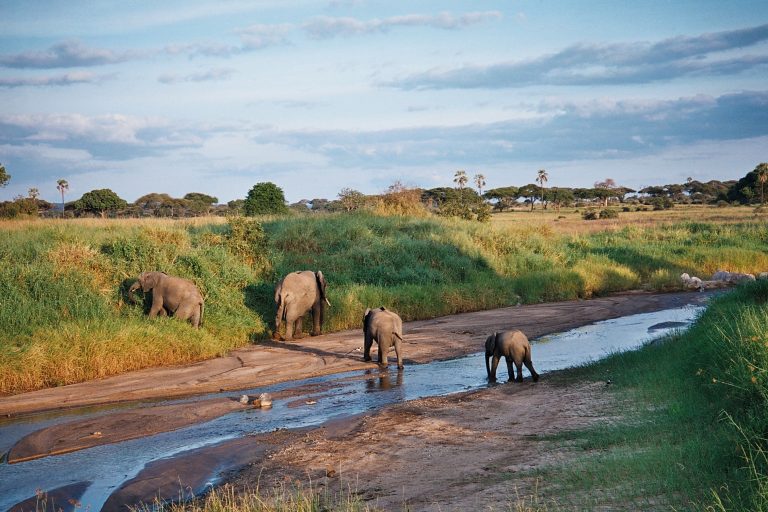
Tarangire in the dry months is the country's elephant set piece. Because the river is the only reliable water across a very large ecosystem, family groups converge on it, and the sight of several hundred animals working the riverbed within a few kilometres is a Tarangire speciality rather than a general Tanzanian one. Large tuskers still occur here.
Ruaha holds substantial numbers in a very different landscape, spread across miombo and along the Great Ruaha. Nyerere's elephant use the riverine belt and can be watched from the water, which changes the encounter completely: an elephant that ignores a boat will often not ignore a vehicle. Lake Manyara's elephant have a particular history, since it was here that Iain Douglas-Hamilton carried out the pioneering field study of African elephant social structure.
Seasonality is the practical point. In the green months elephant disperse across the wider ecosystem and are seen in ones and twos; in the late dry season they compress onto water. The animals have not gone anywhere. They have simply spread out.
Predator watching, and what makes a sighting likely
Predator viewing is the part of a safari most vulnerable to inflated expectation, and the factors that decide it are not the ones most travellers assume.
Prey density matters most. Lion sightings on the Serengeti plains during the calving months are close to routine because the food is there in absurd quantity. The same plains in a green month with the herds three hundred kilometres away still hold territorial prides, but they are harder to find.
Habitat matters next. Open short grass makes cheetah findable; the Serengeti plains and the Ndutu area are the strongest cheetah country in the region. Leopard need cover and prefer riverine woodland, which is why the Seronera valley's sausage trees and the Ruaha riverbanks produce most of the country's leopard sightings. Spotted hyena are everywhere and are far more often the successful hunter than the popular account allows.
African wild dog are the genuine speciality. Nyerere and Ruaha hold populations that are significant on a continental scale, and a wild dog pack on a hunt is a better piece of theatre than almost anything else on a safari. They range enormously, so seeing them is a matter of luck and of being in the right park at all.
Time of day and guiding do the rest. Predators are active in the first and last hour of light and the drives that begin before dawn see disproportionately more. A guide working the radio network and reading tracks will find in an hour what an unguided drive would miss all morning. Night drives, where they are permitted, open up an entirely different set of animals, covered in the night game drive guide.
Dry season and green season
The long dry season, roughly June to October, is when most people travel. Vegetation thins, animals concentrate on permanent water, roads are reliable and sightings are easier. It is also busier and hotter, and the landscape is brown.
The green season, broadly November to May with a heavier period around March to May, reverses all of that. Animals disperse and are harder to find in thick country; some roads and some camps close; and the southern and western parks in particular become difficult. In exchange the light is better, the landscape is transformed, resident birding peaks as migrants arrive, and calving on the Serengeti plains concentrates predator activity in a way no dry month matches.
The short dry spell around January and February is the least discussed and often the best compromise on the northern circuit. It is also a northern phenomenon only, because the southern and western parks run one long wet season with no January gap in it.
How many parks, and how many days
The most common planning error is adding parks. Each additional park costs at least half a day in transfer, plus a new set of entry formalities, plus the time a guide needs to learn where the animals currently are. A trip that visits four parks in seven nights spends a substantial share of those nights packing.
Useful rules of thumb: two nights is the minimum that gives a park one full day plus two half days. Three nights is where a park starts to reveal itself. A first northern circuit works well with Tarangire, Ngorongoro and the Serengeti over seven to nine nights. A southern trip usually pairs Nyerere with Ruaha over the same span, because both are reached by air and the flight between them is short.
Combining north and south in one trip is possible but expensive in time, and the two circuits offer genuinely different experiences rather than complementary ones.
Getting between the parks
The northern circuit is driven. The roads between Arusha, Tarangire, Manyara and the Ngorongoro highlands are good; the descent into the Serengeti is long and rough. A drive from the crater rim to central Serengeti consumes most of a day, which is why many itineraries drive one way and fly the other.
The southern and western parks are flown. Light aircraft schedules link Dar es Salaam, Arusha and the park airstrips, and the difference between a flight and a drive can be six hours. Baggage limits on these aircraft are strict and soft bags are usually required. The allowances the carriers themselves publish, which include hand baggage, are the ones to pack against.
Vehicles matter more than travellers expect. An extended four-wheel-drive with a pop-top roof and a guaranteed window seat for every passenger is the working standard; a full vehicle with a middle seat is a materially worse experience over eight days. Whether the vehicle is shared or private, and whether the same guide stays with the trip throughout, are the two questions worth asking an operator first.
Choosing between a park, a concession and a conservation area
The three categories look alike on a map and behave very differently on the ground.
National parks have the strictest rules. Driving is confined to designated roads and tracks, walking requires an armed ranger and prior arrangement, and gate hours are enforced. That discipline is why the parks hold the wildlife they do.
The Ngorongoro Conservation Area operates under its own authority, with its own descent gate hours, its own vehicle restrictions on the crater floor and a limit on how long a vehicle may remain below. It is also a living landscape with Maasai communities inside it, which is why it is not a national park.
Private concessions and game reserves, including the areas bordering the western and northern Serengeti, generally permit off-road driving, night drives and walking with fewer restrictions, and limit the number of vehicles that can be present. The price of that flexibility is that access is usually tied to staying at a particular camp.
Travellers who want to walk, to drive after dark or to get off the track are better served by building at least one concession night into a circuit than by expecting a national park to bend. The walking safari and night game drive guides set out exactly where each is permitted.
Common questions about wildlife safaris in Tanzania
Northern circuit or southern circuit for a first safari?
The northern circuit for a first trip, in most cases. It is driveable, the parks are close together, the infrastructure is deep and it contains the crater and the Serengeti. The southern parks suit travellers who have been on safari before and want fewer vehicles, more water-based and walking activity, and a wilder feel.
How many days does a safari need?
Seven to nine nights is the working span for a northern circuit that does not feel rushed. Four or five nights is enough for two parks. What three, seven and fourteen nights each realistically hold, and what the driving takes back, is worked through there park by park. Anything shorter usually means more time in transit than in the field.
Is the green season worth considering?
Yes, with eyes open. Animals disperse and thick vegetation makes some sightings harder, and parts of the south and west become difficult to reach. In exchange the landscape, light, birding and the calving concentration on the southern Serengeti plains are all at their best, and the parks are quieter.
Can a safari be combined with the coast or Zanzibar?
Yes, and it is a common pairing. Short flights link the northern and southern circuits to the coast and the islands. The usual order is safari first and beach second, because the safari days start early and the coast is where the recovery happens.
Are safaris suitable for children?
Game drives generally are, subject to a camp's own minimum age. Several specific activities are not: walking safaris in national parks are priced only for children of twelve and above, and chimpanzee trekking excludes anyone under twelve outright. Long transfer days are the real constraint with younger children rather than the wildlife.
What is the difference between a game reserve and a national park?
A national park carries the strongest protection and the tightest rules on where vehicles may go and what visitors may do. Game reserves and concessions sit under different management and typically allow walking, night driving and off-road access that the parks do not, usually in exchange for limited and camp-linked access.
Does every safari see the Big Five?
No. Four of the five are widely distributed and commonly seen across the main circuits. Rhino is the constraint in Tanzania and is realistically limited to a small number of places. The big five safari guide explains where and why.