
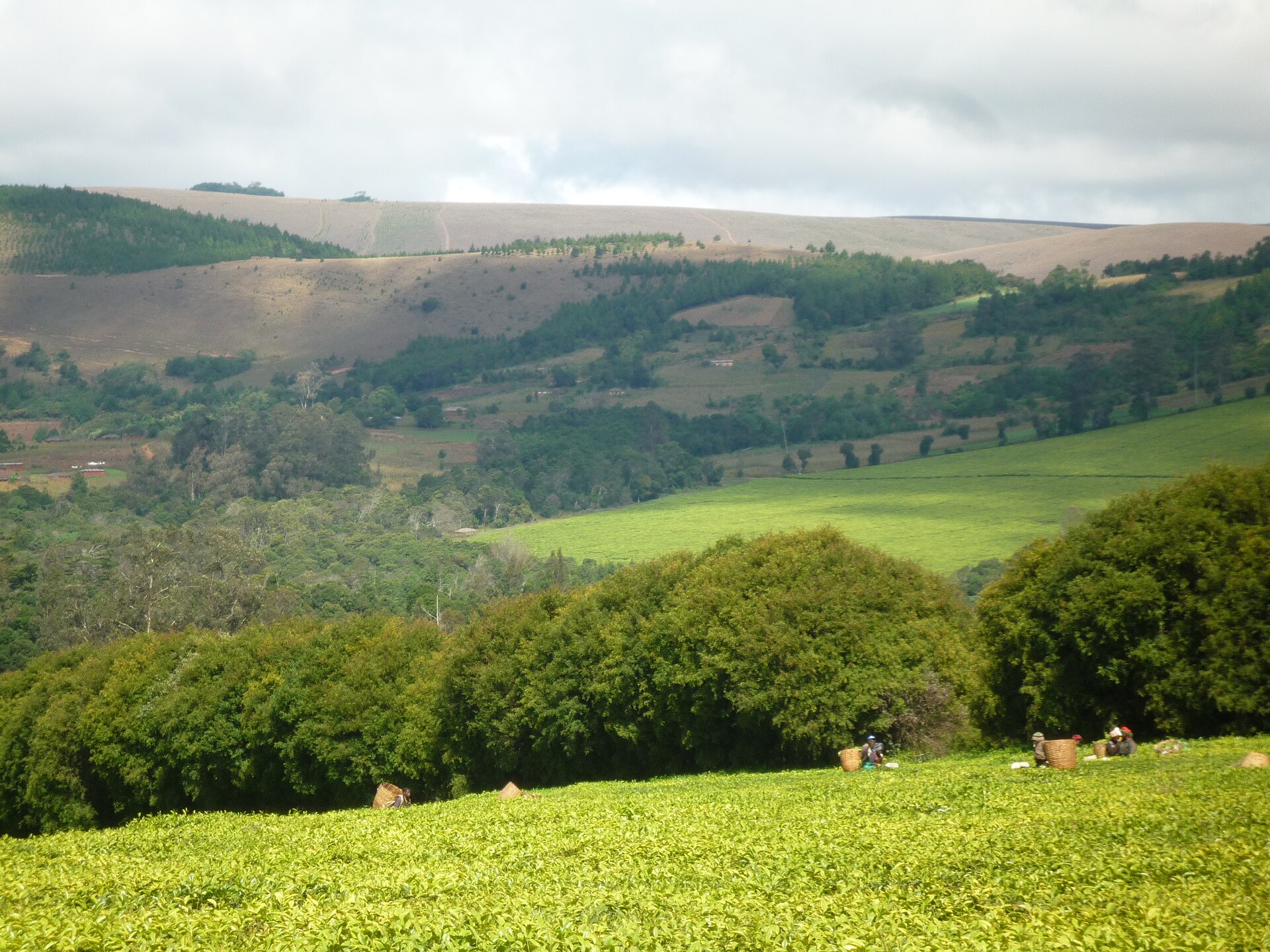
A cold town in the tea and timber country
Njombe sits high on the road between Iringa and Songea, in the eastern Southern Highlands. It is tea and timber country, cold and green and very wet, and the town is a regional administrative and commercial centre rather than a visitor destination.
Njombe Town Council was established in 2007 when Njombe District Council was split, and covers 3,212 square kilometres across two divisions and thirteen wards, three urban and ten rural. Its population was 130,223 at the 2012 census and estimated at 182,127 in 2022.
The climate figures explain the landscape. The council gives a rainy season from October to April with 1,200 to 1,400 millimetres of rain a year, with some areas seeing additional rain in September, and a cold season from May to August when temperatures drop to around four degrees Celsius. That is cold by any standard and startling in a country most visitors associate with heat.
What the district actually offers
Njombe is often written off as a town with nothing to see. Its own local authority disagrees, and publishes a list. It is worth setting out, because the sites are real and because their pattern tells you what a visit here would involve.
- Lupembe Old Lutheran Church — built by the Germans in 1898, 74 kilometres east of Njombe town in Lupembe village. The council notes the construction technique as much as the age.
- Finga cave — in Havanga village, 14 kilometres from the Njombe–Lupembe road, used as a hiding place during both world wars.
- Ninga waterfalls — between the Ninga and Kichiwa wards, 15 kilometres from Mtwango.
- Iditima natural forest — in Itambo village, Mfriga ward, 115 kilometres from Njombe town, noted by the council for its butterflies.
- Mwandulami traditional dispensary — near the Makambako–Songea main road at Itunduma village, a site of traditional medicine practice.
- Nyalumuli and Makwengwe waterfalls, Lyamgendela cave, and the Lupembe tea factory, all named without further description.
The pattern is the point. These are scattered across a very large district, the furthest 115 kilometres from town, and the council itself states that accessibility is mostly seasonal because of the terrain and that the roads are not all-weather, so touring is a dry-season activity.
So: there is genuine content here, and it is dispersed, unserviced and hard to reach. That is an honest description rather than a discouraging one, and it is a more useful answer than either “nothing to see” or a list presented as an itinerary.
Tea, timber and ulanzi
The Southern Highlands around Njombe and Mufindi carry the largest tea plantings in Tanzania, and Njombe’s own estates and the Lupembe factory are part of that. The tea plantation tours guide covers what a visit involves; arrangements in Njombe are local and informal.
Njombe is also the principal district for ulanzi, the bamboo wine tapped from young bamboo shoots in the Southern Highlands — made across Njombe, Iringa, Mbeya and Ruvuma, but associated with Njombe first. It is fresh, low in alcohol and drunk where it is tapped, which makes it one of the more genuinely local things a traveller can try in Tanzania. The food and market tours guide covers the wider picture.
Timber plantation is the other landscape: the district runs into the same softwood belt that produces Sao Hill in Mufindi.
Getting there
Njombe is on the road from Makambako, which sits on the A7 between Iringa and Mbeya, and on the road south to Songea. It is also one of the two approaches to Kitulo National Park — TANAPA lists access from Njombe via Makete — and Makete District Council notes that of its two road approaches, from Njombe and from Mbeya, only the Njombe road is currently passable.
That detail is Njombe’s strongest claim on a traveller’s itinerary: in some conditions it is the practical way in to Kitulo.
There is no railway and no scheduled air service to the town. Everything here is road, and the guide to how far Tanzania’s transport network reaches covers what the southern trunk roads and the regional flights actually reach.
When to go
The council gives the rains from October to April, with the dry and cold season from May to August. The Tanzania Meteorological Authority classifies the south-western highlands as unimodal — one season — which matches. Given the council’s own warning about seasonal road access, the dry months are the only realistic time to tour the district’s sites.
Where it fits in a trip
Njombe is a staging point. It breaks the long drive between Iringa and Songea, it is a practical base for the Njombe-side approach to Kitulo, and it puts the tea country within reach. A night here on a Southern Highlands loop is sensible; a trip built around Njombe is not — a distinction that only makes sense against the number of days a Tanzanian itinerary has to spare.
Common questions
How cold is Njombe?
Njombe Town Council records a cold season from May to August with temperatures dropping to around four degrees Celsius. Pack properly; this is not a coastal climate.
Is Njombe a good base for Kitulo?
It is one of the two approaches. TANAPA lists access to Kitulo from Njombe via Makete, and Makete District Council notes that of its two main roads, only the Njombe one is currently passable.
What is ulanzi?
Bamboo wine, tapped from the sap of young bamboo shoots. It is made across the Southern Highlands — Njombe, Iringa, Mbeya and Ruvuma — and Njombe is the district most associated with it.