
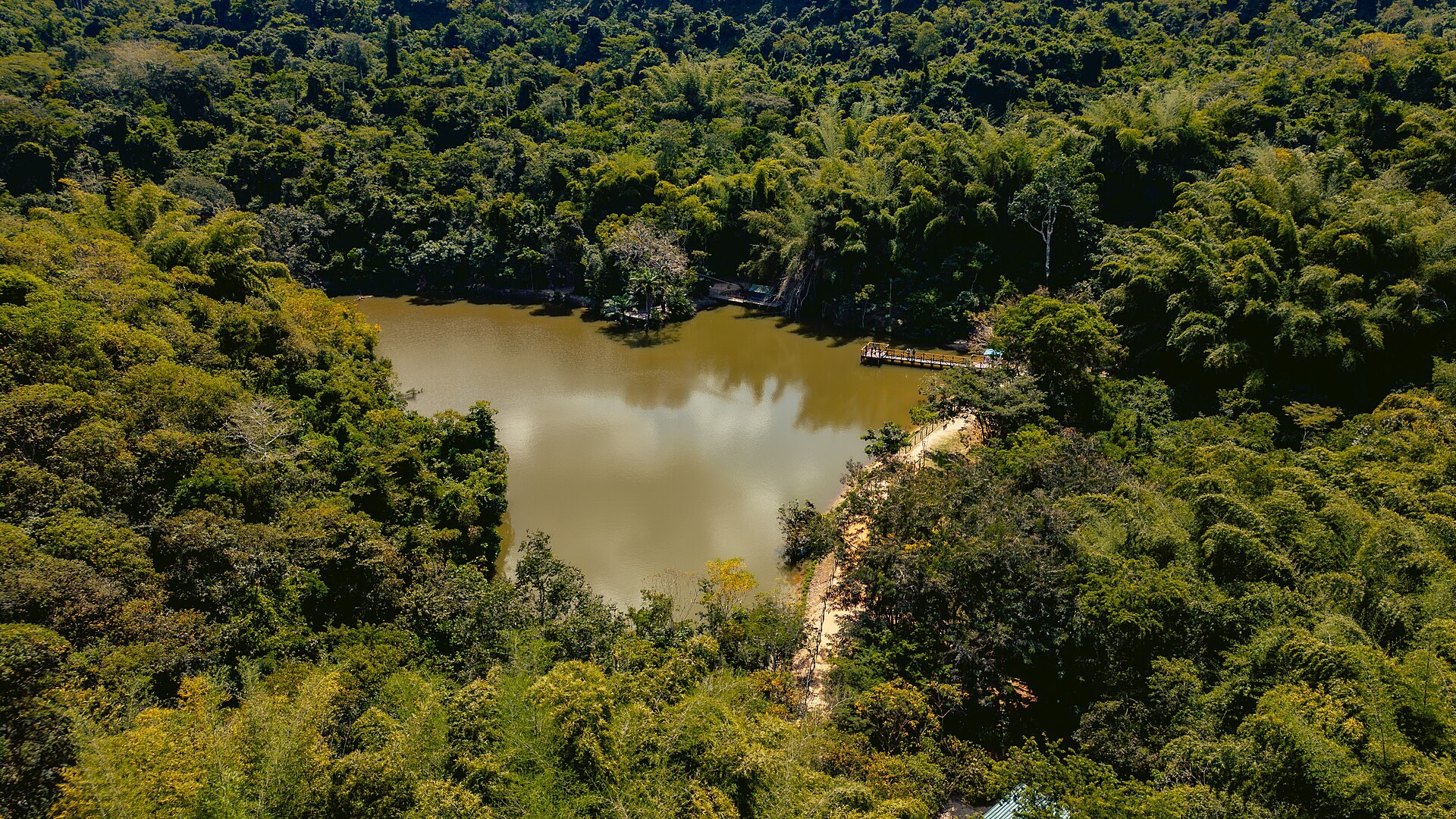
Coastal forest on the edge of the city
Pugu-Kazimzumbwi is a nature forest reserve of 8,965 hectares in the hills of Kisarawe District, about twenty kilometres south-west of Dar es Salaam and reached on tarmac the whole way. Tanzania Forest Services, which manages it, calls it “the lungs of Dar es Salaam” and describes it as the remnant of the oldest lowland coastal forests of Tanzania.
That last phrase is worth reading carefully, because a different claim circulates widely — that Pugu is one of the oldest forest reserves in Africa. TFS’s own description says something more specific and more interesting: it is what remains of the country’s oldest lowland coastal forest type. The East African coastal forests are an ancient, fragmented and highly endemic habitat, and Pugu-Kazimzumbwi is the accessible piece of it.
Its selling point is proximity. Julius Nyerere International Airport is a short drive away, and TFS explicitly pitches the reserve at city residents and at travellers with hours to fill before a flight — the kind of gap the guide to Tanzania’s domestic connections shows is common on an itinerary routed through Dar es Salaam. For a visitor to Tanzania it is the easiest half-day escape from Dar es Salaam that involves no boat and no early start.
What is in the reserve
TFS lists the reserve’s attractions as closed forest with a wide range of plant species, stands of giant bamboo, the Minaki dam, the Tanzanian flag-coloured grasshopper, bat caves, viewpoints over Dar es Salaam, sites used for worship and spiritual practice, the endemic Mpugupugu tree, white colobus monkeys and giant millipedes.
The bat caves are the reserve’s best-known feature and the reason most people make the trip. Caving here is modest in scale and the interest is the roost rather than the geology — see cave exploration. Coastal forest birding is rewarding and quite different from anything you will see on a savanna itinerary: see bird watching.
The forest itself is the real draw for a naturalist. Walking the closed-canopy sections is covered under forest walks, and the climbs out to the city viewpoints under day hiking. Minaki dam supports canoeing and kayaking, and sport fishing is among the activities TFS lists — see canoe safaris and freshwater fishing.
Camping is possible at the reserve; otherwise people stay in Dar es Salaam and come out for the day. Because part of the forest is used for worship and meditation, it is worth asking your guide which areas are in active use and behaving accordingly.
Conservation context
A forest reserve this close to a city of several million people is under obvious pressure — charcoal, clearance, quarrying and encroachment are the familiar threats to the East African coastal forests generally, and proximity concentrates all of them. That is the frame in which a visit here is worth making at all, and it is the frame the guide to conservation tours sets out.
TFS names several nearby sites that pair with a Pugu visit: Vikindu Forest Reserve, Pande Game Reserve, the National Museum in Dar es Salaam, and, further afield, the Kaole ruins and Bagamoyo stone town and Nyerere National Park.
When to go
Kisarawe District is in the northern coastal zone, which the Tanzania Meteorological Authority treats as bimodal: Vuli from October to December and Masika from March to May. The district council’s own account stretches those slightly, giving October to January and March to June, with average annual rainfall around 1,000 millimetres and mean temperatures near 29°C. Either way, June to September is the driest and most comfortable period for walking, and the forest tracks are at their worst during the March-to-May rains.
Mornings are better than afternoons for both birds and heat. Bats are most active around dusk. The coastal forest is walkable year-round, which is unusual in a country where the season normally decides what is open.
Common questions
How far is it from Dar es Salaam?
Tanzania Forest Services gives about twenty kilometres south-west of the city, reached on a tarmac road. Traffic, rather than distance, determines how long the drive takes.
Is it worth a visit if you have half a day before a flight?
That is precisely the use TFS itself suggests for it, given how close the reserve is to Julius Nyerere International Airport. It is a genuine forest rather than a park, and half a day is enough for a walk, a viewpoint and the caves.
What wildlife will you actually see?
Birds, bats, insects and the forest itself, reliably. Primates are listed by TFS but are not a guaranteed sighting, and this is not a large-mammal destination in any sense. Come for the habitat and the caves, not for a game drive.
Do you need a guide?
For the caves and for anything off the main tracks, yes. The reserve is managed by TFS with a conservator based at Kisarawe, and arrangements are made through them.