
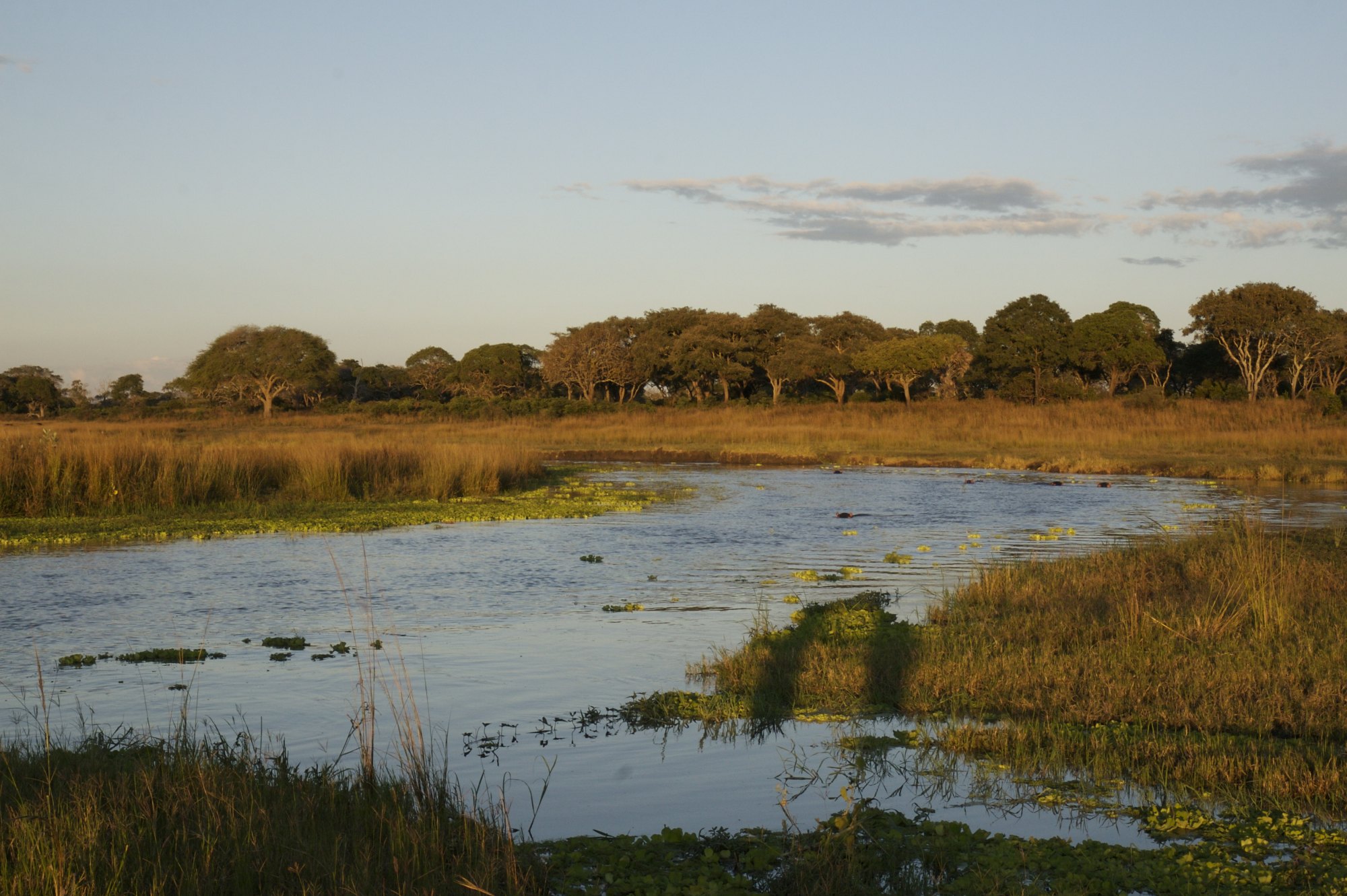
If you have already done a northern circuit safari and want a park where yours may be the only vehicle at a lion sighting, Katavi National Park is the place to look. This remote TANAPA park in western Tanzania, about 40 km south of Mpanda, covers 4,471 square kilometres of floodplain and miombo woodland. Its fame rests on the dry season, June to October, when hundreds of hippos crowd the shrinking pools of the Katuma River.
Wildlife in Katavi National Park
Wildlife in Katavi National Park is about concentration rather than variety: hippos and crocodiles, buffalo and elephants, and the lions that hunt them, all pushed onto the last water of the Katuma River from about July onward. TANAPA’s own description is plain. As the pools shrink, hippos crowd by the hundreds and Nile crocodiles retreat into caves dug into the riverbanks.
The game is there because the water is not. In the rains the Katuma spreads across the Katisunga and Chada floodplains and the seasonal lakes fill, so animals scatter across a huge area. By late in the dry season the river has stopped flowing. What remains is a chain of muddy pools, and everything that drinks has to come to them.
Hippos and Crocodiles of the Katuma River
Hippos are the Katavi sight most visitors fly in for. TANAPA puts the crowding at more than 200 hippos in single Katuma pools, and camps and independent guides report several hundred together at the September and October low point. The bulls fight for space in water that barely covers them, and the grunting carries well over a kilometre on a still night.
Crocodiles do something stranger. When the water drops too low, Nile crocodiles here walk into caves in the riverbanks and lie dormant through the hottest weeks, sometimes several to a cave. Guides at Chada Katavi and TANAPA both describe the behaviour, and it is rarely seen anywhere else. Ask to be shown the caves along the Katuma in September or October.
Buffalo Herds, Elephants and Lion Prides
Buffalo herds on the Katisunga and Chada plains are the second spectacle. Herds of more than a thousand animals are widely reported in the dry months, and TANAPA’s park page cites single herds above 4,000. Elephants move between the river and the shade of the miombo in sizeable groups and wander through the camps.
Lion prides follow the buffalo. TANAPA describes prides patrolling the open plains, with spotted hyena common and leopard in the riverine thickets. African wild dog are occasional visitors only. Katavi holds four of the Big Five; there are no rhino, and some guides list cheetah while TANAPA’s own wildlife page does not, so treat a cheetah sighting as unlikely.
Antelope of the Floodplains and Miombo Woodland
Topi and hartebeest graze alongside zebra, impala and waterbuck across the floodplains and lake margins, with Masai giraffe along the woodland edge. Sable and roan antelope live in the miombo woodland, and TANAPA lists roan as occasional. Finding either means asking your guide for a dedicated drive away from the river.
Birdlife in Katavi
Katavi’s bird list is usually given as more than 400 species, though TANAPA publishes no checklist total. Saddlebill storks and pelicans work the wetlands, and the miombo holds the racket tailed roller and a range of raptors. See the bird watching guide for what to pack and how to plan a birding day. Migrant birds arrive from November, which overlaps with the season when most camps are closing, so June and November are the practical birding months.
Katavi Wildlife Finder
Filter Katavi’s main animals by type, likelihood, area of the park and time of day to see what to look for, and where, on a dry season safari.
Showing all 15 animals
| Animal | Type | Likelihood | Where to look | Best time | When active | What it means for you |
|---|---|---|---|---|---|---|
| 01HippoHippopotamus amphibius | Large mammal | Very likely | Katuma River pools, Ikuu Bridge | Late dry season | By day | Sit at a pool from August; hundreds may gather in one stretch |
| 02Nile crocodileCrocodylus niloticus | Reptile | Very likely | Katuma riverbanks and bank caves | September to October | By day | Ask your guide to show you the riverbank caves |
| 03African buffaloSyncerus caffer | Large mammal | Very likely | Katisunga and Chada plains | June to October | By day | Herds above 1,000 animals; scan the plains from high ground |
| 04African elephantLoxodonta africana | Large mammal | Very likely | Between the river and the miombo | June to October | By day | Often walks through camps; keep to your guide’s instructions |
| 05LionPanthera leo | Predator | Likely | Floodplains near buffalo herds | June to October | By day and at night | Follow the buffalo; dawn and dusk give the best odds |
| 06Spotted hyenaCrocuta crocuta | Predator | Likely | Floodplains and woodland edge | Year round | Mostly at night | Best seen on a booked night game drive |
| 07LeopardPanthera pardus | Predator | Occasional | Riverine thickets | June to October | Mostly at night | Needs luck; a night drive improves the chance |
| 08African wild dogLycaon pictus | Predator | Rare | Moves through the park | Unpredictable | By day | TANAPA calls them occasional visitors; treat a sighting as a bonus |
| 09TopiDamaliscus lunatus | Antelope | Very likely | Katisunga and Chada plains | June to October | By day | Seen on most plains drives |
| 10Defassa waterbuckKobus ellipsiprymnus defassa | Antelope | Likely | River and lake margins | June to October | By day | Look along the Katuma margins |
| 11Masai giraffeGiraffa tippelskirchi | Large mammal | Likely | Woodland edge | June to October | By day | Common on drives between plains and woodland |
| 12Sable antelopeHippotragus niger | Antelope | Occasional | Miombo woodland only | June to October | By day | Ask for a dedicated woodland drive away from the river |
| 13Roan antelopeHippotragus equinus | Antelope | Rare | Miombo woodland | June to October | By day | Genuinely scarce; TANAPA lists roan as occasional |
| 14Saddlebill storkEphippiorhynchus senegalensis | Bird | Likely | Drying margins of Lake Chada and Lake Katavi | June and November | By day | Bring binoculars to the lake margins |
| 15Racket tailed rollerCoracias spatulatus | Bird | Occasional | Miombo woodland | Year round | By day | A miombo speciality; ask a birding guide |
No animals match all selected filters. Try removing one filter.
Last checked November 2026. Likelihood is indicative for a three or four night stay between June and October; sightings are never guaranteed. Night sightings need a booked night game drive (USD 50 per adult on the TANAPA tariff). Sources: TANAPA Katavi wildlife and attractions pages, Nomad Tanzania (Chada Katavi), Katavi Wildlife Camp, Mbali Mbali.
Best Time to Visit Katavi National Park
The best time to visit Katavi National Park is the dry season from June to October, with the strongest game viewing from August to October when the Katuma pools are smallest. TANAPA names June to October as peak wildlife viewing, and the rains run from November to May. The best time to visit Tanzania guide sets Katavi’s single wet season against the north’s two.
The two ends of the dry season are different trips. June is greener and cooler, the camps have just reopened and the game is only starting to gather. September and October bring the hippo and crocodile drama at its peak, and also afternoons of roughly 32C to 34C under a hazy sky. Early in the window is more comfortable; late in it, you see more.
One verified fact cuts against the dry season advice: the heat. By October the shade temperature in the middle of the day leaves little reason to be out, so the best Katavi days run from first light to about 10:00, then from 16:00 to sunset. Pack loose clothing and a wide hat.
Things to Do in Katavi
Things to do in Katavi are few and official: game drives and ranger led walks, night drives, fly camping and waterfall hikes, each priced in the TANAPA tariff. Camps arrange most of them, so the camp you choose decides your activity list.
Game Drive Safaris on the Katuma and Katisunga Plains
Game drive safaris run between 06:30 and 18:30, according to TANAPA, with no fee on top of park entry, and TANAPA recommends a 4×4 vehicle. The routine that works here is to find the water and wait. In the late dry season an hour parked beside a hippo pool usually shows more than a long loop across the plains, and with so few vehicles in the park your guide can stay with a sighting as long as it lasts.
Walking Safaris with an Armed Ranger
Every walking safari in Katavi needs an authorised armed ranger, a park regulation rather than a camp choice. TANAPA charges USD 20 per adult for a short walk of one to four hours and USD 25 for a longer one, and children aged 12 and over can join at a reduced rate. Chada Katavi has built its name on walking, and trip reports keep returning to the same point: on foot, the hippo grunts and buffalo tracks feel very different from the vehicle.
Night Game Drive Tours
Katavi allows night game drive tours, which many Tanzanian parks do not allow, at USD 50 per adult and USD 25 per child aged 5 to 15 on the TANAPA tariff. Mbali Mbali Katavi offers them as an option. A spotlight drive after dark is the best chance of genets or hunting lions, and you book it in advance; the park forbids ordinary driving after dark.
Fly Camping Adventures on the Plains
Fly camping adventures take you away from the permanent tents for a night in a light mobile camp, usually after a day of walking. Nomad describes taking bedrolls out and sleeping under a borassus palm on the Chada plain. Special campsites cost USD 50 per adult per night on the tariff and must be booked in advance. Self catering camping safaris use the same sites.
Waterfall Hiking Trails from Sitalike
Hiking trails start at the park headquarters at Sitalike. TANAPA lists the Sitalike walking trail at 1 to 9 km, taking more than three hours, and the Chorangwa hiking trail at more than 10 km and over five hours. The longest waterfall route covers 17 km to a viewpoint over the Chorangwa, Lukima and Ndido waterfalls. The waterfall hiking guide covers fitness and kit.
Top Attractions in Katavi
The top attractions in Katavi are places on the water: the Katuma River at Ikuu Bridge, the open plains of Katisunga and Lake Chada, and the Lake Katavi floodplain, with three waterfalls and the tamarind tree of the spirit Katabi further afield.
Katuma River and Ikuu Bridge
The Katuma River is the lifeline of the park, and Ikuu Bridge is the classic vantage point over its dry season pools. Hippos wallow below while crocodiles lie out on the mud banks. TANAPA lists it first among Katavi’s attractions.
Katisunga Plain and Lake Chada Floodplain
The Katisunga plain is the open grassland at the centre of the park where most camps look out, and the Lake Chada floodplain lies to its south. Both are where the buffalo herds gather in the dry months, and the open ground lets you watch a pride work a herd from several hundred metres away.
Lake Katavi Floodplain and the Tamarind Tree of Katabi
Lake Katavi is a seasonal lake in the north of the park whose floodplain draws elephants and waterbirds as the water recedes. Near it stands the tamarind tree that local tradition says is home to Katabi, the spirit who gave the park its name. People still leave offerings at its roots, so visit it as you would any place of worship.
Chorangwa, Lukima and Ndido Waterfalls
The Chorangwa, Lukima and Ndido waterfalls lie in the escarpment country away from the floodplains and only the guided hiking trails reach them. They suit a walker with a spare day more than a first time visitor focused on the river.
About Katavi National Park
Katavi National Park was gazetted in 1974 at 1,823 square kilometres and enlarged in 1997 to its present 4,471 square kilometres, taking in the surrounding miombo woodland. TANAPA manages it, and the name comes from Katabi, the spirit of the tamarind tree near Lake Katavi.
The park sits in a truncated arm of the Rift Valley that ends at Lake Rukwa, and most of its area is Brachystegia and Julbernardia woodland. The game viewing happens on a much smaller core: the floodplains of the Katuma River and its two seasonal lakes. Visitor numbers have stayed tiny: about 1,500 foreign visitors in 2012 and 2013, and still well under 2,000 a year in recent Ministry of Natural Resources and Tourism figures.
How Katavi Differs from Ruaha National Park
What sets Katavi apart from other Tanzanian parks is the combination of dry season crowding at a handful of pools and almost no other visitors to share it with. Ruaha, which shares the same flight route, is the park most people weigh it against.
Ruaha suits a traveller with a week and a wish for flexible dates. Katavi suits someone who will build the trip around two flights a week and wants the stranger, quieter spectacle. Many itineraries do both, landing at Katavi on the Ruaha flight.
Where Is Katavi National Park?
Katavi National Park is in Katavi Region in the far west of Tanzania, east of Lake Tanganyika, with its headquarters and main gate at Sitalike, about 40 km south of the town of Mpanda. Mpanda is the last reliable place to buy fuel and food before the park.
Mahale Mountains National Park lies to the west on Lake Tanganyika and is the usual pairing, a 25 minute flight away. There is no road between the two parks, so they connect only by air.
How to Get to Katavi
Most visitors get to Katavi by light aircraft, landing at Ikuu airstrip inside the park, and the only scheduled service is Safari Air Link on Mondays and Thursdays. The alternative is a multi day 4×4 drive through Mpanda. The guide to getting around Tanzania compares flights, roads and rail into the west.
Safari Air Link Flights to Ikuu Airstrip
Safari Air Link flies Ruaha to Katavi on Mondays and Thursdays, leaving Ruaha at 07:00 and landing at Katavi at about 08:40, on its rack rate sheet. The one way fare is USD 615 plus USD 10 tax per person, and the return leg from Katavi connects on to Dar es Salaam the same day at USD 925 plus tax. The circuit runs from 1 June to 31 October and on request from 1 November to 28 February, with all flights suspended from the end of March to 1 June.
Baggage is limited to 23 kg per person including hand luggage, packed in soft bags; the airline refuses hard suitcases. The light aircraft legs double as scenic flights over the floodplains. Some operators fly guests from Arusha on their own routing with a refuel stop at Tabora, a flight Nomad Tanzania times at about four hours.
Driving to Katavi by 4×4 through Mpanda
TANAPA describes road access as long 4×4 drives from Mbeya, Kigoma or Tabora, entering through Sitalike. The southern approach from Mbeya is more than 500 km on mostly unpaved roads. A high clearance 4×4 is a must, especially from November to May, when black cotton soil can stop a vehicle after rain. TANAPA advises carrying spare fuel and water, food, a spare tyre and a satellite phone.
Rail to Mpanda from Tabora
A branch railway runs from Tabora to Mpanda, described in the rail and ferry journeys guide, and is the slow budget route into the region. From Mpanda you still need your own vehicle for the 40 km to Sitalike and for game drives.
Where to Stay in Katavi
Where to stay in Katavi comes down to a handful of small tented camps inside the park, plus TANAPA’s own rest house and campsites for self drivers. Bed numbers are tiny, so the peak months fill early.
Chada Katavi Tented Camp
Chada Katavi, run by Nomad Tanzania, has six tents under tamarind trees on the edge of the Chada plain. It is the camp most associated with walking safaris and fly camping, and guests mention night drives too. Nomad does not publish rates on its site, so ask for a quote.
Katavi Wildlife Camp on the Katisunga Plain
Katavi Wildlife Camp sits on the edge of the Katisunga plain and is run by the Fox family, who also operate Safari Air Link, which makes flight and camp bookings simple to join up. The camp offers walking safaris and bush picnic lunches, with private vehicles on request.
Mbali Mbali Katavi Lodge
Mbali Mbali Katavi has 10 safari tents, six doubles, two twins and two family tents, overlooking the Katisunga plains, and welcomes children of all ages. Its stay includes meals and six house drinks a day, plus limited laundry; game drives, which run twice daily with an optional night drive, and airstrip transfers cost extra.
TANAPA Rest House and Campsites
TANAPA’s rest house at Katavi costs USD 30 per person per night on the tariff, the same as a public campsite, while special campsites cost USD 50 and need booking ahead. All are self catering and suit overlanders with their own vehicle and supplies.
Katavi National Park Entry Fees and Permits
Katavi National Park entry costs USD 30 per non East African adult per 24 hours on the current TANAPA tariff, with no peak or low season split. Children aged 5 to 15 pay USD 10, under 5s are free, Tanzanian residents and expatriates pay USD 15, and East African citizens pay TSh 5,000.
| Fee | Adult, non EA | Child 5 to 15 |
|---|---|---|
| Conservation, per day | USD 30 | USD 10 |
| Concession, per night | USD 30 | USD 10 |
| Public campsite | USD 30 | USD 5 |
| Special campsite | USD 50 | USD 10 |
| Night game drive | USD 50 | USD 25 |
| Short walk, 1 to 4 hrs | USD 20 | USD 10, 12+ |
The concession fee applies to every night spent in a camp inside the park, and a guide or ranger fee of USD 20 per group per day applies where a ranger is needed. A foreign registered vehicle up to 2,000 kg pays USD 40 a day. Payment is electronic, so carry a card that works internationally.
One conflict to know about: TANAPA’s own Katavi web page shows USD 70 for international adults, while its published tariff sheet, the most recent schedule it has issued, shows USD 30. Many camp rates already bundle these fees, so ask whether yours does. The guide to what a Tanzania safari costs shows how park fees stack up with flights and camps.
Why Visit Katavi
Visit Katavi for the hippo pools and crocodile caves, and for buffalo herds in the thousands, seen from a vehicle that is often the only one in sight. Few parks in Africa still offer that, and the walking and night drives add what the busier northern parks do not.
Is Katavi worth it? For travellers on their second or third Tanzania safari, yes: the fixed costs of about USD 1,430 per adult in flights and fees buy a kind of solitude the Serengeti cannot. For a first safari with one week and a tight budget, no. The northern circuit gives more variety for less travel, and Katavi’s appeal depends on having seen the classic parks first.
Sample Katavi Itineraries
The Monday and Thursday flights shape every sample Katavi itinerary, so most trips run three or four nights in the park, or seven nights when Mahale is added.
Four Day Katavi Fly In Safari
Day 1, Monday: fly Ruaha to Ikuu, arriving mid morning, and take an afternoon game drive to the Katuma pools. Day 2: morning walking safari with a ranger, afternoon drive on the Katisunga plain. Day 3: full day to the Chada floodplain with a bush lunch, or a night game drive. Day 4, Thursday: early drive, then the late morning flight back to Ruaha and on to Dar es Salaam.
Seven Day Katavi and Mahale Safari
Days 1 to 4: fly into Katavi on a Monday for three nights of drives and walks, with one night out fly camping. Day 4, Thursday: the 25 minute flight to Mahale, then about an hour and a half by boat along Lake Tanganyika to camp. Days 5 to 7: chimpanzee treks in the Mahale Mountains, flying out the following Monday. The Katavi to Mahale leg costs USD 510 plus tax and needs at least four passengers to run as a seat fare.
Katavi National Park FAQs
Is Katavi National Park worth visiting?
Katavi National Park is worth visiting for travellers who have already done a classic Tanzania safari and want solitude and the dry season hippo and buffalo concentrations. It is a weaker choice for a first safari, because the flights limit dates and the variety of species is narrower than in the Serengeti.
How do you get to Katavi National Park?
Most visitors fly to Katavi National Park with Safari Air Link, which lands at Ikuu airstrip inside the park on Mondays and Thursdays from Ruaha. Self drivers reach the Sitalike gate by 4×4 through Mpanda, a multi day drive from Mbeya or Tabora that is risky in the rains.
How many days do you need in Katavi?
Three or four nights is the right stay in Katavi for most visitors, and the twice weekly flights make it the natural length: Monday to Thursday gives three nights, Thursday to Monday gives four. That allows several drives along the Katuma, a walking safari and a night drive without rushing.
Can you see the Big Five in Katavi?
Katavi has four of the Big Five: lion, leopard, elephant and buffalo. There are no rhino. Lion, elephant and buffalo are seen on most dry season stays, while leopard keeps to the riverine thickets and needs some luck.
Are children allowed in Katavi?
Children are allowed in Katavi, and Mbali Mbali Katavi welcomes all ages, but walking safaris are open only to children aged 12 and over on the TANAPA tariff. The heat, the long flights and the remoteness make Katavi better suited to older children.
Can you self drive in Katavi?
TANAPA permits self driving in Katavi with a capable 4×4, and TANAPA campsites and the rest house cater for it. Stay on designated tracks and drive only in daylight. Fill up with fuel and water in Mpanda, and expect black cotton soil to close tracks after rain.
How much is the Katavi National Park entry fee?
The Katavi National Park entry fee is USD 30 per non East African adult per day on the TANAPA tariff, and USD 10 for children aged 5 to 15. Staying at a camp inside the park adds a concession fee of USD 30 per adult per night.
Do I need malaria precautions for Katavi?
Malaria is present in western Tanzania, so speak to a travel health clinic or your doctor about prevention before visiting Katavi. Mosquitoes are fewer in the dry season but not absent, so use repellent and long sleeves in the evenings.
Planning a Katavi safari around the Monday and Thursday flights takes some care, and Tanzania Safari.travel can help you match the flights and camps to your dates, park fees included, with Mahale or Ruaha added if you want them.