
The Marangu Route
The oldest route and the only one with permanent huts rather than tents, approaching from the south-east. Ascent and descent share the same path, and it is typically sold over fewer days than the western routes. It is also the only route with published cohort data: studies of four and five day Marangu climbs recorded summit rates of 61 and 53 per cent, with acute mountain sickness in around three quarters of trekkers.
Marangu is the only Kilimanjaro route with huts, the only one that descends the way it came, and the only one anybody has properly measured. Two peer-reviewed studies of trekkers on its short profiles found summit rates of 61 and 53 per cent with altitude sickness in three-quarters of climbers — which is both the fairest thing that can be said against it and far more useful than the unsourced percentages that circulate elsewhere. This guide covers the huts at Mandara, Horombo and Kibo, the Saddle crossing beneath Mawenzi, why Gilman's Point is not the summit, and the four genuine reasons to choose this route anyway.
Safaris That Include Marangu Route


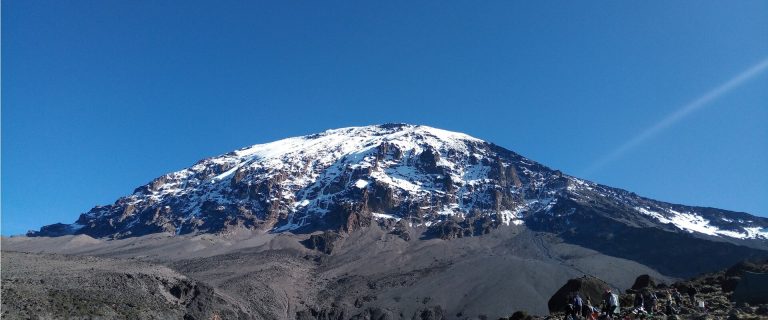

Marangu Route Guide in Tanzania
The only route with huts
Marangu is different from the other eight in a way that no amount of itinerary tinkering can change: it is the only route on Kilimanjaro where you sleep in a building. TANAPA runs huts at Mandara, Horombo and Kibo, and every other route on the mountain sleeps in tents at designated campsites.
It is also the oldest route, the busiest, and the one the park itself is administered from — Marangu Gate is Kilimanjaro National Park's headquarters, 41 kilometres from Moshi and 86 from Kilimanjaro International Airport, which makes it the easiest trailhead in the country to reach.
And it is the route with the worst reputation, usually delivered as a flat statement that it has the lowest summit rate on the mountain. That statement is more nearly true than most of the numbers that circulate about Kilimanjaro, and it is worth unpacking properly, because Marangu is also the only route anybody has actually measured.
Where it goes
Marangu climbs the south-eastern flank in a straight line and comes back down the same one. From the gate the path runs up through montane forest to Mandara, at 2,743 metres. Above Mandara the trees give out into heath and moorland, and a long steady day crosses that country to Horombo at around 3,700 metres, which sits on an open shoulder with Mawenzi's 5,149-metre spires filling the view to the north-east.
From Horombo the route climbs into alpine desert and out onto the Saddle — the wide, high, empty plain that joins Mawenzi to Kibo. Crossing it takes most of a day and it is the bleakest ground on the mountain: no vegetation, no shelter, no water, and the two summits standing at either end of it. At the far side, under Kibo's eastern scree, is Kibo Hut at around 4,700 metres.
Summit night starts from there, up the scree in the dark to Gilman's Point on the crater rim, then round the rim to Uhuru Peak at 5,895 metres. Then all the way back: Kibo, Horombo, Mandara, the gate.
The huts
Nobody would call them luxurious and that is not the point. Mandara and Horombo are clusters of A-frame sleeping huts with bunks and mattresses, plus a communal dining building. Kibo is a single stone block, cold, high and functional, where almost nobody sleeps much because you are getting up before midnight anyway.
What the huts actually buy you is narrower than "comfort" and more useful. You are not putting up or taking down a tent in the rain. You are not lying on the ground. There is somewhere with a roof to eat and dry out, and there is a dry room to be ill in if you need one. For travellers with a back that objects to sleeping mats, for people climbing in the wet months, and for anyone whose deciding factor is the prospect of six mornings packing a soaking tent, those are real advantages and they are not available anywhere else on the mountain.
The trade is privacy and quiet. Bunks are shared with whoever else is on the route that night, and on Marangu that is a lot of people.
Five days or six, and what the research actually found
Marangu is sold in a four-night version and a five-night one. The longer adds a day at Horombo, usually spent walking up towards Mawenzi or out to Zebra Rocks and coming back to sleep at the same hut — the classic climb-high-sleep-low pattern.
Two peer-reviewed studies have measured what happens on these profiles, and they were both done here.
- A team from Manchester stationed researchers at all three huts for sixteen days and followed 312 trekkers on the fixed four- and five-day profiles. Of the 181 complete data sets, 111 (61 per cent) reached the summit and 139 (77 per cent) developed acute mountain sickness. Summit success and sickness rates were about the same on the four-day and the five-day version. Their conclusion was blunt: trekkers need a more gradual profile than this route provides. Published in Wilderness & Environmental Medicine, 2009.
- A Finnish group followed 112 of their countrymen up the same route across the 2006–07 season. Fifty-nine of them (53 per cent) reached Gilman's Point or Uhuru Peak, and 75 per cent had acute mountain sickness. The authors put the blame on rapid ascent driven by fixed commercial timetables. Published in High Altitude Medicine & Biology, 2008.
A third study, from Edinburgh, recruited trekkers at 2,743 metres and again at 4,730 metres — Mandara and Kibo. Three per cent were sick at the lower hut and 47 per cent at the upper one. It also found no measurable benefit from the single extra rest day at Horombo, at the ascent rates people were actually walking.
These are old studies and small ones, and none of them is a current statistic for any operator's clients today. But they are measurements with methods attached, which is more than can be said for the percentages that circulate elsewhere. What they show is consistent: on a short profile up this route, something like half to two-thirds of people summit, and three-quarters feel ill. How to read figures like these, and what the wider evidence says about ascent rates, is set out in the main Kilimanjaro climbing guide. Taking the extra day at Horombo is still the right call — but it is a smaller lever than a fundamentally longer route would be.
Gilman's Point is not the summit
This matters here more than anywhere else on the mountain, and it is part of why Marangu's numbers are hard to read.
The Marangu ascent meets the crater rim at Gilman's Point. Uhuru Peak, the actual summit at 5,895 metres, is a further walk around the rim from there — on a bad morning, in wind, after a night of no sleep, it is a long further walk. A great many people stop at Gilman's. The Finnish study counted "reached Gilman's Point or Uhuru Peak" as one outcome, which tells you how routinely the two are treated as equivalent.
If reaching the true summit matters to you, say so to your guide before you start, agree a turnaround time rather than a turnaround point, and be clear with yourself about which of the two you are training for.
What there is to see on this side
Marangu is routinely written off as the dull route. It is the least varied, because it goes up and down one flank rather than wrapping around the mountain, but "nothing to see" is wrong and the park's own material says so.
- Maundi Crater, a fifteen-minute walk past Mandara hut, a small parasitic crater with a panorama that takes in Lake Chala, Lake Jipe and the Nyumba ya Mungu reservoir, all of which are fed by water off the mountain.
- Lauwo Waterfall, 2.8 kilometres from Marangu Gate inside the thick forest, and reachable without climbing anything.
- Kifinika, a sacred site on this route used historically by the Chagga for ritual. It is the only cultural site the park lists on any of the trekking routes, and the mountain's human history is much older than its climbing history.
- The Saddle, which is genuinely strange country — a high desert plain between two volcanoes, and unlike anything on the southern routes.
- Mawenzi, which you walk beneath for two days. It is a technical peak requiring a separate permit and is not climbable on this trip, but it is the most dramatic thing on the mountain to look at.
Up and down the same path
Marangu is the only route that descends the way it came. Whether this is a drawback depends entirely on what you want.
Against it: you see nothing new on the way down, and the last day retraces a forest you have already walked. Every other route comes off the mountain by a different line, most of them through Mweka Gate.
For it: you know exactly what is coming, the descent is on a good path rather than loose scree, and if you have to come down early — which is what happens when altitude illness gets serious — you are descending ground you have already walked, towards huts you have already slept in, on the shortest line off the mountain from anywhere on the route. That is a genuine safety property and it is rarely mentioned.
Who it suits
It suits travellers who want a roof, a bunk and a dining hall; anyone climbing in or near the wet months, when a hut route removes the worst daily misery of a tented one; people with a short window who would otherwise not climb at all; those who want the simplest logistics on the mountain, since the trailhead is the park headquarters and there is no long drive to it; and anyone for whom carrying and sleeping on camping equipment is the obstacle.
Look elsewhere if your priority is standing on Uhuru Peak. The evidence on this route's profile is not encouraging and it is the best evidence anyone has. Machame is the usual alternative from the same side of the mountain with a much better-shaped profile, and Rongai — which comes up the northern side and descends this very path — is the option for people who want a gentler gradient and a drier approach. Look elsewhere too if you want scenery as the main event, or if sharing a bunk room with strangers at 3,700 metres sounds worse than a tent. And if a short window is the real reason this route is on your list, what the mountain asks of a calendar and a budget is worth settling before the route is.
Common questions
Is Marangu the easiest route?
It is the easiest walking and it is not the easiest climb. The gradients are gentle and the huts remove a lot of daily hardship, but the profile gives your body less time and less of the climb-high-sleep-low stimulus than the longer routes, and that is the part that decides most summit attempts.
Why is it called the Coca-Cola route?
An old nickname contrasting it with Machame's "Whiskey route" — the easy, comfortable, popular option against the rough camping one. It is a piece of mountain folklore rather than a description of either route as they are sold today.
Should I take the extra day at Horombo?
Yes. It is the only acclimatisation the route offers and it costs one day. Be aware that one published study found no measurable reduction in altitude sickness from that single rest day at the ascent rates observed, so take it and still expect the climb to be hard on you.
Do I need a sleeping bag if there are huts?
Yes. The huts provide bunks and mattresses, not bedding, and Kibo hut is above 4,700 metres and extremely cold.
Can children climb Marangu?
Not to the summit if they are under ten: park rules prohibit anyone under ten from going above 3,700 metres. The forest section, Mandara and Maundi Crater are all below that line and make a good short trip in their own right.
How crowded is it?
It is the most-walked route on the mountain and the huts fill. In peak season expect full bunk rooms, a busy dining hall and a great many people on the Saddle at the same time as you.