
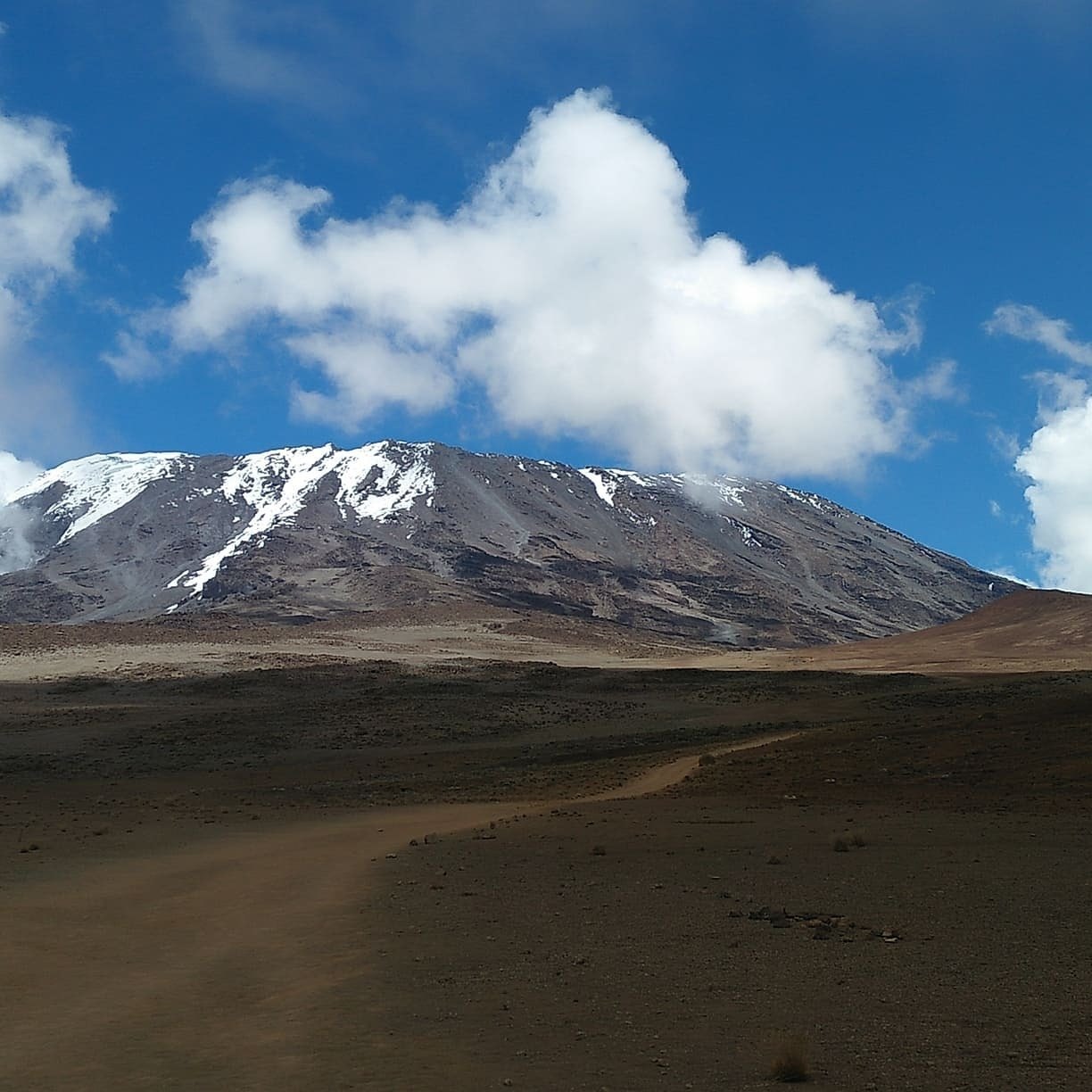
Most Kilimanjaro pages begin with the routes. This one begins earlier, with the questions that come before the route matters: whether to climb at all, what the mountain takes from your calendar and your budget, what fitness and health have to do with it, which month to go, and how to choose the company you hand yourself to. The route guides on this site cover the paths. This page is about the decision to stand at the gate.
What you are actually committing to
Kilimanjaro is unusual among the world’s famous mountains in requiring no technical skill on any standard route. It is a walk. That is why it catches people out: the barrier is not the ground, it is the altitude, and altitude does not care how strong you are.
Tanzania National Parks states in its general brochure (TNP/BDS/B/01, edition 2024/2 Rev. 1, October 2024) that “Climbing to Kibo peak takes 5 – 9 days depending on the route”. Its own park page for the mountain says five to eight, and counts six mountain trails where the brochure counts seven — the authority has not reconciled the two, and this page does not either. Both carry the sentence that should govern most of this decision: “The more days, the higher the possibility to conquer the summit.” KINAPA’s own Park Commander puts a floor under it — climbers “are required to spend not less than five days to ascend and descend the Kibo peak for the purpose of acclimatization”.
Uhuru Peak stands at 5,895 metres, the figure TANAPA publishes on every surface, in a park of 1,712 km². Mawenzi, at 5,149 metres, is a technical peak under a separate permit and not part of any trek. TANAPA counts five eco-climatic zones between the gates and the rim, and describes the peak as snow-covered all year round.
The commitment has four parts, and they are not interchangeable:
- Time. Five to nine days on the mountain, plus the days around it. Realistically seven to eleven nights in Tanzania for a climb on its own.
- Money. A park fee stack that rises with every extra day, plus operator costs that are mostly wages for a crew far larger than your party.
- Discomfort. Not difficulty — discomfort. Cold, poor sleep, no appetite, a summit night that begins around midnight.
- Uncertainty. Nobody can promise the summit, and the published research on summit rates is less flattering than the marketing figures. The climbing Mount Kilimanjaro guide sets out what has been measured.
The time budget, and where the mountain sits in a Tanzania trip
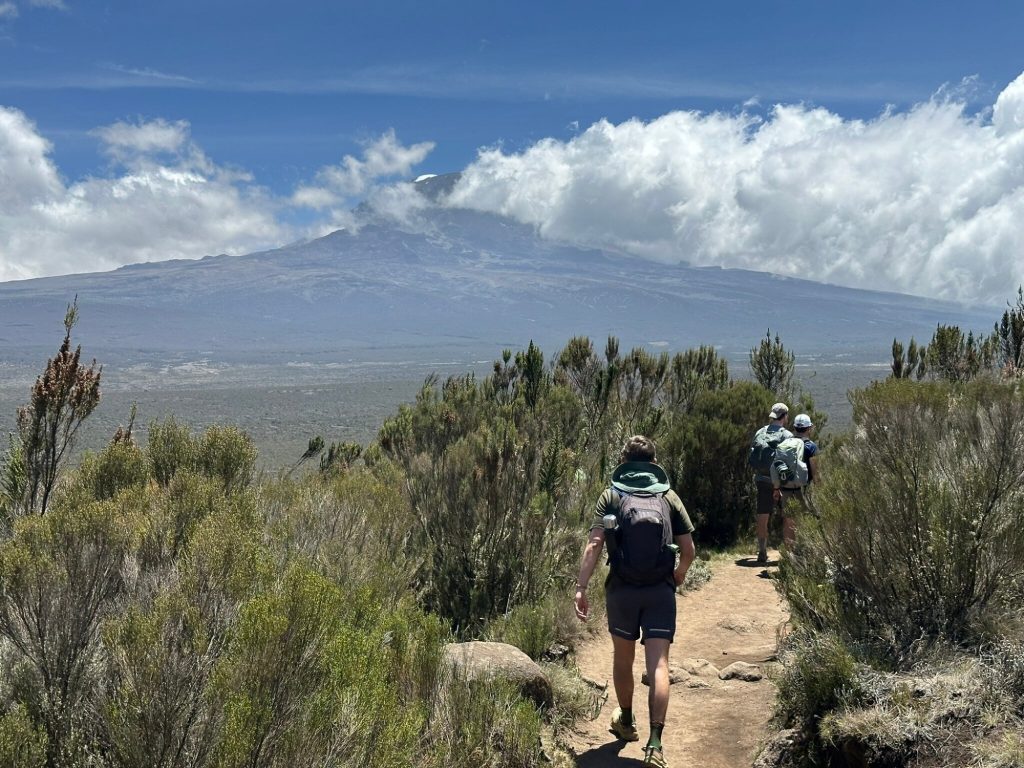
The climb is the number people plan around. It is not the number that fills the calendar.
| Element | Nights |
|---|---|
| Arrival, briefing and kit check in Moshi or Arusha | 1, sometimes 2 |
| On the mountain | 4–8 (TANAPA’s 5–9 day range) |
| After the descent | 1 |
| Contingency against a delayed flight or a weather day | 1 |
| Total for a climb alone | 7–11 |
Kilimanjaro International Airport is the gateway: about 45 minutes from Moshi, where most climbers stay, 41 km from Moshi to Marangu and the park headquarters, and 86 km from the airport to Marangu. Arusha is the alternative base and adds a road transfer.
Combining a climb with a safari, and which comes first
Mountain first protects the climb: a delayed flight is absorbed by the contingency day, whereas a delay eating into a fixed climb start is hard to recover from. You arrive at the safari tired, which matters less, because a safari is done sitting down.
Safari first has one specific advantage: if the safari included time at altitude — the Ngorongoro rim, the Crater Highlands, Karatu — you begin partly acclimatised, which the Kilimanjaro literature consistently supports.
The stronger version of that is Mount Meru, in Arusha National Park: a three- to four-night climb taken deliberately as acclimatisation. It is the most useful thing you can bolt onto a Kilimanjaro trip, and it turns the trip into a fortnight. See climbing Mount Meru.
What does not work is a compressed safari after a compressed climb. How many days you need in Tanzania has the arithmetic; ten days gives you a climb and little else.
What a climb costs you, and where a cheap one takes its money from
The state’s share is easy to compute, because everything is charged by the day. These are the heads that apply, from TANAPA’s tariff booklet From 1st July 2023 to 30th June 2024, retrieved 21 September 2026 — non-East African adult rates, before the 18 per cent VAT the booklet says is charged on top.
| Head | Rate | Basis |
|---|---|---|
| Conservation fee | 70 | per person per day, all year |
| Public campsite | 50 | per person per night |
| Huts (Mandara, Horombo, Kibo — Marangu route only) | 60 | per person per night |
| Rescue fee | 20 | per person per trip, non-refundable |
| Conservation fee, child 5–15 | 20 | per person per day |
| Cycling on Kilimanjaro | 50 | per person per day, on top of the conservation fee |
| Upper Barafu Camp | 100 | per person per night |
| Mawenzi Peak technical climbing | 750 | per person per day |
One absence in that table is informative. There is no TANAPA guide fee on Kilimanjaro — the tariff line reads “guide fee in all parks except Kilimanjaro”, because your guides come from the operator, not the park, and the park’s own crew charge is TShs 5,000 per trip. What you pay the crew is entirely the operator’s number, which is why it is the line that varies.
Two caveats. The 2023/24 booklet is the most recent TANAPA has published, and TANAPA’s website states fees are VAT-inclusive while the booklet it links to states the opposite. The booklet is the instrument; get the basis confirmed in writing. Full picture in how much a Tanzania safari costs.
The structural point
Every extra day on the mountain adds a conservation fee and a bed fee to the state’s share before the operator counts a single one of its own costs. That is the concrete reason a longer, safer itinerary costs more, and why the gap between a six-day and an eight-day climb is not padding.
It also shows where a conspicuously cheap climb finds its money. Park fees are fixed and identical for every company; the mountain is the same mountain. What is left to cut is the crew — how many there are, what they are paid, what they eat, what they sleep in and what they wear at 4,500 metres in the dark. That is not a line you should want optimised on your behalf.
What sits outside the climb price
- International flights and the visa — see Tanzania travel requirements.
- Insurance with high-altitude and evacuation cover. See below; not optional.
- Tips for the crew — a substantial, expected sum on a mountain with a dozen or more staff per small party. Ask the operator the local norm and how the split is made.
- Personal equipment, or its hire in Moshi.
- Nights before and after the climb, unless explicitly included, and anything bought on the mountain.
When to climb
Two authorities describe this mountain’s year, and they do not say quite the same thing. It is worth having both, because the difference falls in the shoulder months where most of the timing mistakes are made.
What the park says. TANAPA’s Kilimanjaro brochure: “There are two rainy seasons in a year mainly influenced by the prevailing trade winds. The short rainy period is from October to November and the wet season is from March to May during which it rains around the mountain base and snow accumulates on its peak. The dry season is from late June to September and from December to early March during which the nights are cool and the days completely clear and thus provides good climbing conditions.”
What the meteorological authority says. The Tanzania Meteorological Authority places Kilimanjaro Region in the north-eastern highlands, a bimodal zone. Its short rains, Vuli, run October to December — TMA publishes its forecast under exactly that title — and the long rains, Masika, run March to May. TMA describes January and February as “relatively dry” and June to September as dry nationwide.
| Months | TANAPA | TMA | For a climb |
|---|---|---|---|
| Dec – early March | Dry season | Dry gap in January–February; December is still inside Vuli | The warmer dry window and less crowded than midsummer. December is the month the two accounts disagree about most. |
| March – May | Wet season | Masika; April normally wettest | The window most climbers avoid. Rain around the base, snow accumulating on the peak. |
| Late June – September | Dry season | Dry nationwide; also TMA’s cool season | The main climbing season. Clearest, coldest, busiest. |
| October – November or December | Short rains, October–November | Vuli, October–December | Shorter, sharper rain than Masika. Route choice does real work here. |
Where they differ, plan against the wetter reading. TANAPA ends the short rains in November and TMA carries them to December, so a December climb sold as safely dry is being sold against the more optimistic of two official calendars. At either end, Vuli begins in October on both accounts: a mid-October climb described as “before the rains” is inside them.
One more thing the tourism framing obscures: the dry season is also the cool season. TMA puts the cool months at May to August. A July climb is the clearest and the coldest at the same time, and TANAPA’s own wording agrees — “the nights are cool and the days completely clear”.
TANAPA names no “best months”; it says only that the two dry windows provide good climbing conditions. Anyone quoting the park as endorsing a specific month is adding something it did not say.
If you do climb in or near the rains, two levers help: the northern and north-eastern approaches to the mountain are drier than the southern and western ones, and the hut route removes the problem of packing a wet tent every morning. Which routes those are is covered in the route guides below.
What the month does not change is the thing that actually decides a climb. A long itinerary in a mediocre month beats a short one in a perfect month, every time. If you can only travel in April, take more days rather than fewer. Best time to visit Tanzania covers the wider seasonal picture, including why the south of the country runs a different calendar entirely.
How fit do you need to be, and what fitness is not
The honest answer is that fitness makes the walk pleasant and does very little to decide whether you summit. Fit people turn back constantly; unfit people finish. The US Centers for Disease Control put it flatly in their 2026 travel health guidance, which names Kilimanjaro specifically: “Training and physical fitness do not affect risk.” What decides it is how your body handles thin air, and how many nights your itinerary gives it to adapt.
Three practical consequences follow. Buy nights, not training — between a better-equipped short climb and a longer plain one, take the longer one; the cohorts summarised in the activity guide show short itineraries producing summit rates far below the figures commonly advertised. Train for the descent, which is fast, long, hard on knees and where most injuries happen; downhill walking with a loaded pack is the most useful preparation. And arrive acclimatised if you can — the one preparation the literature consistently supports, whether through Mount Meru, nights at altitude on a safari, or time at height at home.
What you need is the ability to walk five to seven hours a day on consecutive days over uneven ground with a daypack — and then to get up at midnight and do the hardest of those days last, on no sleep.
Who should have a conversation with a doctor first
“Altitude sickness” flattens a real distinction. Ordinary acute mountain sickness — headache, nausea, no appetite, no sleep — is common on Kilimanjaro and resolves on descent. The conditions that kill are high altitude pulmonary oedema (HAPE) and high altitude cerebral oedema (HACE).
The best primary evidence on which of those matters is a two-year review of climbers presenting at the main regional referral hospital in Moshi, published by Dekker and colleagues in Wilderness & Environmental Medicine in 2021. Of 56 presenting with high altitude illness, 30 (54 per cent) had HAPE, 7 (12 per cent) HACE and 11 (20 per cent) both, with mean symptom onset from about 4,600 metres upwards. Of 21 climbers who died and underwent postmortem evaluation, 16 deaths were caused by HAPE and three by HAPE with HACE. The authors’ conclusion is the sentence to carry: HAPE was the main cause of death during climbing as well as of hospital admissions.
That study gives a numerator without a denominator, so it yields no death rate, and no Tanzanian authority publishes one. What it tells you is which symptoms you and your guide are watching for: breathlessness at rest, a cough, a falling oxygen saturation, at and above the high camps. The largest prospective cohort — Croughs and colleagues, Journal of Travel Medicine, 2022, 1,237 hikers — found severe altitude illness in 8.6 per cent and hospital admission in 1.1 per cent, and found that climbing over more days predicted summit success. That is the evidence behind everything this page says about itinerary length.
TANAPA requires no medical certificate from climbers. The only annual medical-certificate rule in the mountain regulations applies to porters, through their association. The climber-facing rule is behavioural — the brochure’s instruction is not to push on “if your body is exhausted or if you have extreme mountain sickness”. Nobody is going to check that you are fit to do this. That is the reason to check yourself.
This is a guide to planning a trip, not medical advice, and nothing here replaces a consultation with a doctor who knows your history. But these are the circumstances in which that consultation is not optional:
- Any heart or lung condition, including asthma that is not well controlled.
- Uncontrolled high blood pressure.
- Pregnancy.
- Sickle cell trait or disease.
- A previous episode of altitude illness of any severity.
- Recent surgery, or any condition requiring medication whose absorption or effect might change at altitude.
- Diabetes, where appetite loss and exertion interact with insulin or oral control.
On acetazolamide and other altitude drugs: these are prescription decisions for a doctor, the Kilimanjaro-specific evidence is mixed rather than glowing, and no drug substitutes for a longer itinerary. Ask your doctor, not your operator.
Build the medical conversation into the timeline. A consultation, a prescription and any vaccinations need weeks, not days, and sit alongside the entry requirements in Tanzania travel requirements.
Age, and climbing with family
The rule is not a minimum age but an altitude ceiling, and it is law rather than policy. Regulation 19 of the Mountains National Parks Regulations 2003 — Government Notice No. 191 of 25 July 2003, made under the National Parks Ordinance — states that “children under 10 years old are not allowed to climb beyond 3700 Metres”, and TANAPA’s brochure repeats it. So there is no minimum age for entering the park or walking the forest and moorland; the summit is effectively ten and over. Mawenzi technical climbing is separately restricted to eighteen and over.
Below 3,700 metres there is a real trip rather than a consolation: nature trails in the forest zone, day walks on the Shira Plateau, and the lower slopes around Marangu and Machame — waterfalls, Chagga villages, coffee farms.
There is no published upper age limit, and the park’s own record says so loudly: in July 2026 KINAPA formally received a climber who had set a record as the oldest person to reach the summit, at ninety. The relevant factors are cardiovascular health and itinerary length rather than a number. One published Kilimanjaro cohort found that being forty or over predicted not summiting while not predicting illness — which again points at taking more days rather than at not going.
Where some of a family will climb and some will not, the usual shape is a climb for those going and a short northern-circuit safari for those not, meeting afterwards in Moshi or Arusha.
Choosing a route without reading ten guides first
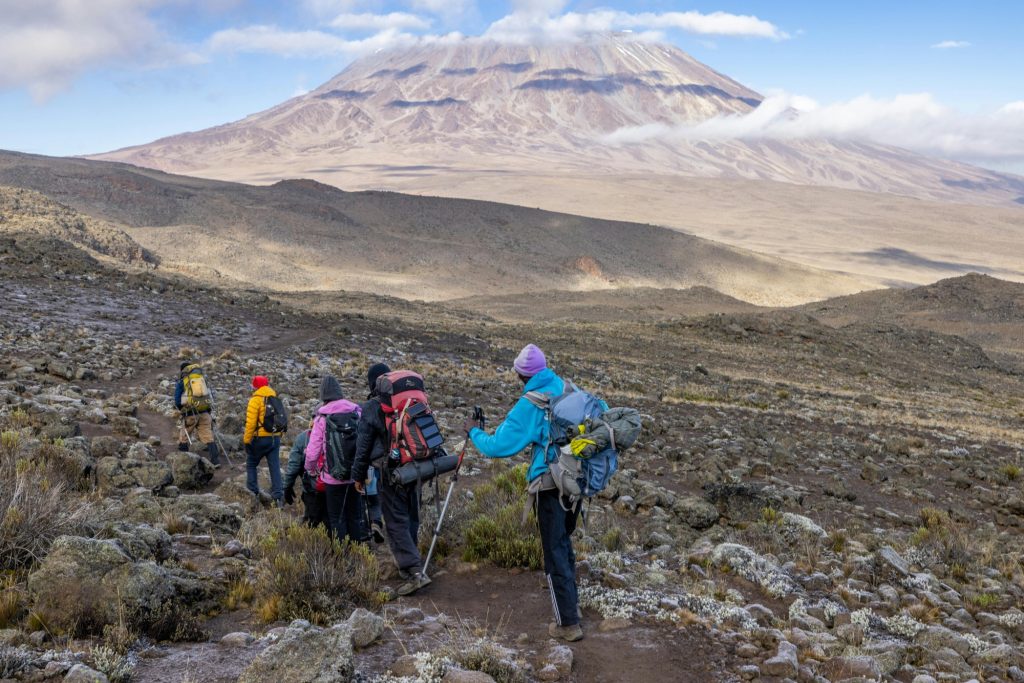
Route choice is consequential and over-discussed. Five things differ; the rest is detail.
- How many nights you sleep high — the biggest factor, and the one most often traded away to fit a holiday.
- The shape of the profile — whether it takes you above your sleeping altitude by day and brings you back down, or simply climbs.
- Which side you approach from — the southern and western flanks catch the weather and carry the forest; the north and north-east are drier.
- Huts or tents. Only one route has huts.
- How busy the path is. Two routes carry most of the traffic; several are genuinely quiet.
Use this to narrow it to two, then read those two.
| If your priority is | Start with |
|---|---|
| A well-shaped first climb, accepting company on the path | Machame |
| The same climb with extra acclimatisation days in front of it | Lemosho |
| A roof over your head, a shorter trip, or a wet-season climb | Marangu |
| The longest, highest-probability itinerary on the mountain | Northern Circuit |
| A drier approach, or a steadier gradient | Rongai |
| A direct, steep line, already acclimatised | Umbwe |
| Starting high on the western plateau | Shira |
| A scrambling summit approach with a different risk profile | Western Breach |
| A night inside the summit caldera, added to a long itinerary | Crater Camp |
| An overview of how all of them compare | Climbing Mount Kilimanjaro |
Two entries there are not routes in the ordinary sense, and both need a warning that most pages do not give.
The Western Breach has been closed, and the closure has never been publicly lifted. TANAPA does not use the name: its Public Notice No. 18/2024, issued at Arusha on 20 January 2024, closes the section it calls Arrow Glacier, used by climbers coming up Machame, Umbwe, Lemosho and Londorosi. The stated reason was rockfall, ice and slipperiness after heavier-than-usual rains, following an inspection by KINAPA specialists with the National Outdoor Leadership School which found the section not safe for users. Climbers were redirected to the normal line from Barranco through Karanga to Barafu, and reopening was made conditional on the rains stopping and a further inspection.
That notice is no longer on TANAPA’s website — the announcements section was removed when the site was rebuilt — and no reopening notice has been published since. So the honest position is: closed in January 2024, conditionally, with no published reopening and no published confirmation that it remains closed. Anyone offered this route should ask the operator for KINAPA’s current written position rather than accept a verbal assurance, and should treat the rockfall exposure as a separate decision from route choice.
Crater Camp, by contrast, is running — which takes some establishing, because TANAPA’s tariff suggests otherwise. The 2022/23 tariff carried a line for “Mt. Kilimanjaro Crater Camping”; in the 2023/24 tariff that slot was replaced by a fee for Upper Barafu Camp and the word “crater” disappeared entirely, and TANAPA’s 2024 park map plots no campsite inside the caldera. But the Ministry of Natural Resources and Tourism’s 2025 statistical bulletin lists a “Crater Fee Kilimanjaro” levied month by month through 2025, 196 times in the year. The fee is still being charged; the tariff booklet is simply incomplete. It remains a night at extreme altitude for strongly acclimatised climbers on long itineraries only.
A note on how many routes there are. TANAPA’s own surfaces do not agree: its brochure says “seven mountain trails”, its park site says six, and its Park Commander’s list names six ascending routes plus Mweka for descent. What is consistent across its map and its prose is that Mweka is descent-only and Marangu is the only route the park shows as both an ascent and a descent. Eight gates ring the mountain — Marangu, which is also the park headquarters, plus Rongai, Machame, Londorosi, Lemosho, Kilema, Mweka and Umbwe.
Choosing the company you hand yourself to
You cannot climb Kilimanjaro alone, and this is settled in law rather than in website copy. The Mountains National Parks Regulations 2003 (GN No. 191/2003) provide at regulation 4 that “guide(s) and or an armed park ranger shall guide every climbing group”; at regulation 3 that the park “shall only deal with properly registered and licenced tour operations who are also members of a tour operators association”; at regulation 6 that operators may only employ trained guides who belong to a registered guides association and hold a valid park identity card; and at regulation 9 that “all climbers including guides and porters shall be registered at the entrance points”. Your permit names the gates you enter and leave by, and using others is a breach of it.
So the operator choice is the most consequential decision on this page after itinerary length: the regulations make the operator the mechanism through which the park’s safety rules reach you. This site ranks nobody and verifies nobody; what it can do is tell you what to ask. An operator who answers these crisply is telling you something. One who changes the subject is telling you something else.
On the itinerary
- How many nights on the mountain, and at what altitude is each one?
- Does the profile include climb-high-sleep-low days, and where?
- What happens to the price and the plan if a climber decides on the mountain to add a day?
On safety
- What is the guide-to-client ratio, and how many of the guides are qualified in wilderness first aid?
- Is pulse oximetry done twice daily, and are the readings written down and shown to the climber?
- What is carried — oxygen, a stretcher, a portable altitude chamber, a radio or satellite phone?
- At what point does a guide turn a client around, and who has the final say?
- What is the evacuation plan from the highest camp on this route, and how long does it take?
On the crew
There are legal numbers to hold them to, and there are two of them, which is itself worth knowing. Regulation 12 of the 2003 mountain regulations provides that “porters shall only carry luggage weighing between 18-25 kilograms while ascending or descending the appropriate mountain”. The Tourism (Tour Guides) Regulations 2015 — Government Notice No. 270 of 17 July 2015 — provide at regulation 22(3) that “a porter shall not carry a luggage weighing more than 20 kilograms at any one time”. Both instruments are live, neither revokes the other, and the lower figure is the later one. TANAPA’s climber-facing rule meanwhile puts a 25 kg ceiling on you: do not “exceed 25kgs of luggage to porters (including their belongings) during the climb” — gross, including the porter’s own kit.
The 2015 regulations also cover payment, at regulation 22(4): “a porter shall be paid a half of his wage at the beginning of his duty and the remaining sum immediately after completing his duty.” That is a checkable thing to ask about. What is not published anywhere is a statutory wage rate for porters or guides, or any guide-to-client or porter-to-client ratio, so those remain questions for the operator rather than numbers you can hold up against a rule.
- How many porters, carrying what weight each, weighed where?
- What do they sleep in and eat?
- Who supplies their boots and jackets?
- How are tips divided, and who tells the crew what the split was?
- What happens, in practice and in payment, if a porter is injured at 4,500 metres?
On the company
- Does it hold a valid mountain-climbing licence? Under the Tourism Act 2008 nobody may operate without a licence from the tourism licensing board, and the specific class is Class A, item 9, “Mountain Climbing or Trekking”. That class is reserved to companies wholly owned by Tanzanians — the ministry’s own fee schedule shows no non-citizen rate for it at all. Licences run for twelve calendar months. Ask to see the current one: there is no searchable public register a traveller can query, so the document is what you have.
- Are the guides employed or engaged per climb, and do they hold current park identity cards?
- What is the cancellation policy if you are ill before departure, and are park fees recoverable? TANAPA’s booklet states that “fees once paid is non-refundable”, so the answer is a matter of the operator’s own policy, not the park’s.
Insurance and evacuation
TANAPA charges a rescue fee of US$20 per person per trip, non-refundable, for Kilimanjaro and Meru. It is easy to misread that as evacuation cover. It is not.
The tariff does not define what the fee buys. The nearest TANAPA gets is that “rescue services for the sick and injured including first aid and radio communications are available in all mountain stations”, and the 2003 regulations put the duty on the guide to give first aid and “rescue him or her down”. No TANAPA document says the rescue fee covers a helicopter, an ambulance or hospital treatment. Park rescue means being walked or stretchered down to a gate.
Helicopters do fly there — TANAPA confirmed as much in a public notice about an accident on the upper mountain in December 2025, naming the private operator — but they are run by companies, not the park, and no Tanzanian source establishes who authorises an evacuation, who pays, or whether it is gated on your insurance. Assume it is on you.
One more sentence is worth reading before you book. Regulation 22 of the mountain regulations provides that “every climber climbs at his own risk and the Trustees of Tanzania National Parks shall not in any way be liable to any climber’s loss of properties, loss of life, injury”. The park has told you, in a statutory instrument, that the risk is yours. Insurance is how you hold it.
Establish these before booking, from the policy document rather than a summary: altitude (many policies cap cover well below 5,895 metres, and trekking cover to summit height must be explicit); evacuation and repatriation, including who authorises a helicopter and who pays at the point of use; medical treatment in Tanzania, including at the regional hospitals in Moshi; and cancellation and curtailment, which matters more than usual since park fees are non-refundable once paid.
If you do not summit
Decide in advance what the trip is for. A meaningful proportion turn back, and the ones who take it worst are those for whom the summit was the entire point.
Know the difference between the named points on the rim: Gilman’s Point and Stella Point are where ascent lines meet the crater rim, and there is still a walk around it to reach Uhuru Peak, so “reaching the rim” and “reaching the summit” are not the same claim. Agree in advance with your guide what you are aiming at. And accept the turn-around decision when it comes — altitude illness improves with descent and worsens with height, and no version of it is improved by continuing up.
Operators do not refund a climb that does not summit; the costs were incurred either way. Some will discuss a discounted return. Ask before you book if it matters.
What to arrange before you leave home
- Entry requirements — visa, passport validity, health documentation. See Tanzania travel requirements, and start early.
- A doctor’s appointment if any of the circumstances above apply, and any prescriptions that follow.
- Insurance with explicit altitude cover, read rather than skimmed.
- Boots, broken in. The single most common avoidable misery on the mountain.
- A sleeping bag rated well below freezing, or confirmation that the operator supplies one that is.
- A plan for water on summit night, which freezes.
- Cash for tips, in the currency and denominations your operator says are usable, and the rest of the trip, which is easier to decide before the climb than after it.
Frequently asked questions about planning a Kilimanjaro climb
Do I need mountaineering experience?
Not for the standard routes, which are walks on paths and scree with no rope and no technical ground. The exceptions are the Western Breach, which involves scrambling on steep loose ground, and Mawenzi Peak, which is a technical climb under a separate permit and is not part of any trekking route.
How many days should I book?
TANAPA’s range is five to nine days and its guidance is that more days improve your chance of reaching the summit; the research points the same way. If the choice is a shorter climb now or a longer one later, take the longer one.
Which route has the highest success rate?
Nobody has published a route-by-route table and this site will not invent one. The measured cohorts are set out, with their routes and itineraries, in the climbing Mount Kilimanjaro guide. An operator quoting a percentage for a specific route is quoting a figure with no published source.
Can I climb independently, without a company?
No. Climbs are arranged through a licensed operator and you register at the gate. This is park regulation rather than a preference of this site.
Is a cheap climb dangerous?
Not automatically, but it is worth knowing what has been cut. Park fees are identical for everyone, so a very low price comes from somewhere else — fewer days, fewer guides, less equipment, or crew costs. Ask which. A company that can explain its price is in a different position from one that cannot.
What is the minimum age?
TANAPA does not permit children under ten above 3,700 metres, which puts the summit out of reach for them. Below that altitude the forest and moorland zones are open, and the park runs day visits and nature trails there.
Do I need oxygen?
Supplementary oxygen on Kilimanjaro is an emergency measure, not a summit aid; the treatment for altitude illness is descent. Ask whether oxygen and a pulse oximeter are carried as standard — a safety question, not a performance one.
Should I climb Meru first?
If you have the days, yes. Arriving already acclimatised is the preparation the literature most consistently supports, and Meru is a three- to four-night climb in Arusha National Park with its own rewards. It turns a Kilimanjaro trip into a two-week one.
Is there anything on Kilimanjaro for people not climbing?
Yes, and it is underrated — see the age section above, and the Mount Kilimanjaro destination guide for what sits where.
Where this leads next
- Climbing Mount Kilimanjaro — what the climb itself involves, the published research on summit rates and altitude sickness, and porter welfare in detail.
- Mount Kilimanjaro — the mountain and the park as a place, including what is on the lower slopes.
- Best time to visit Tanzania — the seasons in full, and why the rest of the country runs a different calendar.
- How many days do you need in Tanzania — fitting a climb into a wider trip.
- How much does a Tanzania safari cost — the whole published tariff, dated and sourced.
- Getting around Tanzania — arriving at Kilimanjaro International and moving on afterwards.
- Tanzania travel requirements — visas, health rules and entry.
Finding a climb and an operator to run it
This site does not sell climbs, take bookings or handle payments, and it ranks nobody. It lists trips run by Tanzania’s own operators so that the questions on this page can be put to several of them at once and the answers compared.
Browse the safaris and climbs listed by Tanzanian operators, or read about the companies behind them first. When you enquire, lead with the itinerary length and the safety questions rather than the price — the price will follow the answers, and it should.