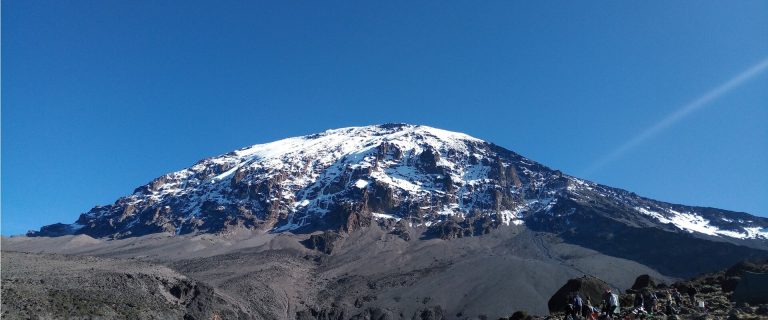
Kilimanjaro National Park protects Mount Kilimanjaro, at 5,895 m the highest point in Africa, together with the montane forest belt around it in the Kilimanjaro Region of northern Tanzania, close to the Kenyan border. Most visitors come for a guided summit trek of five to eight days; others walk the forest on a day hike or cycle the lower slopes. Non resident adults pay a USD 70 conservation fee per day on the current TANAPA tariff.
Reasons to Plan a Kilimanjaro Safari
The main reason to plan a Kilimanjaro safari is the chance to walk to the roof of Africa without ropes or technical skill, on a guided trek that climbs through five vegetation zones in under a week. TANAPA counts more than 35,000 climbers a year, and most of them reach the crater rim on foot with poles, warm layers and a slow pace.
The second reason gets less attention. A day in the forest on the Marangu side, with black and white colobus in the canopy and a crater viewpoint above Mandara Hut, suits travellers who have no wish to sleep at altitude. Add a Shira Plateau excursion or a mountain bike ride and the park fills two or three days for people who never intend to summit.
Kilimanjaro also sits close to Arusha. A climb links easily with a northern circuit safari.
Safari Activities in Kilimanjaro National Park
Summit trekking is the headline activity in Kilimanjaro National Park; forest day hikes, plateau trips, cycling and several specialist activities fill out the list. Every activity runs with a licensed guide; TANAPA does not permit solo trekking on the mountain.
Kilimanjaro Summit Trekking on Six Routes
Kilimanjaro summit trekking takes five to eight days on the mountain, and TANAPA notes that more days give a better chance of reaching the top. Six ascent trails lead to Uhuru Peak: Marangu, the only route with huts, plus Machame, Lemosho, Rongai, Umbwe and the Northern Circuit, with Mweka used for descent. Our separate Machame, Lemosho and Marangu guides cover each route day by day, as do the guides to the Shira route and the Western Breach, so this park guide keeps to the choices that shape a visit.
Altitude decides most summits. Several trip reports describe climbers who felt strong on day two and then struggled at dinner above 4,000 m, and many give up on the last steep pitch just below Stella Point on summit night. An extra acclimatisation day above 3,000 m is the change most often recommended by the park itself. Travellers worried about heights tend to find that the Barranco Wall on the western routes looks far more exposed in photographs than in person, and the Marangu route avoids it entirely.
Marangu Forest Hiking to Mandara Hut and Maundi Crater
Marangu forest hiking is the classic Kilimanjaro day hike and the simplest way to see the park in a single day: a guided walk from Marangu Gate to Mandara Hut at 2,700 m, about 8 km each way, with a short extra climb to Maundi Crater roughly 15 minutes beyond the hut. Day hikers in forum threads report six to eight hours for the round trip, uphill most of the way in and downhill all the way out.
Rain can fall in the forest in any month. The trail turns slick quickly. Day hikers who posted about the walk most often wished they had brought the following:
- A light rain jacket, even in the dry season
- Broken in boots with grip for wet roots
- Two litres of water and a packed lunch
- A warm layer for the crater rim
On a clear morning Maundi Crater looks out to Kibo and down to the plains and lakes below, so start early: the gates close at 6 pm and cloud usually builds on the mountain by early afternoon.
Shira Plateau Day Trip from Londorossi
A Shira Plateau day trip drives through Londorossi Gate on the western side and climbs by vehicle to a high plateau of heath and moorland at about 3,500 m, with giant groundsels, lobelias and wide views of Kibo. Short guided walks run from the Morum Barrier towards Shira 1 camp and Cathedral Point. Forum posters note that a Shira day costs considerably more than a Mandara hike because of the long drive, and the sudden altitude gain catches out people who flew in the day before.
Mountain Cycling Tours on the Kilema Route
Mountain cycling tours run on two park routes: the Kilema route for summit bound riders and the Shira Plateau for non summit rides, both with picnic sites and rest points. The cycling fee is USD 50 per person per day on top of the conservation fee. A full Kilema summit ride takes about seven days with acclimatisation stops at Horombo.
Crater Camping Expedition on Kibo
A crater camping expedition adds a night inside the Kibo crater near the summit, close to the bench shaped glaciers and the Ash Pit. Few climbers choose it, because sleeping above 5,700 m carries real altitude risk, and only operators experienced with the extra night should arrange it.
Mawenzi Technical Climbing
Mawenzi technical climbing is reserved for experienced, equipped mountaineers on the rugged 5,149 m second summit of Kilimanjaro. The park charges USD 750 per person per day for it, the highest activity fee on the mountain.
Paragliding Adventures from the Upper Slopes
Paragliding adventures from Kilimanjaro need prior permission and an experienced pilot. On the current tariff a pilot pays USD 500 and a passenger USD 250 per day, in addition to conservation fees.
Bird Watching Walks in the Montane Forest
Bird watching walks in the montane forest between roughly 1,800 m and 2,800 m give the best birding on the mountain, with Hartlaub’s turaco, silvery cheeked hornbill and several sunbirds among the species birders look for. Published bird counts for the park vary widely between sources, so treat any single total with caution.
Animals You Can See in Kilimanjaro National Park
Kilimanjaro National Park holds more than 140 mammal species, but most of them live in the montane forest and are shy, so the animals visitors actually see are monkeys, small antelope and birds rather than big game. Kilimanjaro is a mountain park. Large mammal sightings are not guaranteed on any route.
Forest Primates and Antelope
Black and white colobus and blue monkeys are the most reliable sightings in Kilimanjaro, usually in the first hours of the Marangu, Machame and Lemosho trails. Bushbuck and duikers share the forest, and the endangered Abbott’s duiker survives here in small numbers. Tree hyrax are heard far more often than seen; their calls carry through the forest camps after dark.
Elephants, Buffalo and Eland on the Shira Plateau
Elephants, buffalo and eland use the Shira Plateau and the quieter northern Rongai side, where fewer people walk. Leopard live here too. Few visitors see one. Above the moorland almost no mammals live, and the white necked raven is often the only animal around the high camps, scavenging near the mess tents.
How Kilimanjaro Differs from Mount Meru
Kilimanjaro differs from Mount Meru, its neighbour in Arusha National Park, mainly in height and cost: Kilimanjaro is 1,329 m higher and its park fees run USD 20 more per adult per day. Meru suits travellers who want a shorter mountain with more wildlife on the lower slopes, and many climbers use it to acclimatise before Kilimanjaro.
| Feature | Kilimanjaro | Mount Meru |
|---|---|---|
| Summit | 5,895 m | 4,566 m |
| Usual climb | 5 to 8 days | 3 or 4 days |
| Adult park fee | USD 70 a day | USD 50 a day |
| Hut fee | USD 60 a night | USD 30 a night |
| Wildlife | Mostly forest | Giraffe, buffalo |
Meru climbers walk with an armed park ranger because buffalo and giraffe share the lower trail, which makes the first day closer to a walking safari. Kilimanjaro has the height, the glaciers and the World Heritage listing, and it is the summit most people have come to Tanzania for. A Meru ascent followed by a Kilimanjaro climb gives the best acclimatisation, at the cost of about four extra days.
What Is Kilimanjaro National Park Known For?
Kilimanjaro National Park is known for protecting the largest free standing volcanic mass in the world, a dormant volcano with three cones, Kibo, Mawenzi and Shira, that rises 4,877 m above the plains around it. The park was established in 1973 and inscribed as a UNESCO World Heritage Site in 1987.
The original park covered the mountain above the tree line plus six forest corridors. UNESCO’s World Heritage Committee asked Tanzania to protect more of the montane forest, and a 2005 extension brought the natural forest that had been part of the Kilimanjaro Forest Reserve inside the park. TANAPA and UNESCO give the area as about 756 km² (75,575 ha); many travel sites quote 1,688 km², a figure the authority’s own pages do not use.
The glaciers on Kibo are shrinking. UNESCO lists their retreat as the feature of the property most exposed to climate change. The forest belt also feeds most of the streams that supply farms and towns on the lower slopes.
Where Kilimanjaro Sits in Tanzania
Kilimanjaro sits in the Kilimanjaro Region of northeastern Tanzania, on the border with Kenya, with Moshi as its main town to the south. Park headquarters are at Marangu Gate, roughly 41 km from Moshi, and Kilimanjaro International Airport lies about 40 km to the southwest. Arusha is about 128 km away by road.
The northern slopes face Amboseli National Park in Kenya, and UNESCO notes that the park remains connected to Amboseli for wildlife movement. Farms of coffee and bananas fill the lower slopes in Chagga villages up to the forest edge, which is why every gate is reached through cultivated land.
Places to See in Kilimanjaro National Park
The places to see in Kilimanjaro National Park are its three volcanic cones and the Shira Plateau, plus smaller trail landmarks such as Maundi Crater and Zebra Rock.
Kibo Crater and Uhuru Peak
Kibo is the summit cone and the only one most climbers reach. Gilman’s Point and Stella Point sit on the crater rim, and Uhuru Peak at 5,895 m is the highest point, about a further hour along the rim from Stella Point for most climbers. Inside the crater lie the Ash Pit and the remaining ice walls.
Mawenzi Peak
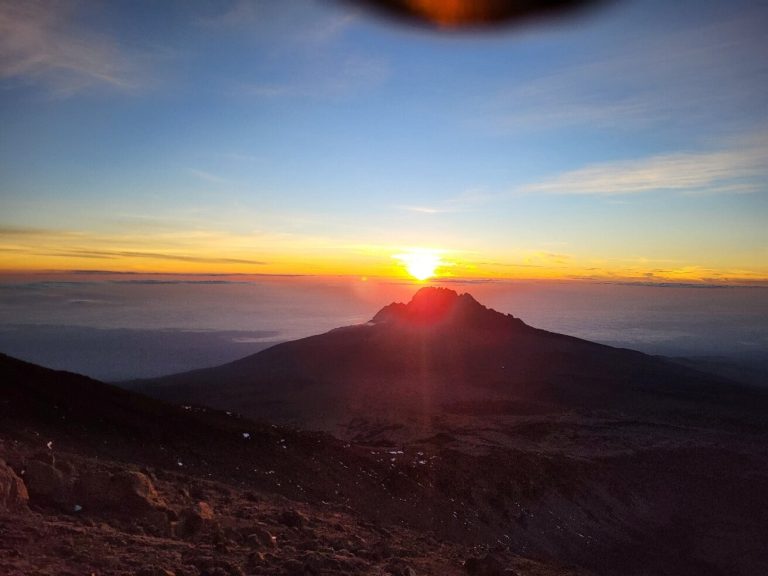
Mawenzi, at 5,149 m, is the jagged eastern summit, eroded into pinnacles and gullies. Hikers see it best from Horombo Hut and the saddle on the Marangu and Rongai routes; climbing it needs a technical permit.
Shira Plateau and Cathedral Point
The Shira Plateau formed when the oldest cone, Shira at 3,962 m, collapsed. The plateau is open heath and moorland with Cathedral Point at its edge, reachable on a day trip or on the Lemosho route.
Maundi Crater, Lauwo Waterfall and Zebra Rock
Maundi Crater is a small parasitic cone just above Mandara Hut with views east towards Lake Chala and Nyumba ya Mungu on clear days. Lauwo Waterfall lies on a forest loop off the lower Marangu trail. Zebra Rock, a cliff streaked black and white by mineral run off, sits about 3 km above Horombo Hut and makes a common acclimatisation walk.
When to Go to Kilimanjaro for Trekking
The best time to go to Kilimanjaro for trekking is the dry season from late June to October and the warmer dry spell from January to early March. Long rains fall from mid March to May, and short rains arrive in November, when forest trails turn muddy and summit views close in.
| Months | Conditions | Crowds |
|---|---|---|
| Jan to early Mar | Warm, mostly dry | Busy |
| Mid Mar to May | Long rains | Quiet |
| Jun to Oct | Cold, dry, clear | Busiest |
| Nov | Short rains | Quiet |
| Dec | Drying out | Busy at holidays |
Night temperatures near the summit drop well below freezing in every month, and the Tanzania Tourist Board advises climbers to be ready for minus 25°C with wind. January and February bring less wind and warmer days, which many climbers prefer; July and August are colder but the most popular, so camps on Machame and Lemosho fill up. In the long rains the northern Rongai route is drier than the southern routes.
How Much It Costs to Visit Kilimanjaro
Visiting Kilimanjaro costs USD 70 per non resident adult per day in conservation fees on the current TANAPA tariff, plus USD 50 a night for camping or USD 60 a night for huts and a USD 20 rescue fee for overnight climbers. A day visitor pays the daily conservation fee plus whatever the guide or operator charges; our guide to what a Tanzania safari costs puts these fees alongside the rest of a trip budget.
Conservation Fees by Visitor Category
Kilimanjaro National Park fees start with the conservation fee of USD 70 per non resident adult, charged per person for each 24 hours from entry. The park applies one rate all year with no high or low season, and children under five enter free.
| Fee (USD) | Adult | Child 5 to 15 | Resident adult |
|---|---|---|---|
| Conservation, per day | 70 | 20 | 35 |
| Camping, per night | 50 | 10 | 50 |
| Huts, per night | 60 | 20 | 60 |
| Rescue, per trip | 20 | 20 | 20 |
Resident rates apply to expatriates holding a Tanzanian residence or work permit. East African Community citizens pay in Tanzanian shillings at a much lower rate, and the figure published on TANAPA’s Kilimanjaro page differs from the one in its tariff schedule, so confirm the shilling amount before travel.
Park Fees for a Climb, Worked Through
Park fees for a climb add up to roughly USD 740 to 810 per non resident adult, depending on route and nights, before the operator’s charges for guides, porters, food and transport.
TANAPA’s tariff page says its fees include 18% VAT where applicable, yet many operators quote the conservation fee as USD 82.60, which is USD 70 with VAT added. Ask any operator to show the park fees as a separate line so you can see which basis they use.
Activity Fees for Cycling, Paragliding and Mawenzi
Activity fees sit on top of the daily conservation fee: cycling costs USD 50 per day, paragliding USD 250 per passenger or USD 500 per pilot per day, and Mawenzi technical climbing USD 750 per day. A night at Upper Barafu Camp is charged at USD 100 instead of the standard camping rate.
Kilimanjaro Park Fee Calculator
Add up the TANAPA park fees for your Kilimanjaro visit by visitor category, days and nights. Operator charges for guides, porters, food and transport are not included.
USD 1,620
USD 810 per adult
| Fee | Basis | USD |
|---|---|---|
| Conservation fee | 2 adults × 7 days × 70 | 980 |
| Camping fee | 2 adults × 6 nights × 50 | 600 |
| Rescue fee | 2 people × 20 per trip | 40 |
Rates on the current TANAPA tariff, per person: conservation USD 70 adult, USD 20 child (residents USD 35 and USD 10); camping USD 50 adult, USD 10 child; huts USD 60 adult, USD 20 child; rescue USD 20 per trip for overnight visitors; Upper Barafu Camp USD 100; cycling USD 50 a day; paragliding USD 250 per passenger a day; Mawenzi technical climbing USD 750 a day. Children under 5 enter free. TANAPA states its fees include VAT where applicable, but some operators add 18% VAT to these figures (USD 82.60 a day conservation), so totals in quotes may run higher. East African citizens pay lower shilling rates. Last checked November 2026. Indicative only. Source: TANAPA park tariff.
Kilimanjaro Huts, Camps and Gateway Hotels
Accommodation inside Kilimanjaro National Park is limited to the three hut stations on the Marangu route and the designated campsites on every other route; everyone else sleeps in hotels and lodges in Moshi, Marangu village or Arusha before and after the mountain.
Mountain Huts on the Marangu Route
The Marangu route uses three park hut stations: Mandara at 2,700 m, Horombo at 3,720 m and Kibo at 4,720 m. The huts are simple dormitory style A frames with shared toilets and dining halls, and the park charges USD 60 per adult per night. Expect to share. Climbers often bunk with people outside their own group.
Tented Camps on the Other Routes
Tented camps on Machame, Lemosho, Rongai, Umbwe and the Northern Circuit are designated campsites where operators pitch sleeping, mess and toilet tents for each group. Camping costs USD 50 per adult per night on the TANAPA tariff. Barranco, Karanga and Barafu are the busiest camps in July and August; groups that leave Barranco early in the morning usually reach the wall before the queue.
Hotels in Moshi and Marangu Village
Moshi holds the largest choice of hotels for climbers, from guesthouses to garden hotels with pools, and sits about 45 minutes from Marangu and Machame gates. Marangu village is quieter and closer to the forest; the family run Marangu Hotel there began as a farmhouse, has hosted guests since the early 1920s, organises climbs and has views of Kibo and Mawenzi from its 12 acres of gardens.
Arusha Lodges for Safari Combinations
Arusha lodges suit travellers joining a climb to a northern circuit safari, since most safari vehicles start there. The catch is distance. Arusha is two to three hours by road from the Kilimanjaro gates.
Getting to Kilimanjaro National Park by Air and Road
Getting to Kilimanjaro National Park means flying into Kilimanjaro International Airport (JRO) and transferring by road to Moshi, Marangu or straight to a gate. Every gate is reached by road; there is no air access to the park itself.
Flights to Kilimanjaro International Airport
Kilimanjaro International Airport sits between Moshi and Arusha, about 40 km from the park. It takes international flights through regional hubs plus domestic flights, and transfers to Moshi take about 45 minutes. Arusha Airport handles light aircraft for safari connections.
Road Transfers to the Park Gates
Road transfers from Moshi take about 45 minutes to Marangu Gate and about an hour to Machame Gate. Londorossi Gate, for Lemosho and the Shira Plateau, and Rongai Gate in the north are the longest drives, and transfers from Arusha to any gate run two to three hours. Mweka Gate is used only for descent, and Kilema Gate serves the cycling route.
Kilimanjaro Safari Itineraries and Tour Packages
Kilimanjaro safari itineraries range from a single forest day to a week on the mountain, and the right length depends on whether you plan to summit. These sample plans use verified gate distances and park rules; operators set their own prices.
One Day: Mandara Hut and Maundi Crater
Leave Moshi at about 7 am, register and pay the conservation fee at Marangu Gate, then walk the forest trail to Mandara Hut for lunch. Climb to Maundi Crater for the view, descend by mid afternoon and return to Moshi before dark. Good for travellers with a spare day before or after a safari.
Three Days Around the Mountain Without Summiting
Spend day one on the Marangu forest hike, day two on a Shira Plateau trip through Londorossi Gate, and day three outside the park at Lake Chala or Materuni Waterfalls. Base yourself in Moshi or Marangu for all three nights. Other ways to fill a non summit day are coffee tours in the Chagga villages, a scenic flight past Kibo, or the Kilimanjaro Marathon, run from Moshi each year and covered in running events.
Eight Days for a Summit Climb
Arrive at Kilimanjaro International Airport and rest a night in Moshi or Marangu, climb for six or seven days on a route with an acclimatisation day, then take a final hotel night before flying out or starting a safari. Keep a buffer day after descent. It protects onward flights if weather slows the climb. The climbing Kilimanjaro planning guide compares route lengths in detail.
Questions Travellers Ask About Kilimanjaro National Park
Can you do a Kilimanjaro day hike without climbing to the summit?
Yes, Kilimanjaro National Park welcomes day visitors. The most popular Kilimanjaro day hike is the guided Marangu forest walk to Mandara Hut and Maundi Crater, and Shira Plateau trips, forest walks from Machame Gate and mountain cycling also run without a summit attempt. Day visitors pay the daily conservation fee and must walk with a guide.
Is Kilimanjaro National Park worth visiting?
Kilimanjaro National Park is worth visiting for anyone who wants to stand on Africa’s highest summit or walk a high mountain forest, and it pairs well with a northern circuit safari. Travellers who mainly want big game should skip extra days here and spend them in Tarangire or the Serengeti, because large mammals are scarce on the mountain.
Do you need a guide in Kilimanjaro National Park?
A licensed guide is compulsory for every climb and hike in Kilimanjaro National Park. TANAPA does not permit solo trekking, and guide and porter services are arranged through licensed tour operators.
How much is the Kilimanjaro National Park entry fee?
The Kilimanjaro National Park conservation fee is USD 70 per non resident adult and USD 20 per child aged 5 to 15 for each 24 hours, on the current TANAPA tariff. Overnight climbers also pay camping or hut fees and a USD 20 rescue fee, and children under five enter free.
How many days do you need for Kilimanjaro?
Kilimanjaro needs one day for a forest hike, two or three for a mix of hikes and plateau trips, and seven or eight days for a summit climb including arrival and rest nights. Longer itineraries with an acclimatisation day give a better chance of reaching Uhuru Peak.
Where is the best view of Kilimanjaro?
The most photographed view of Kilimanjaro is from Amboseli National Park in Kenya, across the northern border, and UNESCO names Amboseli and Arusha as key viewpoints. In Tanzania, clear morning views come from Moshi, Marangu and the road from Arusha before cloud builds.
Is Kilimanjaro National Park safe?
Kilimanjaro National Park is safe for guided visitors, and the main risk is altitude sickness rather than crime or wildlife. Choose an itinerary with an acclimatisation day, report headaches or nausea to your guide early, and carry insurance that covers trekking to 6,000 m and evacuation.
Tanzania Safari.travel helps travellers plan Kilimanjaro National Park visits, from a forest day near Marangu to a full summit climb, and lists licensed Tanzanian operators so you can compare who runs your trek before you pay.